The Jericho Horn: When LLMs Collapse Institutional Walls
- LLMs And The Erosion Of Institutional Expertise Gatekeeping
Introduction
Institutional gatekeeping rarely depended on physical secrecy. Statutes, peer-reviewed monographs, and clinical guidelines have long occupied public repositories.
The structural barrier to institutional domain expertise historically rested on two operational constraints:
- The Translation Bottleneck : Scarce human capital was required to decode dense domain dialect into actionable comprehension.
- Marginal Cost Compression : Frontier large language models dramatically compress the marginal cost of this translation, sparking claims that institutional moats have dissolved.
Evaluating these shifts requires separating two distinct epistemic states:
- Belief Revision vs. Skill Acquisition : Analysis must distinguish between dismantling ideological silos and developing structured, institutional technical competence.
- Test-Time Compute Evolution : As the frontier transitions from System 1 predictive text to System 2 self-verifying architectures utilising test-time compute—such as OpenAI o1 —the operational bottleneck shifts, even as empirical data refutes claims of frictionless democratisation .
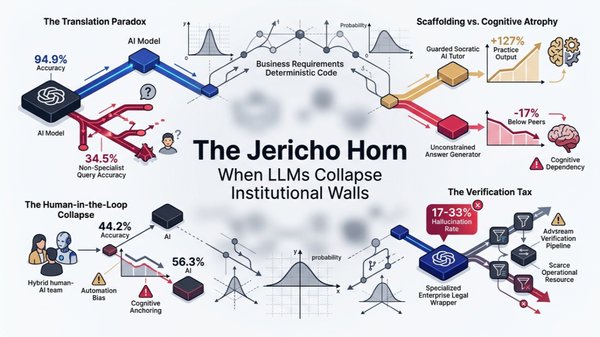
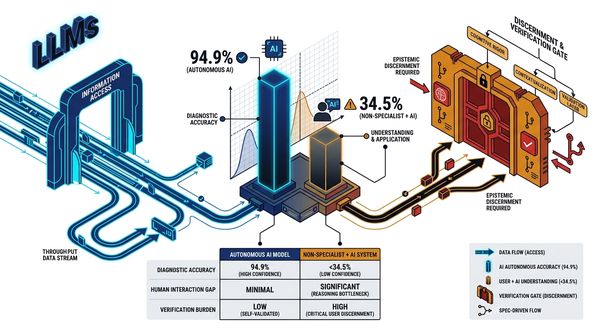
As demonstrated in a landmark Oxford Internet Institute Study in Nature Medicine , standalone models correctly identified clinical conditions in 94.9% of benchmark scenarios. Yet, non-specialist users querying those identical engines identified relevant diagnoses in fewer than 34.5% of cases.
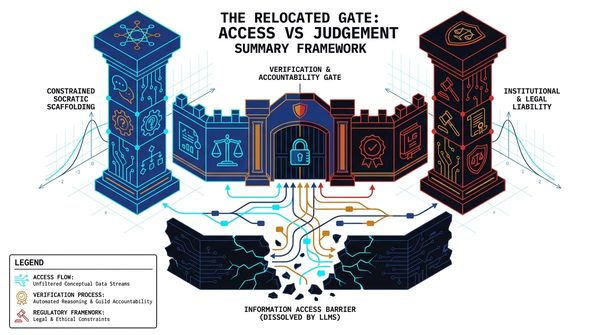
Unrestricted information access does not confer functional understanding; it relocates the gate from access to discernment.
The Barrier Was Explanation, Not Information
Historically, professional guilds maintained authority because outsiders lacked the contextual scaffolding required to parse arcane internal dialect. This division also fragments institutions internally, isolating specialised disciplines into non-communicating silos.
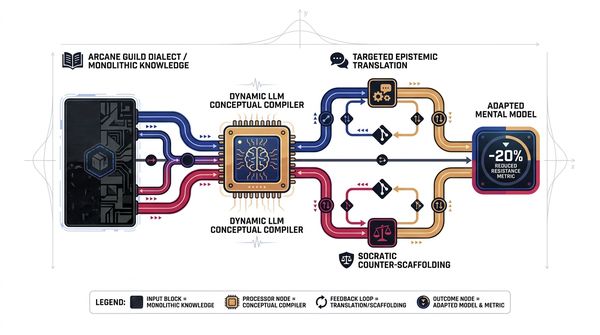
Iterative language models function as dynamic compilers across domain boundaries, demonstrating high efficacy in bespoke conceptual translation.
A review of empirical trials reveals four distinct findings regarding personalised model translation:
- Targeted Persuasion Efficacy : In Costello, Pennycook, and Rand's Science Study , 2,190 conspiracy believers engaged in personalised, evidence-grounded dialogues with GPT-4 Turbo .
- Durable Conviction Reduction : The intervention reduced conspiratorial conviction by approximately 20%, persisting across a two-month follow-up.
- Neutralising Baseline Resistance : As highlighted in the Nieman Lab Analysis , conviction shifted even among participants harbouring deep baseline scepticism toward artificial intelligence.
- Bespoke vs. Broadcast Alignment : Broadcast counterevidence historically failed against idiosyncratic, individual premises rather than immutable mental models.
This trial measured targeted persuasion, not holistic domain comprehension. Systems engineers must differentiate epistemic translation from technical mastery across two technical boundaries:
- Translation vs. Moat Erosion : While an LLM translates concepts to dismantle ideological silos, shifting a user's stance does not demonstrate the collapse of an institutional moat.
- Comprehension vs. Guild Mastery : Translating a concept remains distinct from acquiring guild expertise, establishing only that the barrier to bespoke explanation has fallen.
Where the Evidence Is Strong
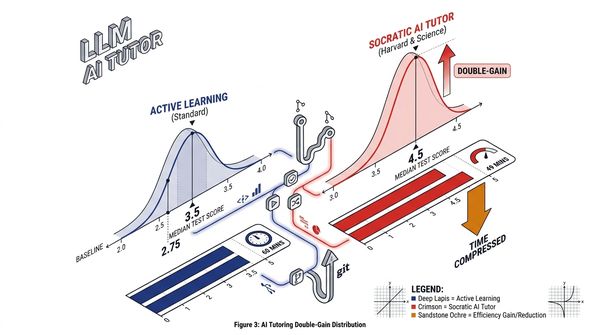
When generative interfaces enforce structured pedagogical principles rather than unconstrained answer generation, learning gains outstrip conventional instruction. In a randomised crossover trial of 194 undergraduates documented in the Scientific Reports Randomised Trial , researchers benchmarked an intentional Socratic AI tutor against an active-learning classroom in foundational physics.
As reviewed in the iatroX Clinical & Educational Synthesis , the purpose-built tutor yielded learning gains more than double those of the active-learning cohort (median post-test score 4.5 versus 3.5, from a 2.75 baseline) while cutting task duration from 60 to 49 minutes.
Three critical caveats temper broad generalisations from these findings:
- Cohort Specificity : The trial evaluated two physics modules exclusively within a single, highly selected elite cohort.
- Metacognitive Scaling Limits : The observed 'double the learning gains' metric may not scale linearly to student populations with lower baseline metacognitive skills.
- Extrapolation Deficits : Popular claims equating these outcomes to 37%–65% of Bloom's two-sigma tutoring effect remain unverified post-hoc extrapolations grounded in GPT-4-era baselines.
Guided pedagogical friction accelerates cognitive mastery when interface boundaries remain intact.
Where the Claim Fails
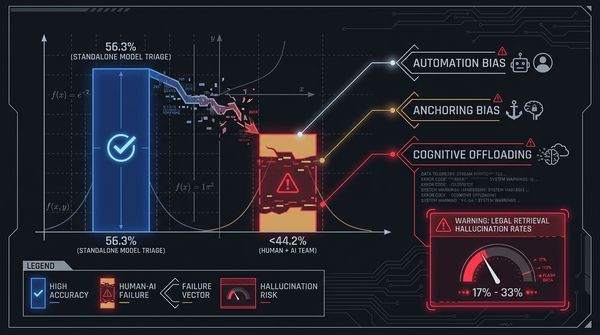
The hypothesis that general-purpose conversational models grant non-specialists reliable autonomy collapses in high-stakes environments. In an Oxford Internet Institute evaluation spanning 1,298 participants, detailed in the Oxford Internet Institute arXiv Pre-Print and the Oxford Open-Access Mirror , human users paired with frontier systems ( GPT-4o , Llama 3 , Command R+ ) achieved correct triage decisions in fewer than 44.2% of cases—underperforming standalone model triage (56.3%) and failing to beat unassisted search controls.
This parity gap mirrors clinical findings catalogued in the PubMed Central Medical Archive , where AI-assisted clinicians underperformed unassisted diagnostic baselines.
In human-computer interaction (HCI) literature, two distinct cognitive mechanisms drive this performance degradation:
- Automation Bias : Operators display uncritical trust in confident machine outputs or synthetic confabulations.
- Anchoring Bias : Practitioners fail to override an initial model recommendation, resulting in systemic cognitive offloading that degrades human judgement .
Enterprise legal tools exhibit identical architectural vulnerabilities.
A benchmark by the Stanford RegLab & CodeX Legal Evaluation revealed that specialised retrieval products ( Lexis+ AI and Ask Practical Law AI ) generated hallucinations between 17% and 33% of the time, proving that domain wrappers reduce but do not eliminate synthetic confabulation.
Design and Effort Decide the Outcome
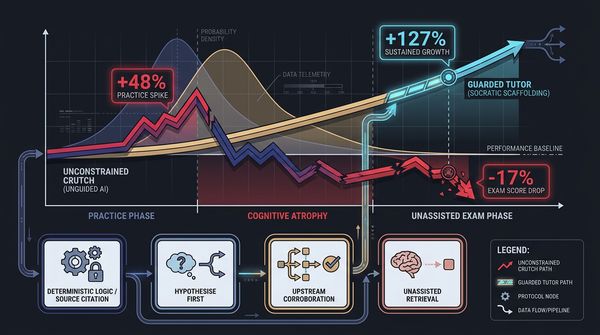
Interface constraints and user discipline govern the divergence between cognitive augmentation and operational failure. A field trial of nearly 1,000 mathematics students published in the PNAS Field Experiment demonstrated this divide: unguided base models inflated practice performance by 48%. At the same time, a Socratic tutor lifted practice output by 127%.
As documented in the PsyPost Cognitive Research Report , revoking software access during exam conditions caused unguided users to score 17% below unassisted peers. Unguarded access encouraged answer extraction and induced cognitive atrophy, whereas guarded tutoring insulated students against skill degradation.
Robust operational adoption requires four structured interaction protocols:
- Combat Automation Bias : Explicitly instruct the model to display deterministic, step-by-step logic and cite exact line numbers from source documents, lowering the 'verification tax' and preventing operators from anchoring to initial outputs.
- Hypothesise First : Formulate an explicit solution hypothesis prior to prompt submission, utilising the model strictly as an adversarial counterweight.
- Corroborate Upstream : Treat generative outputs as unverified hypotheses, validating statutory and empirical citations directly against primary indices.
- Unassisted Retrieval : Execute periodic, unassisted operational reviews to verify that baseline core competencies remain intact.
Conclusion & Strategic Advice
The scarce commodity in knowledge ecosystems has pivoted from raw explanation to independent verification. Deploying generative tools as unconstrained query engines degrades decision accuracy and induces intellectual dependency.
Configuring high-leverage deployments requires balancing two operational realities:
- Constrained Scaffolding : Structuring models as constrained Socratic scaffolds yields outsized conceptual gains while mitigating cognitive offloading.
- Institutional Accountability : While next-generation reasoning architectures process automated verification workloads, institutional guilds retain legal liability and credentialed audit authority.
The barrier to functional comprehension is no longer access to translation; it is the rigour of personal verification.
How is your organisation auditing against automation bias before deploying LLMs into mission-critical workflows? Drop your perspective below💬 and share this framework with your professional network! ♻️
Further Reading
- Stanford RegLab: Hallucination-Free? Assessing the Reliability of Leading AI Legal Research Tools
- Nature Medicine: Large Language Models in Clinical Triage and Decision Support
- arXiv: Human-AI Collaboration Bottlenecks in Complex Diagnostic Reasoning
More From Me
Original Article: Read on LinkedIn | Read on Substack