Breaking Monolith Tax: Will AI Clean-Room Clones beat Adobe's
Breaking Monolith Tax: Will AI Clean-Room Clones beat Adobe's
Introduction
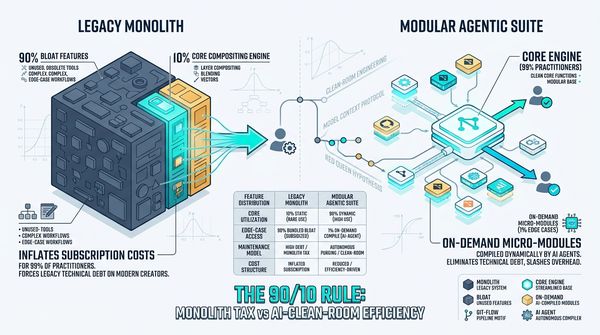
Sceptics of clean-room software development routinely invoke the classic 90/10 engineering rule: shipping the initial 90% of an application requires 10% of the effort, whereas mastering the final 10% of edge cases consumes the remaining 90%. For decades, this dynamic served as an unassailable defensive moat for entrenched creative software monoliths.
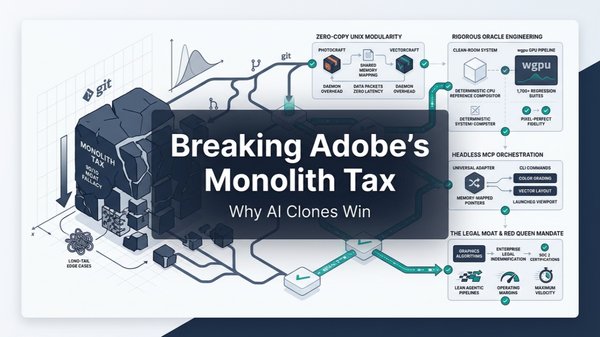
However, this defence conflates marginal code volume with realised utility, as demonstrated by the open-source Storytold ArtCraft suite :
- Architectural Bypass : Modular, pure- Rust implementations circumvent the legacy edge-case trap by isolating core graphics routines from historic enterprise bloat.
- The Monolith Tax : Clean-room systems expose how traditional subscriptions force practitioners to subsidise compatibility layers they never execute.
- Agentic Orchestration : Decoupled software suites establish a practical blueprint for transitioning from calcified monoliths to composable, agent-directed pipelines.
The Fallacy of the 90/10 Moat and Combinatorial Dependency
From a systems-design perspective, the defensive argument for monolithic architectures relied on combinatorial feature dependencies across user segments:
- Core Functional Baseline : Approximately 99% of digital practitioners strictly require deterministic layer compositing, non-destructive blending, and vector manipulation.
- Isolated Edge Dependencies : Specific professional workflows demand divergent long-tail utilities, such as a web designer requiring an esoteric CSS exporter or a print illustrator needing a legacy spot-colour proofing module.
- Static Bundling : Incumbent monoliths maintained their monopoly by binding these disparate edge cases into an indivisible binary package.
Under Clayton Christensen's Low-End Disruption Theory , agentic workflows invert this distribution model:
- On-Demand Compilation : Autonomous agents dynamically assemble and compile isolated edge cases on demand, rather than packaging the entire 100% surface area upfront.
- Architectural Disruption : Decoupling long-tail capabilities into composable micro-modules neutralises the 90/10 moat through runtime composability rather than static binary aggregation.
The "Monolith Tax" and 35 Years of Legacy Debt
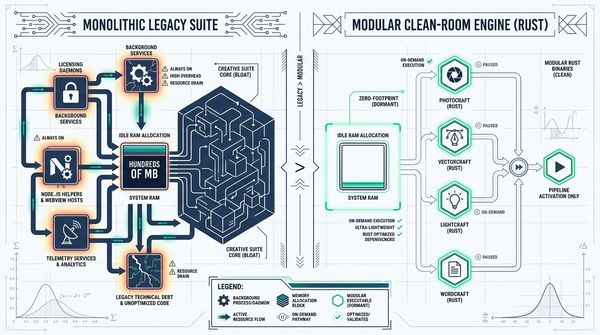
A standard creative subscription costs $60 to $80 monthly because multi-gigabyte monoliths carry 35 years of backwards-compatibility obligations, not because raster mathematics are inherently expensive.
Benchmarking baseline memory footprints highlights the architectural overhead inherent in this design:
- Monolithic Idle Overhead : An idle Adobe Creative Cloud host environment—burdened with legacy Node.js helpers, telemetry daemons, and licensing sync agents—consumes hundreds of megabytes of RAM before instantiating a single canvas.
- Zero-Footprint Binaries : Dormant ArtCraft executables leave an imperceptible memory footprint until an operational pipeline executes.
As detailed in Beyond Technical Debt: Overcoming The Burden of Legacy Systems , legacy engines suffer from acute refactoring paralysis:
- Regression Hazards : Modernising core rendering pipelines introduces severe risks of breaking obscure, decades-old enterprise plugins.
- Compounded Monolith Tax : Subscribers continuously fund obsolete legacy interfaces through recurring fees while absorbing degraded runtime performance and restrictive licensing models.
The Unix Philosophy Applied to Desktop Creative Tools
The structural antidote to monolithic sprawl is Unix modularity: isolated binaries constrained to discrete functional boundaries. ArtCraft implements this architecture across four distinct Rust workspaces:
- PhotoCraft : Pure raster pipelines and PSD canvas manipulation.
- VectorCraft : Deterministic Bézier geometry and SVG parsing.
- LightCraft : High-dynamic-range RAW digital negative processing.
- WordCraft : Structured typography engine and OOXML document compilation.
Deconstructing a multi-gigabyte raster runtime introduces an Inter-Process Communication (IPC) bottleneck when piping uncompressed pixel buffers through standard network sockets. The ArtCraft architecture resolves this through two concrete mechanics:
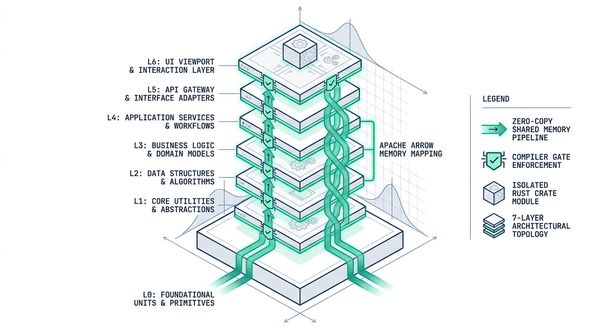
- Zero-Copy Shared Memory : Leveraging Apache Arrow -based memory mapping allows discrete desktop binaries to exchange multi-gigabyte framebuffers with zero serialisation latency.
- Enforced Layer Topologies : WordCraft enforces a strict seven-layer architecture (L0 foundational units through L6 UI), while PhotoCraft isolates operations across 24 crates. Compilation gates (cargo xtask layers) immediately terminate builds if circular references or upward crate dependencies emerge.
Disciplined Agentic Engineering: Oracles Over Vibes
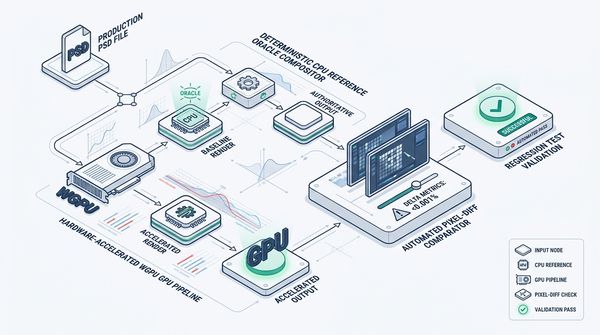
Unstructured synthetic code generation introduces structural instability into complex systems. Engineering production-grade toolchains demands the rigorous harness designs detailed in Beyond 'Vibe Coding': Kiro Brings Discipline to AI Development .
PhotoCraft enforces pixel-perfect rendering fidelity via the architectural patterns established in Digital Oracles: How LLMs Are Changing the Game for Real-World Stress Testing :
- Dual-Compositor Oracles : A deterministic CPU reference compositor acts as an authoritative baseline, executing automated pixel-diff checks against hardware-accelerated GPU pipelines powered by wgpu.
- Clean-Room Contracts : Formal specifications defined within AGENTS.md govern agentic code generation boundaries.
- Spec-Driven Validation : Machine-readable backlog definitions in docs/gaps.md, structured according to GitHub Spec-Kit: Executing Spec-Driven Development , drive iterative implementation.
- Corpus Regression Testing : Over 1,700 automated regression suites validate rendering accuracy against historical, production-grade PSD files.
The Universal Glue: Unbundling via Model Context Protocol (MCP)
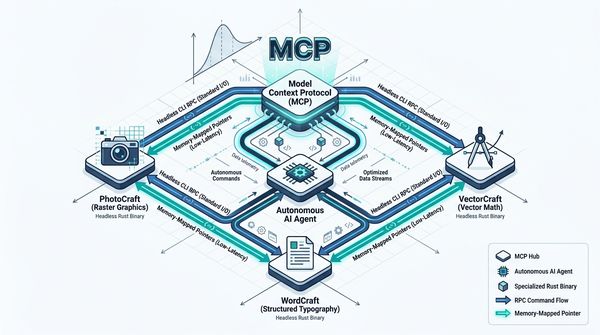
Historically, unbundled desktop toolchains suffered from acute interoperability friction across application boundaries. The Model Context Protocol (MCP) , acting as the Universal Adapter for Agentic AI and detailed in Understanding CodeAct and MCP: A Guide for Professionals , resolves this coordination problem.
The Craft architecture operationalises headless orchestration across three functional primitives:
- Headless CLI Interfaces : Each workspace binary exposes an RPC command registry over standard I/O via <app>-cli mcp.
- Automated Asset Pipelines : Autonomous agents coordinate composite actions headlessly, executing colour grading in PhotoCraft, vector placement in VectorCraft, and document compilation in WordCraft without launching graphical UI viewports.
- Deterministic DOM Introspection : Direct DOM queries routed over local loopback interfaces eliminate the token cost and precision loss associated with multimodal vision models.
Architects must recognise empirical payload boundaries when designing MCP agent integration:
- Payload Specialisation : MCP efficiently handles structured metadata, schema negotiation, and orchestration signals, but raw 16-bit uncompressed raster frames overwhelm JSON-RPC transport layers.
- Memory-Mapped Pointers : High-throughput pipelines must pass file descriptors and memory-mapped pointers via MCP rather than inlining binary image payloads, preventing serialisation bottlenecks across process boundaries.
The Enterprise Support Moat and Adobe's Red Queen Mandate
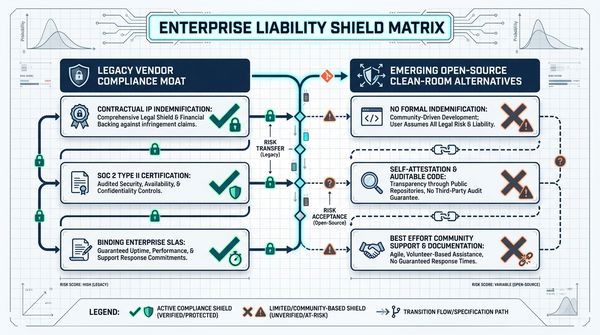
Enterprise holding groups will not displace legacy software vendors based purely on technical parity. Clean-room implementations such as ArtCraft remain in early development phases, and enterprise procurement models evaluate vendors against rigid governance requirements:
- Contractual Risk Mitigation : Enterprise risk policies mandate enforceable contractual indemnification against intellectual property infringement.
- Regulatory Compliance : Procurement requires verified SOC 2 type II certifications and binding Service Level Agreements (SLAs).
- Licensing Limitations : Standard open-source "AS IS" disclaimers fail institutional risk management assessments.
Incumbent competitive advantages are legal and regulatory rather than algorithmic. This dynamic establishes two structural industry pressures:
- Margin Compression : While Adobe preserves enterprise market share in the near term, operating margins face severe compression from leaner agentic workflows.
- The Red Queen Mandate : To defend existing market capitalisations, incumbents must follow the Red Queen hypothesis by running internal agent swarms to eliminate legacy technical debt, compress engineering overhead, and reduce customer subscription costs while raising fidelity.
Who Maintains It When the Creator Does Not Want To?
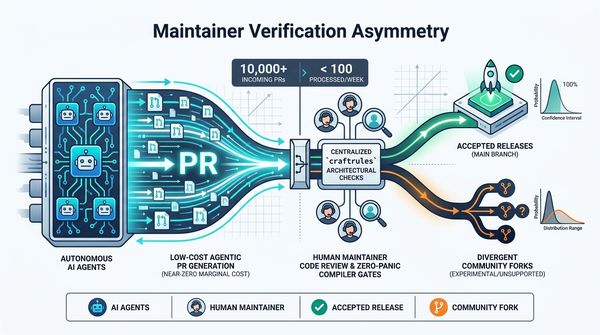
Rapid clean-room development introduces significant governance friction as project scale accelerates. The maintenance pipeline encounters three structural bottlenecks:
- Verification Asymmetry : While docs/contributing.md mandates strict zero-panic guarantees and layer isolation, agentic workflows generate pull requests at near-zero marginal cost while human code review remains resource-intensive.
- Governance Centralisation : Centralised private rule stores (craftrules) restrict outside architectural influence, forcing community forks as the primary evolutionary escape hatch.
- Commercial Support Gaps : Long-term sustainability requires enterprise service providers—following the historical Red Hat operational model—to wrap raw open-source code in commercial indemnification and governance guarantees, as evaluated in OpenClaw Advantage: Governing Agents with CODEOWNERS .
Conclusion & Strategic Advice
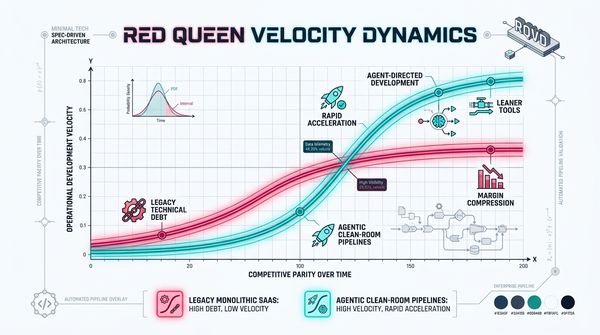
The creative software ecosystem operates under the Red Queen hypothesis: vendors and engineering organisations must execute at maximum velocity merely to preserve baseline parity.
When architecting production pipelines, Technical Architects must balance regulatory risk against system agility across two distinct deployment models:
- Enterprise Core Workflows : Retain commercial monoliths within departments where enterprise legal indemnity, contractual compliance guarantees, and enterprise vendor tiers are non-negotiable.
- Sovereign Creative Pipelines : Deploy decoupled, clean-room Rust tools orchestrated via MCP to eliminate licensing overhead and maximise pipeline throughput.
As detailed in The Indie Creator's 2026 Survival Guide: My Comic Creator Blueprint , autonomous pipelines shield digital studios from captive subscription pricing models. Architecture teams must audit existing operational dependencies on legacy proprietary formats, benchmark deterministic clean-room engines, and eliminate the Monolith Tax before mounting technical debt dictates engineering margins.
Will enterprise legal indemnity protect monolithic creative suites once agentic, clean-room pipelines reach feature parity across studio workflows? Share your perspective below💬 and repost this with your engineering network! ♻️
Further Reading
- Model Context Protocol Specification
- wgpu: Safe, Portable Graphics Library for Rust
- Clayton Christensen Institute: Disruptive Innovation Theory
More From Me
Original Article: Read on LinkedIn | Read on Substack