OpenClaw Advantage: Governing Agents with CODEOWNERS
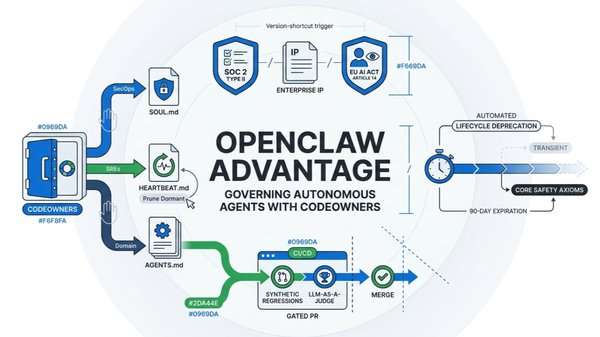
- Part 7 of 8 - Mitigating Prompt Rot and Elevating the Creator as a Strategic Asset
Introduction
Autonomous execution introduces a critical operational blind spot into enterprise systems. As deployed across multi-instance daemon fleets in Part 6: Six AI Agents, One Box: Deploying Sovereign Domain Fleets , background processes parse periodic directives on a scheduled execution loop. Here, natural language markdown stops being passive documentation and becomes an active runtime policy engine.
Engineering teams face significant governance challenges as autonomous footprint scales across the organisation:
- Sovereign Multi-Domain Topologies : Autonomous agents extend the domain architectures detailed in OpenClaw Advantage: Domain-Specific AI Workspaces: Regulated Sovereign Agents directly into background operational environments.
- Proactive Runtime Directives : As demonstrated in OpenClaw Advantage: The Heartbeat Pattern and Proactive AI Beyond Chat , scheduled daemon loops process Markdown files as operational instructions at execution time.
- Configuration Abandonment Risk : Unmonitored agent directories produce configuration decay, where Markdown checklists parsed by daemons become unowned legacy artefacts once the author departs.
- Git-Native Anchoring : Extending the principles established in OpenClaw Advantage: Why Your Agent's Brain Should Be a Markdown File , this architecture binds agent directives (SOUL.md, HEARTBEAT.md, AGENTS.md) directly to Git branch protections and repository code ownership.
- Auditable Intellectual Property : Deterministic pull request reviews prevent configuration decay while establishing prompt engineering as recognised, auditable enterprise intellectual property.
- Semantic Continuous Integration : Conventional CI/CD validations fail on probabilistic assets; engineering pipelines require continuous integration adapted for empirical semantic benchmarking to enforce behavioural alignment.
The Trap of Unowned Markdown Checklists
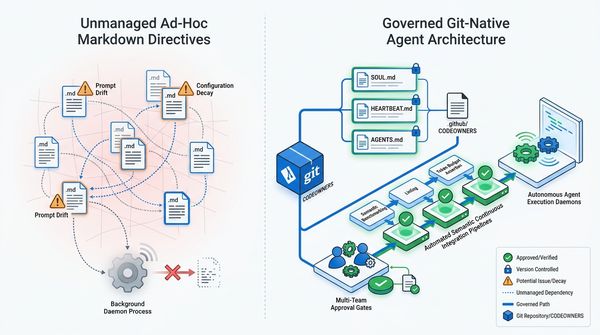
Treating autonomous directives as informal text reproduces the pre-DevOps anti-pattern of manual production server modifications. As analysed in Beyond Technical Debt: Overcoming The Burden of Legacy Systems , unmanaged configurations compound structural fragility until operational agility collapses.
Without programmatic ownership, production agent environments deteriorate across two distinct operational vectors:
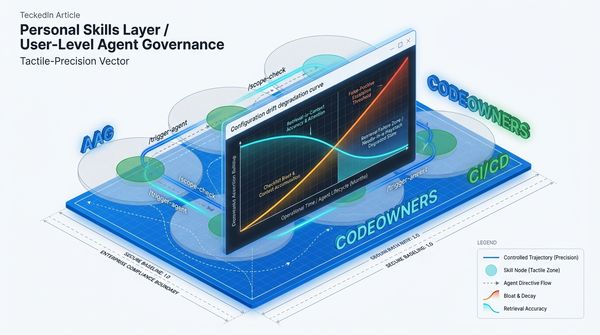
- Obsolete Assertion Buildup and Retrieval Degradation : Modern LLMs support context windows scaling into the millions, shifting the primary vulnerability from arbitrary token ceilings to Retrieval-in-Context Failure . Dormant validation tasks remaining inside recurring heartbeat loops create severe prompt bloat, burying critical instructions and inducing "needle-in-a-haystack" failure modes where model attention degrades and triggers false-positive escalations.
- Cognitive Drift and Operational Fear : Successor maintainers cannot discern whether an ambiguous instruction represents a critical compliance invariant or obsolete historical baggage. As a result, teams avoid pruning directives, which can lead to behavioural drift and operational paralysis.
Implementing CODEOWNERS for Agent Cognition
Anchoring cognitive directives to repository root configurations using the GitHub Documentation: About Code Owners specification establishes deterministic ownership boundaries. Review responsibilities map directly to functional team handles rather than transient individuals:
# .github/CODEOWNERS
/SOUL.md                          @platform-security @ciso-office
/HEARTBEAT.md                     @sre-team @lead-architect
/AGENTS.md                        @domain-leads
/workspaces/finance/AGENTS.md     @quant-risk @compliance-officer
/workspaces/soc/PLAYBOOK.md       @soc-tier3 @secops-lead
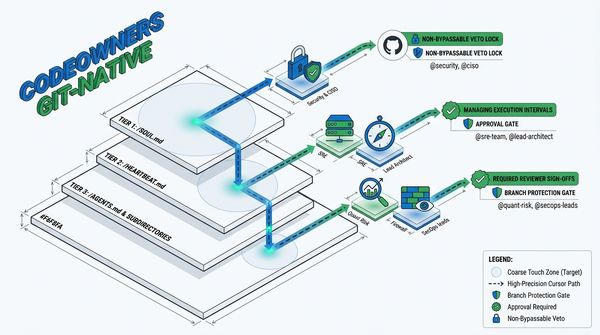
Repository ownership layers enforce strict operational separation across three functional tiers:
- Safety Axioms and Identity ( /SOUL.md): Governed by security authorities who retain absolute veto over behavioural constraints.
- Cadence and Execution Loops ( /HEARTBEAT.md): Governed by site reliability teams managing execution intervals, silence rules, and routing.
- Domain Playbooks ( /AGENTS.md): Maintained by business functional leads with workspace-specific path overrides.
Elevating the Prompt Author to Strategic Business Asset
Treating directives as production code elevates natural language composition from ad-hoc scripting into strategic infrastructure.
This governance model provides three primary business advantages:
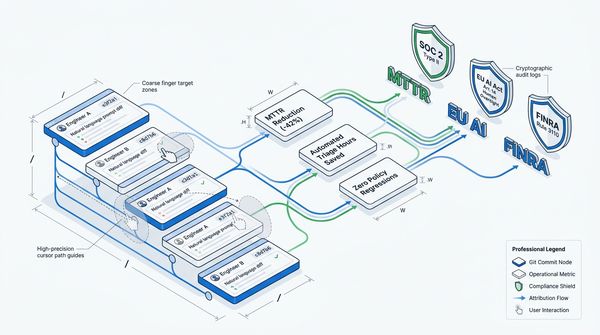
- Institutional Memory Codification : Tacit domain workflows transform into auditable, version-controlled repository assets.
- Quantifiable Business Attribution : Automating operational triage or mitigating incidents ties directly to author identities, showing measurable returns on prompt design.
- Statutory Compliance : Immutable Git logs satisfy auditability standards under SOC 2 Type II trust criteria. Furthermore, they fulfil human oversight mandates defined in EU Artificial Intelligence Act: Article 14 - Human Oversight for high-risk deployments and satisfy supervisory review requirements under FINRA Rule 3110: Supervision .
The 4-Step Governed Directive Pipeline
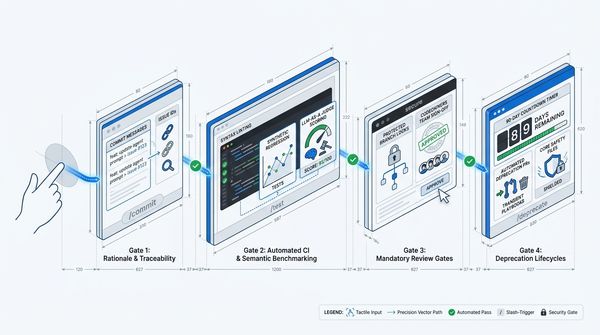
Because a single-word modification in a natural language prompt can invert agent behaviour, production directive updates traverse four mandatory validation gates:
- Gate 1: Rationale and Traceability : Branches require explicit operational justifications and linked issue-tracking identifiers within commit messages.
- Gate 2: Automated CI Validation : Pull requests trigger standard syntax checks alongside deterministic empirical evaluations using test harnesses such as Promptfoo , Braintrust , or LangSmith . These pipelines execute synthetic regression tests and " LLM-as-a-Judge " validations to confirm that linguistic changes do not induce behavioural drift, trigger jailbreak regressions, or violate core safety axioms.
- Gate 3: Mandatory Review Gates : Protected branch policies enforce non-bypassable approvals from designated code owners.
- Gate 4: Deprecation Lifecycles : Deprecation logic is explicitly segregated by file type to prevent time-bombs on critical safety files. Core identity and safety directives (SOUL.md) remain exempt from time-to-live (TTL) expirations. Conversely, transient operational playbooks in AGENTS.md mandate ISO expiration dates or active tickets; dormant items in these transient directories trigger automated deprecation pull requests after 90 days to enforce periodic relevance reviews.
To balance governance and experimentation, staging workspaces and developer branches should run separately from production connectors and sensitive data. This boundary delivers sandbox agility without exposing live infrastructure to operational risk.
Conclusion & Strategic Advice
Unifying Git -native source control with autonomous agents replaces brittle, person-dependent configurations with sovereign, auditable architecture.
Teams should deploy this operational framework across four distinct implementation tiers:
- Low-Risk Internal Automations : Standard branch protections with single domain lead approval and 90-day checklist lifecycles for playbooks.
- Regulated Domain Workspaces : Multi-party CODEOWNERS sign-offs and automated AST schema assertions.
- Synthetic Behavioural Evaluation : CI pipelines enforcing a mandatory minimum pass rate on LLM-as-a-Judge semantic regression tests before code owners may approve pull requests.
- Exploratory Prototypes : Staging branches running sandbox daemons isolated from production alerting and core data stores.
For foundational state persistence patterns, consult OpenClaw Advantage: The Git-Native AI Agent: Version-Controlling Cognition and clone the OpenClaw Starter Workspace Repository .
For comprehensive enterprise implementation, advance to the final series synthesis: Part 8: Autonomous Agent Architecture Playbook . Begin by auditing unowned daemon markdown files and committing your baseline .github/CODEOWNERS mapping today.
How is your engineering team handling cognitive drift and state persistence across production agent fleets? Drop your thoughts below💬 and share this blueprint with your dev network! ♻️
Further Reading
- GitHub Docs: About code owners
- Promptfoo Documentation: Testing Prompts with GitHub Actions
- EU AI Act Explorer: Article 14 - Human Oversight
More From Me
Original Article: Read on LinkedIn | Read on Substack