Brand Purity: AI Guardrails for Multi-Brand Identity
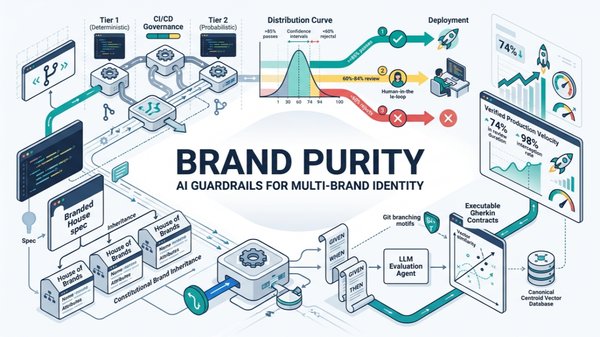
Part 1 of 3 - Machine-Readable Constitutions, Constitutional Inheritance, and AI Guardrails
Introduction
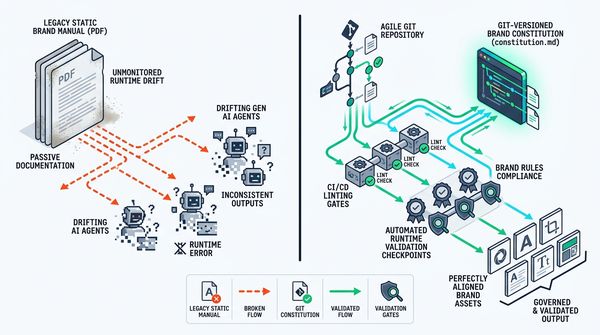
Static brand guidelines trapped in multi-page PDF documents cannot protect enterprise portfolios from the drift inherent in generative AI workflows. Passive documentation fails runtime enforcement once autonomous agents and automated pipelines generate content at scale.
Applying core software engineering disciplines resolves this governance deficit, as established in Bridging the Gap: Programmering Tools for All :
- Version Control : Tracking brand guidelines as declarative code commits to ensure tamper-evident history.
- Declarative Schemas : Codifying stylistic guidelines into deterministic, machine-readable specifications.
- Automated Linters : Enforcing brand rules during compilation rather than during retrospective editorial review.
This architectural guide demonstrates how to replace subjective editorial reviews with machine-readable specifications, version-controlled constitutions, and continuous automated guardrails. Translating abstract stylistic guidelines into deterministic code contracts preserves brand fidelity across sub-brands while decoupling production velocity from manual editorial bottlenecks.
The Payoff: Why Spec-Driven Governance Matters Now
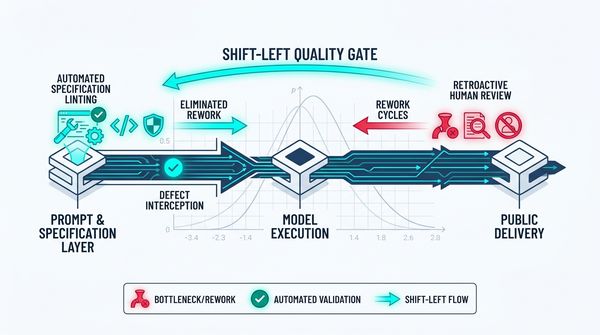
Transitioning from retroactive review to automated specification testing mirrors the architectural shift to continuous integration and continuous deployment ( CI/CD ). Shifting quality control upstream intercepts non-compliant syntax before public delivery, cutting downstream rework cycles.
Git-backed specification commits establish immutable, tamper-evident audit trails that satisfy enterprise risk compliance across three functional vectors:
- Upstream Defect Interception : Linting engines validate generative output against lexical schemas before asset distribution.
- Auditable Provenance : Versioned commits track policy updates across distributed pipelines, ensuring verifiable governance.
- Omnichannel Consistency : Regional execution teams deploy across omnichannel touchpoints without diluting parent corporate equity.
The Brand Constitution as a Single Source of Truth
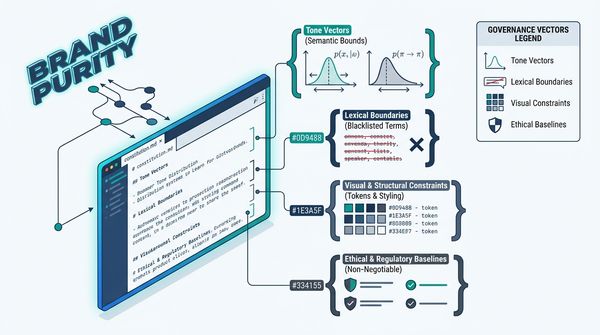
Subjective brand assurance transitions into an automated validation loop when codified into a repository-hosted constitution.md, as detailed in GitHub Spec-Kit: Executing Spec-Driven Development .
This declarative file functions as the canonical source of truth for downstream generative agents across four operational dimensions:
- Tone Vectors : Mathematical and semantic boundaries governing stylistic registers.
- Lexical Boundaries : Blacklists of forbidden buzzwords and restricted industry terminology.
- Visual & Structural Constraints : Spacing rules, palette anchors, and layout tokens.
- Ethical & Regulatory Baselines : Non-negotiable safety guardrails (see constitution.example.md ).
Constitutional Inheritance Across Enterprise Architectures
Complex enterprise portfolios cannot rely on a single, uniform ruleset. As explored in Brand Architecture: 3 Ways It Impacts Your Website (and How Optimizely Can Help) , brand structures dictate governance topologies.
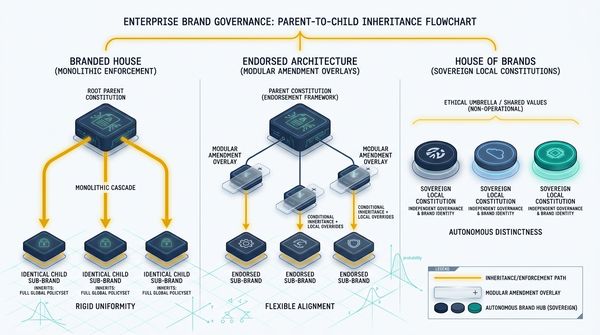
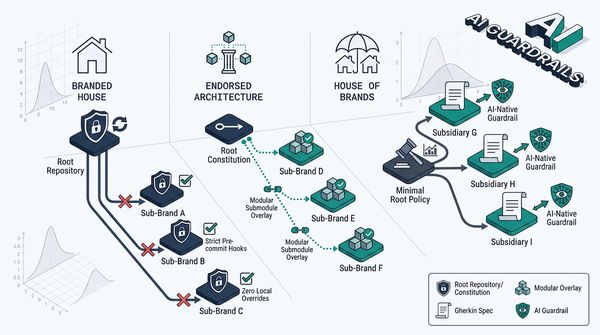
Constitutional inheritance maps these paradigms directly into three object-oriented file hierarchies:
- Branded House : A monolithic root constitution.md enforces identical stylistic and lexical rules across all products without local deviation.
- Endorsed Architecture : A global parent constitution establishes shared brand governance, augmented by child amendment files that define sub-brand styling.
- House of Brands : A minimalist corporate parent defines high-level legal and ethical guardrails, while subsidiaries operate fully autonomous local constitutions, as exemplified across the Procter & Gamble Brands Estate .
When Constitutions Are Missing: The Cost of Brand Drift
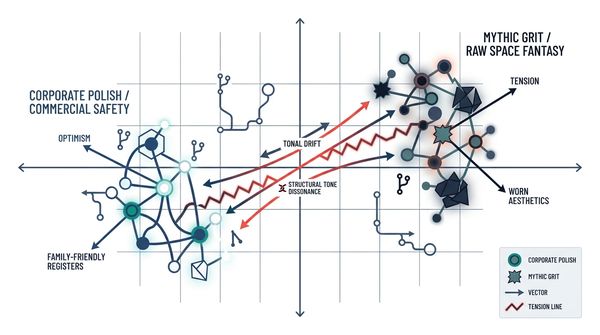
Un-governed brand integration introduces quantifiable financial risk, as evidenced by The Walt Disney Company Acquisition Announcement of Lucasfilm for $4.05 billion. The subsequent clash between Disney's polished corporate register and the gritty, mythic tone of Star Wars produced persistent franchise friction.
Generative AI amplifies structural tone dissonance across automated production pipelines through three primary failure modes:
- Compounding Micro-Violations : Distributed generative agents produce thousands of micro-assets daily, accelerating stylistic drift across consumer touchpoints.
- Prohibitive Stewardship Costs : Re-anchoring canonical tone retroactively requires substantial capital allocation and manual executive intervention.
- Scalability Bottlenecks : Human-dependent oversight fails to scale against autonomous agent generation velocity.
Architectural autonomy offers an alternative operational pattern. The Salesforce Closes Slack Acquisition Release demonstrates structural isolation, preserving Slack's developer-focused voice through distinct, air-gapped brand boundaries.
Upstream Enforcement: How Modern Systems Enforce Brand Purity
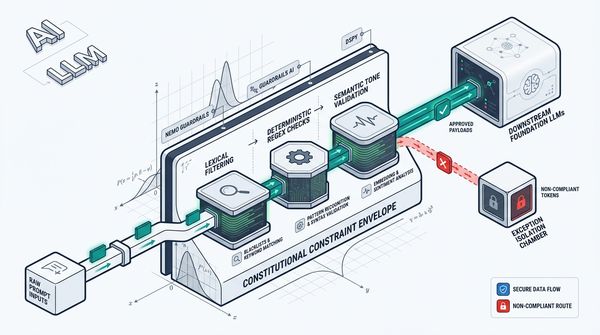
Modern enterprise platforms operationalise constitutional rules directly at the foundation model layer. Contemporary architectures enforce constraints prior to generation across four primary tooling patterns:
- Programmatic Guardrail Frameworks : Open-source implementations such as NVIDIA NeMo Guardrails , Guardrails AI , and DSPy execute structural and semantic validation, functioning as deterministic enforcement engines between the model and human-readable intent.
- Writer.com : Ingests custom brand files to evaluate generated syntax against approved tone vectors and vocabulary constraints in real time.
- Typeface.io : Wraps model API calls within an active constraint envelope, enforcing discrete sub-brand tone boundaries.
- Jasper.ai : Applies statistical guardrails trained on historical, high-performing corporate assets.
Caveat : Lexical rules and blacklists evaluate deterministically, whereas the semantic validation of abstract tone vectors remains probabilistic, requiring calibrated confidence thresholds.
Spec-Driven Governance in a 30-Brand Estate
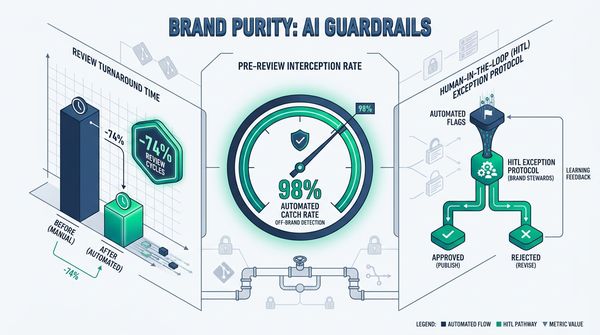
In a production deployment managing over 30 consumer brands under a House of Brands topology, an enterprise implemented a shared ethical root constitution paired with subsidiary-specific Gherkin specifications (internal, anonymised client data) .
The production deployment delivered three verified operational outcomes:
- 74% Reduction in Review Cycles : Editorial workflows shifted from line-by-line inspection to focused reviews of automated exception flags.
- 98% Pre-Review Interception Rate : Automated linting agents intercepted off-brand terminology and tone deviations prior to human review. A Human-in-the-Loop (HITL) exception protocol permitted brand stewards to evaluate and override false positives manually.
- Sovereign Local Execution : Distributed teams deployed localised collateral autonomously without compromising root parent governance.
Executable Specifications: Gherkin as a Brand Contract
Translating creative intent into computational enforcement requires Behaviour-Driven Development (BDD) expressed through Gherkin syntax (Given/When/Then).
Within this architecture, the evaluation stack decouples specification from runtime validation across two distinct layers:
- Business Logic Interface : Gherkin formats human brand expectations into machine-parseable compliance contracts.
- Execution Engine : Probabilistic frameworks like Guardrails AI or constrained decoding engines execute real-time payload validation.
Feature: Sub-Brand Tone and Lexical Integrity

  Scenario: Auditing marketing copy against constitutional voice
    Given the content target is a subsidiary product launch
    When the generation pipeline produces draft customer copy
    Then the tone score for "Pragmatic Authority" should exceed 0.85 with a confidence threshold of 90%, else route to manual review
    And the copy MUST NOT contain terms from the "corporate_buzzwords" blacklist
    And any deviation from core product lore must trigger a build failure
Directly integrating probabilistic evaluations into deployment gates exposes pipelines to the 'Flaky Test Paradox'. Because semantic tone assessment relies on non-deterministic models, deployment gates risk reporting contradictory 'Pass' and 'Fail' verdicts on identical payloads.
Engineering teams stabilise stochastic CI/CD gates against evaluator variance using three core remediation strategies:
- Zero-Temperature Inference : Pinning evaluator temperature to 0 to eliminate sampling variance during assertion checks.
- Calibrated Confidence Thresholds : Implementing scoring bounds with explicit confidence intervals to determine pass/fail or HITL escalation (as modelled in the Gherkin scenario).
- Specialised Small Language Models (SLMs) : Deploying sovereign, task-tuned SLMs optimised exclusively for deterministic classification and scoring.
Empirical benchmarks published in the Brand Constitution Code Samples Repository validate this architecture across two distinct validation metrics:
- Unstructured Prompting : Yielded a 72.4% non-compliance rate under production testing.
- Spec-Driven Validation : Maintained a 98.2% automated compliance rate through deterministic gate enforcement.
Conclusion & Strategic Advice
Treating brand identity as an uncodified, subjective manual guarantees drift in an AI-accelerated enterprise. Brand purity requires treating corporate voice as a version-controlled software contract.
Architectural Recommendation Matrix
Enterprise governance topologies require distinct deployment patterns across three organisational models:
- Branded House : Deploy a single root repository with strict pre-commit hooks and zero local overrides.
- Endorsed Architecture : Implement a root constitution with modular submodule overlays for each sub-brand.
- House of Brands : Enforce a minimal root policy for legal and ethical baselines, giving subsidiaries sovereign Gherkin specifications evaluated by AI-native guardrails.
Move brand rules out of static PDFs and into version control. Define a foundational constitution.md, express non-negotiable boundaries in Gherkin scenarios, and wire them into release gates with stabilised, probabilistic tolerances.
Continue the architectural implementation in Part 2: Brand Purity: The Automated Brand Pipeline to build upstream generation guardrails and CI/CD linting gates, and explore multimodal visual enforcement in Part 3: Multimodal Asset Governance with LoRA, Voice Adapters, and ComfyUI .
How is your engineering team shifting brand compliance upstream into automated AI pipelines? Drop your thoughts below💬 and share this framework with your network! ♻️
Further Reading
Architectural references and foundational research:
- Constitutional AI: Harmlessness from AI Feedback (Anthropic Research)
- Gherkin Reference Manual & Syntax Specification (Cucumber Open Source)
- Introducing Behaviour-Driven Development (Dan North)
- Specification by Example: How Successful Teams Deliver the Right Software (Martin Fowler)
More From Me
Related systems architecture and engineering briefs:
- Bridging the Gap: Programmering Tools for All
- GitHub Spec-Kit: Executing Spec-Driven Development
- Brand Architecture: 3 Ways It Impacts Your Website (and How Optimizely Can Help)
- OpenClaw Advantage: Why Your Agent's Brain Should Be a Markdown File
Original Article: Read on LinkedIn | Read on Substack