Brand Purity: The Automated Brand Pipeline
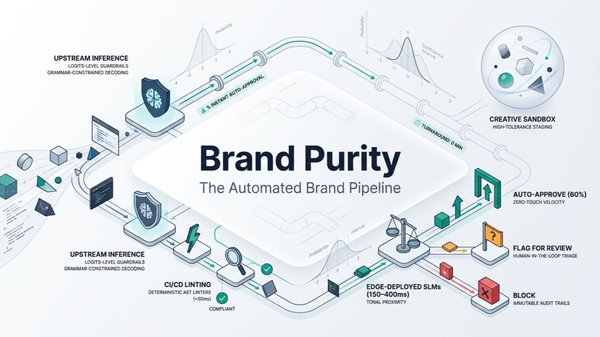
Part 2 of 3 - Upstream Guardrails, Automated Linting, and Human-in-the-Loop Governance
Introduction
A Brand Constitution without automated enforcement remains a dormant file. Building on the foundational specifications established in Part 1: Brand Purity: AI Guardrails for Multi-Brand Identity—which translated brand identity into machine-readable Gherkin specifications and canonical templates like constitution.example.md —the challenge shifts from definition to execution.
Unchecked generation produces semantic erosion and gradual identity drift across disparate content channels. Resolving this degradation requires transitioning from static PDF guidelines to an active, sovereign enforcement pipeline that evaluates assets at runtime and pre-deployment.
This architecture mirrors the sovereign hub model detailed in the Optimizely Opal Hub-and-Spoke Architecture , routing compliance checks through upstream generation endpoints and downstream continuous integration gates.
(Note: Mentions of commercial platforms like Writer, Typeface, Jasper, Acrolinx, and Siteimprove serve as illustrative architectural implementations rather than sponsored endorsements.)
This guide establishes four operational implementations for systems engineers:
- Policy-as-Code Guardrails : Deploy end-to-end programmatic constraints across all creation surfaces.
- Latency-Optimised CI/CD Gates : Integrate structural and semantic validation linters directly into the deployment pipeline.
- Human-in-the-Loop Triage : Route borderline linguistic deviations into structured steward exception queues.
- Isolated Creative Sandboxes : Structurally partition exploratory design environments to prevent systemic over-governance.
From Constitution to Enforcement
Operationalising identity rules requires an active pipeline connecting upstream synthesis directly to downstream deployment gates.
The sovereign constitution operates as an authoritative single source of truth, routing automated policy checks across three core pipeline phases:
- Authoritative Policy Routing : Centralises governance rules within version-controlled repositories rather than relying on retroactive manual auditing.
- Runtime Verification : Intercepts lexical and structural deviations before payloads reach persistent storage.
- Continuous Gatekeeping : Enforces deterministic compliance across all creation and publication interfaces.
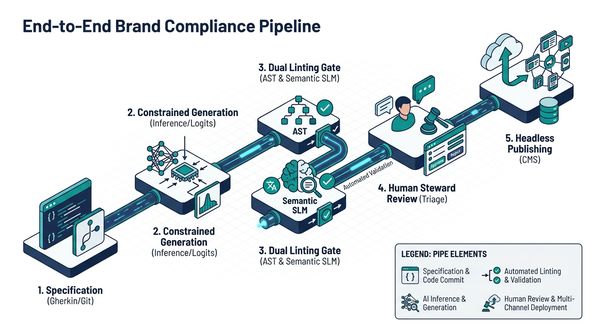
Upstream: Generation-Time Guardrails
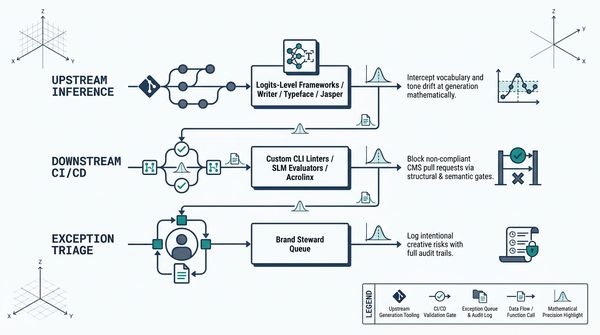
The primary line of defence executes during model inference. Injecting machine-readable brand rules directly into model orchestration intercepts deviations before drafts reach downstream review.
While established enterprise SaaS integrations offer baseline protections, production-grade architectures implement three discrete upstream controls:
- Semantic Routing & Constrained Decoding : Upstream governance moves beyond simple prompt templating. Using frameworks like Outlines or Guidance , brand guardrails execute at the logits level via grammar-constrained decoding, mathematically restricting model outputs to approved JSON schemas or structural vocabularies during inference. Coupled with Semantic Router , pipelines execute low-latency, vector-based routing before inference.
- Prompt Optimisation ( DSPy ) : Programmatic prompt orchestration frameworks compile brand instructions algorithmically, ensuring models internalise guidelines rather than relying on brittle, manually engineered prompts.
- Enterprise Platform Integrations : Dedicated enterprise engines provide specialised capabilities: the Writer Enterprise Platform ingests terminology models for inline term interception; Typeface Arc Graph and Brand Agent parses sub-brand boundaries dynamically; and Jasper AI Platform calculates tonal vectors against curated brand corpora.
To standardise generative visual assets upstream, structured prompt modules like 'Brand Cards' embed deterministic design boundaries directly into model inputs, feeding into these constrained decoding models:
Brand: [Target Brand] | Palette: [#0F172A, #38BDF8, #F8FAFC]
Typography: Display: Satoshi, Body: Inter | Spacing: Strict negative space
Aesthetic: Minimalist, clinical technical precision
Directive: Generate marketing card mockup adhering strictly to hex constraints.
Downstream: CI/CD-Style Linting
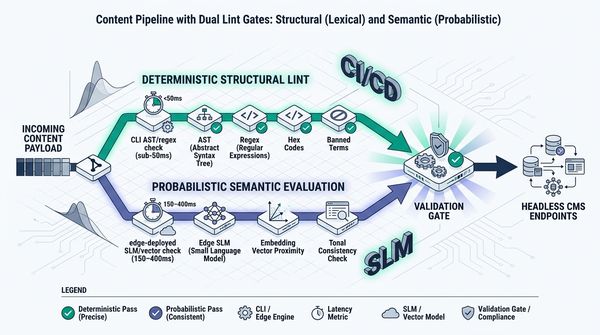
The downstream tier operates between content generation and headless CMS publishing endpoints such as Contentful, WordPress, or Optimizely CMP. Drawing directly on principles from GitHub Spec-Kit: Executing Spec-Driven Development , automated linters intercept subtle AI drift before code or copy merges into production branches.
This architecture partitions validation into three distinct evaluation layers rather than conflating deterministic checks with probabilistic scoring:
- Deterministic Structural Linting : Command-line interface ( CLI ) linters evaluate absolute rules using Abstract Syntax Trees ( AST ) and regular expressions. This layer enforces rigid adherence to lexical constraints, including required hex codes, banned vocabulary, and exact structural formatting conventions.
- Probabilistic Semantic Evaluation : Nuanced tonal attributes cannot be evaluated deterministically. Semantic rules governing brand voice and sentiment execute via edge-deployed Small Language Models ( SLMs ) functioning as localised policy evaluators, or via embedding proximity checks that calculate mathematical vector deviation from a canonical asset baseline.
- Enterprise Quality Gates : Downstream monoliths like Acrolinx Enterprise Governance synthesise these approaches to evaluate tone and scannability, while Siteimprove Digital Optimization executes post-generation regression tests to capture accessibility defects and visual drift across digital estates.
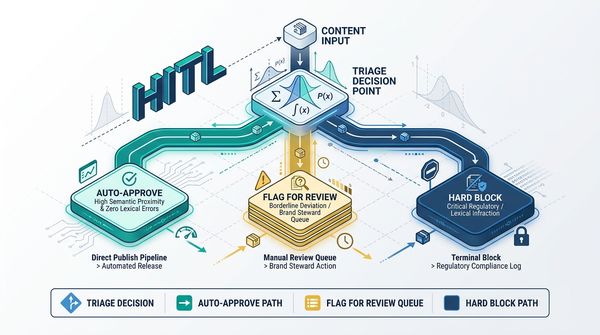
Human-in-the-Loop: The Brand Steward Queue
Automated enforcement requires a relief valve for intentional creative risk.
A deterministic three-tier exception queue manages triage dynamically:
- Auto-Approve : Assets clearing both deterministic lexical linting and probabilistic semantic thresholds proceed directly to deployment without human touch.
- Flag for Review : Assets yielding borderline semantic proximity scores route to brand stewards, who evaluate deviations and record an immutable justification in the audit log.
- Block : Payloads containing critical regulatory, legal, or ethical infractions halt deployment immediately.
Measuring Success: Compliance Rates, Velocity Gains, and Audit Trails
A spec-driven pipeline yields actionable operational telemetry across two core performance vectors:
- Compliance Rate : Measures the percentage of assets clearing automated gates on first pass, targeting a 90% baseline across production environments.
- Velocity Acceleration : Tracks the elimination of manual line-editing bottlenecks and editorial turnaround lag.
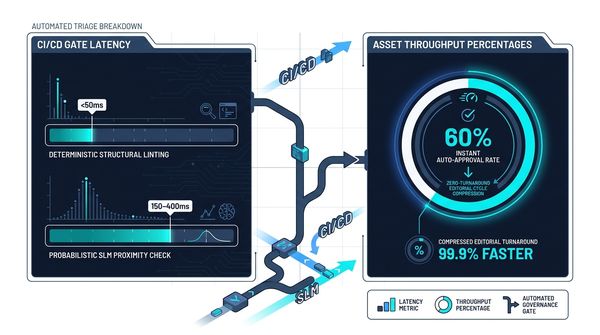
Empirical testing using the headless CLI engine ( linter/validate_brand.py ) within the companion GitHub Brand Constitution Code Samples establishes clear performance benchmarks:
- Deterministic Structural Linting : Demonstrates sub-50 millisecond execution latency per document.
- Probabilistic Semantic Proximity Checks : Edge-deployed SLMs complete vector proximity scoring within 150-400 ms .
- Instant Auto-Approval Rate : In production benchmarks, 60% of compliant assets achieved Instant Auto-Approval by clearing both evaluation thresholds.
- Editorial Cycle Compression : Automated gate clearing collapsed editorial cycle times from 45 minutes to zero.
Future-Proofing: Version Control, Rollback, and Brand Evolution
Treating the brand constitution as version-controlled code ensures long-term architectural durability.
Production environments maintain stability across three configuration management patterns:
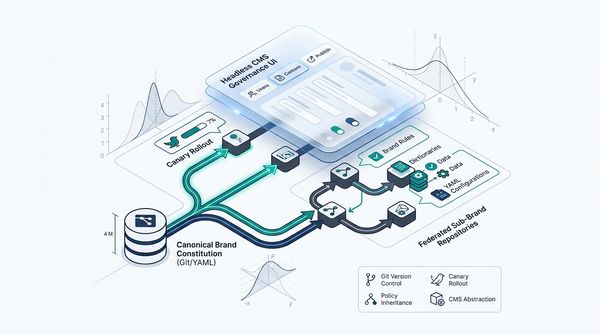
- Git Tracking & Rollback : Rules, dictionaries, and prompt modules are tracked via Git commits; faulty tone thresholds can be reverted instantly. To ground this in the practical reality of marketing operations, these version-control mechanics are obfuscated behind a headless CMS UI, allowing non-technical brand managers to interact with the pipeline without direct Git exposure.
- Canary Rollouts : Policy modifications deploy to localised sub-brands first to audit pass rates and isolate potential false positives prior to network-wide rollout.
- Federated Inheritance : Subsidiary brands inherit core group constraints while maintaining scoped repository overrides for regional identity requirements.
Creative Sandboxes: Preventing Over-Governance
Excessive algorithmic linting risks creative stagnation, converting generative pipelines into recursive echo chambers. Establishing designated Creative Sandboxes prevents this operational bottleneck.
Technically defined, a Creative Sandbox deploys through three architectural components:
- Isolated Git Environments : Operates within a dedicated, isolated Git branch or ephemeral development staging environment.
- High-Tolerance Configurations : Utilises modified, high-tolerance YAML configuration files that loosen lexical and semantic thresholds to allow experimental framing and visual exploration.
- Upstream Codification : Protects main production branches from CI/CD deployment blocks while providing a structured path to codify validated creative patterns back into the central constitution.
Conclusion & Strategic Advice
Protecting brand purity across modern multi-brand estates requires coupling upstream constrained-decoding guardrails with fast downstream CI/CD linting and immutable steward exception queues.
Begin by deploying the headless CLI linter into pre-commit webhooks to establish baseline compliance metrics before enforcing blocking gates. In Part 3, we expand beyond copy governance into multimodal asset architectures: compiling brand aesthetics into version-controlled LoRA weights, voice adapters, and ComfyUI pipelines. Read Part 3: Brand Purity: Multimodal Asset Governance with LoRA, Voice Adapters, and ComfyUI.
How is your engineering team enforcing brand integrity across generative content pipelines? Drop your thoughts below💬 and share this architectural blueprint with your network! ♻️
Further Reading
- Open Policy Agent (OPA) Documentation — CNCF declarative policy engine for decoupling policy from runtime code.
- Styra: Policy-as-Code Architecture & Best Practices — Production design patterns for continuous compliance gates.
- Vale Prose Linter Documentation — Syntax-aware prose and editorial linter for CI/CD documentation pipelines.
- Acrolinx Platform Architecture & Quality Gates — Enterprise content governance automation and API-driven scoring.
More From Me
Original Article: Read on LinkedIn | Read on Substack