Brand Purity: Multimodal Asset Governance with LoRA, Voice Adapters, and ComfyUI
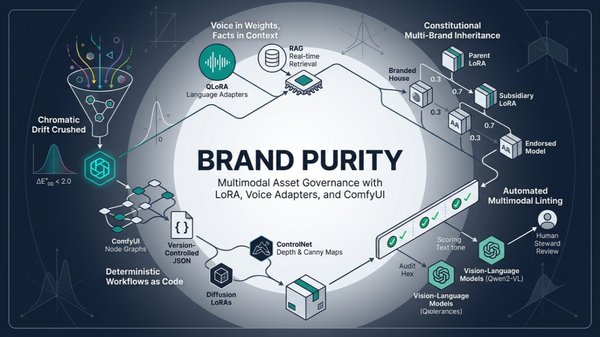
Part 3 of 3 - Visual Constitutions, Parameter-Efficient Weights, and Node-Based Pipelines
Introduction
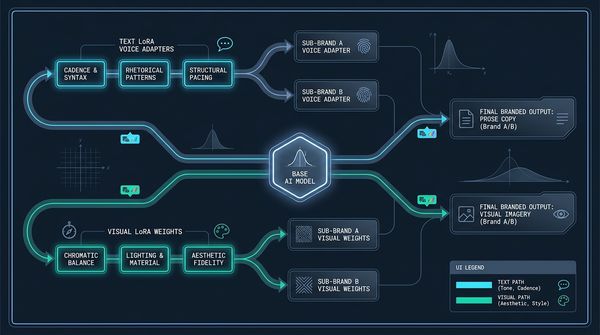
Text-based brand guidelines (constitution.md), established in Brand Purity Part 1: AI Guardrails for Multi-Brand Identity and Brand Purity Part 2: The Automated Brand Pipeline , successfully enforce negative constraints and upstream schema validation. However, static prose fails to govern granular aesthetic execution across two primary modalities:
- Copy Cadence & Syntax : Prose rules cannot enforce subtle pacing, lexical density, or rhetorical rhythm.
- Visual Fidelity : Uncompiled guidelines cannot regulate volumetric lighting, chromatic balance, or surface material texture.
Governing brand identity across generative pipelines requires compiling style into parametric weights instead of relying on conversational prompts. Encoding identity into Low-Rank Adaptation ( LoRA: Low-Rank Adaptation of Large Language Models (Hu et al., 2021) ) transforms passive guidelines into version-controlled mathematical deltas that deterministically eliminate generative drift.
Why Prompt Engineering Fails Both Copy and Design
Relying on circulating system prompts across distributed pipelines introduces four operational failure modes:
- Seed & Temperature Drift : In diffusion models, seed adjustments destabilise lighting and palette grading. In language models, sampling temperature variances trigger generic corporate filler.
- Context Competition & Token Bloat : Loading extensive negative brand rules into prompts consumes finite attention windows, degrading brief comprehension.
- Toolchain Inconsistency : Disparate interfaces and web clients interpret prompt syntax unpredictably across regional units.
- Absent Version Control : Prompts resist cryptographic signing, diffing, and continuous integration regression testing.
Empirical benchmarks published in the Brand Constitution Code Samples demonstrate the measurable limits of prompt-based colour governance across two testing configurations:
- Prompt-Only Chromatic Drift : When targeting brand colours (#0A192F and #64FFDA), unconstrained diffusion prompts produced severe chromatic instability. Evaluated under the industry-standard CIEDE2000 (ΔE00∗Δ E 00∗) metric within the perceptually uniform CIELAB colour space , deviation frequently exceeded ΔE00∗>12.0Δ E 00∗>12.0.
- Compiled LoRA Stability : Compiling identity parameters into visual LoRA weights restricted chromatic deviation strictly to ΔE00∗<2.0Δ E 00∗<2.0. This falls below the threshold for human perceptual difference, enforcing aesthetic consistency across arbitrary seeds to meet professional print and digital design standards.
Tone of Voice in Silicon: Fine-Tuning LLMs with Language LoRAs
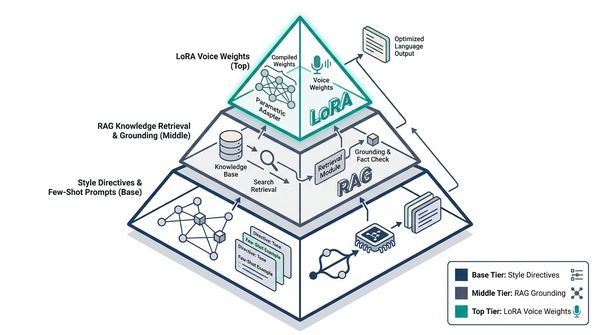
Scalable content pipelines decouple factual grounding from stylistic voice across three architectural tiers:
- Style Directives & Few-Shot Prompting : Accelerates initial prototyping, but exemplar fragments rapidly exhaust available context windows.
- Retrieval-Augmented Generation (RAG) : Indexes dynamic knowledge bases into vector stores to guarantee factual accuracy, while leaving the underlying syntactic cadence generic.
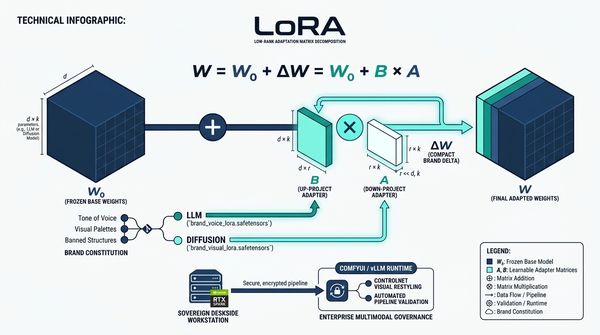
- Language LoRA Fine-Tuning : Trains parameter-efficient matrices (W=W0+B×A W = W 0+ B × A ) on 300 to 1,000 paired brief-and-final exemplars (150,000 to 500,000 tokens) via QLoRA (Dettmers et al., 2023) .
Operating language generation in production follows two foundational runtime rules:
- Separation of Concerns : Voice belongs in weights, facts belong in context . Fine-tuning compiles rhetorical pacing and eliminates corporate clichés, while dynamic real-time claims remain strictly grounded via RAG retrieval pipelines.
- Runtime Efficiency : Serving engines like vLLM (Kwon et al., 2023) execute millisecond adapter swaps dynamically across requests without reallocating base model memory.
Visual Aesthetics in Silicon: LoRA Training & ComfyUI Pipelines
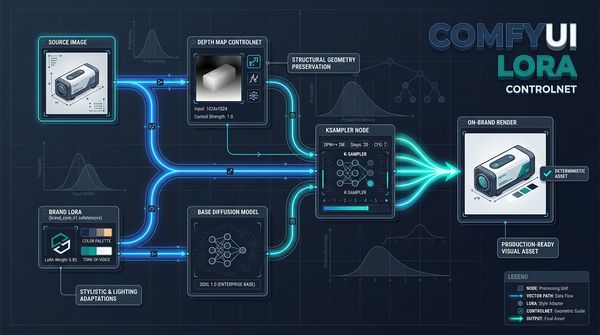
Visual identity governance encodes colour palettes, surface tactility, and lighting ratios into compact diffusion adapters through three pipeline stages:
- Dataset Curation & Tagging : Curate 20 to 50 high-resolution exemplars covering diverse compositions. Tag assets with a bespoke trigger token (brand_core_v1) and generate captions automatically using dense vision models like Florence-2 (Xiao et al., 2023) .
- Deterministic Spatial Conditioning : Replace open-ended text prompts with node graphs executing ControlNet (Zhang and Agrawala, 2023) . Depth and Canny edge maps extract structural geometry directly from source photography, locking packaging contours while the LoRA restyles lighting and surface texture.
- Workflows as Code : Node graphs export directly as declarative JSON files, enabling Git version control and programmatic execution via headless ComfyUI APIs.
Production deployment introduces two specific technical constraints:
- Vector & Typographic Boundaries : Diffusion LoRAs do not render mathematically precise vector logos or micro-typography. These elements require dedicated secondary vector compositing passes, ControlNet masking passes, or SVG injection layers.
- Hardware & VRAM Thresholds : Training language and visual LoRAs locally requires a minimum of 16GB–24GB VRAM. Workstations running unified-memory inference—such as the Apple Mac Studio (M2/M3 Ultra with 128GB/192GB Unified Memory) or NVIDIA RTX 6000 Ada Generation multi-GPU configurations—prevent host-to-device paging bottlenecks.
Constitutional Inheritance for Multimodal Adapters
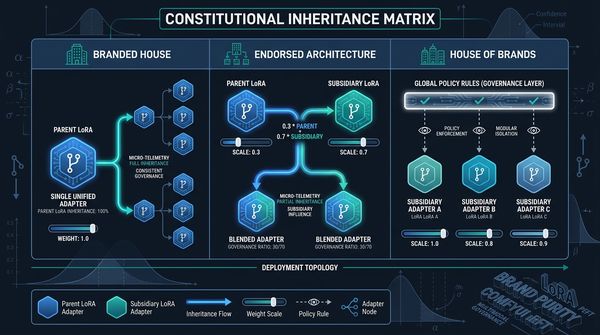
Enterprise multi-brand structures scale across three hierarchical adapter inheritance models:
- Branded House : Operating units globally load a unified adapter pair (parent_voice.safetensors and parent_visual.safetensors) to enforce global brand consistency.
- Endorsed Architecture : Generation pipelines interpolate the corporate parent LoRA (scale weight 0.3) with a subsidiary-specific adapter (scale weight 0.7), maintaining baseline corporate governance while adopting local subsidiary expression.
- House of Brands : Autonomous operating units deploy isolated, dedicated adapter pairs, while the parent repository enforces baseline safety constraints, minimum resolution thresholds, and banned token registries.
Closing the Loop: Automated Multimodal Linting & Sanity Gates
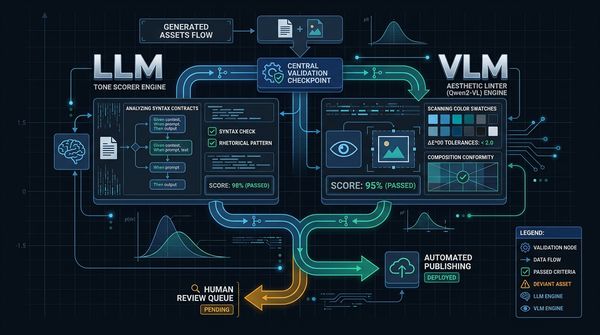
Downstream governance enforces automated release verification prior to asset publication through three discrete gates:
- Text Tone Scoring : LLM linters evaluate candidate copy against Gherkin contract specifications, scoring syntactic deviation, banned corporate clichés, and passive-voice density.
- Visual Palette Linting : Vision-Language Models such as Qwen2-VL (Wang et al., 2024) inspect rendered imagery against Brand Card hex tolerances, lighting contrast ratios, and prohibited visual motifs.
- Continuous Integration Inference Requirements : Standard CI/CD platforms lack native persistent GPU support. Consequently, automated multimodal pipelines dispatch webhook triggers to dedicated, persistent GPU inference endpoints (such as vLLM server instances) instead of running on ephemeral CI/CD runners. Rendered assets exceeding chromatic tolerance thresholds (ΔE00∗>2.0Δ E 00∗>2.0) route automatically to human steward review queues.
Conclusion & Strategic Advice
Governing multimodal generation requires transitioning from conversational prompt libraries to compiled, testable engineering assets.
Production teams select deployment models based on three operational tiers:
- Rapid Prototyping : Few-shot prompting and dynamic RAG context injection.
- Deterministic Production : Quantised base models paired with modular LoRA .safetensors deltas (20MB–150MB) and ControlNet spatial constraints.
- Multi-Brand Topologies : Weighted adapter inheritance orchestrated via headless ComfyUI and governed by automated VLM linting gates.
The Series Wrap-up : Across this three-part series, the core architectural thesis remains constant: generative brand integrity is an infrastructure discipline. Enforcing end-to-end brand purity across enterprise synthetic workflows relies on three structural milestones:
- Part 1 : Brand Purity: AI Guardrails for Multi-Brand Identity .
- Part 2 : Brand Purity: The Automated Brand Pipeline.
How is your engineering team currently enforcing brand consistency across visual and language model pipelines? Drop your perspective below💬 and share this framework with your technical and creative teams! ♻️
Further Reading
- Hugging Face PEFT Documentation
- ComfyUI Official Architecture & API Reference
- vLLM Documentation: Serving Multi-LoRA Adapters
- ControlNet: Adding Conditional Control to Text-to-Image Diffusion
More From Me
- LLM Anti-Patterns: 'One Prompt to Rule Them All'
- Sovereign Vision: Practical Guide to Tailored Generative AI
- Choosing AI Image Models: Essential Factors in Comic Creation
- Overcoming AI Image Limits: Experience for Comic Creator
Original Article: Read on LinkedIn | Read on Substack