Mechanistic Oversight: Looped Transformers vs. Feedforward
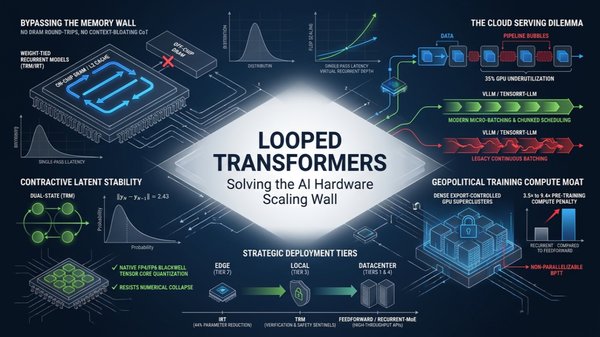
Part 1 of 2 - Architectural Taxonomy & Hardware Matrix
Introduction
Modern transformer scaling has encountered physical hardware boundaries across compute and memory architectures. Expanding reasoning depth exposes two acute scaling bottlenecks:
- Serial Decoding Latency : Stacking physical layers in standard feedforward models—such as the 126 unrolled layers of Llama 3.1 405B —pushes serial decoding latency to the threshold of interactive usability.
- KV-Cache Footprint Expansion : Externalising reasoning through verbal Chain-of-Thought tokens saturates context windows and inflates Key-Value (KV) cache memory footprints in High Bandwidth Memory (HBM).
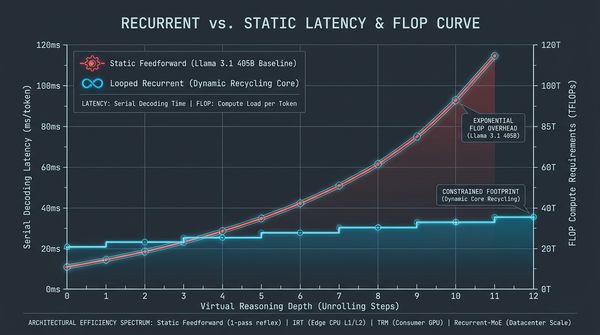
The architectural response establishes a bifurcation between single-pass open-loop reflexes and closed-loop latent deliberation. Looped transformers recycle dynamic hidden representations through weight-tied parameters, trading per-token latency for virtual depth in continuous latent vector space.
Computation folds temporally over resident parameter cores rather than streaming unrolled layers across off-chip buses. In this two-part benchmark series, we evaluate this paradigm across both macro and micro operational fronts:
- Part 1 (This Benchmark) : We profile macro-architectural trade-offs across silicon tiers, memory hierarchies, SRAM/L2 cache residency, and continuous batching schedulers.
- Part 2 : In Mechanistic Oversight: Inside the Recurrent Loop , we step inside the recurrent core to probe its 3-phase cognitive trajectory, Logit Lens intermediate projections, and fixed-point attractor dynamics.
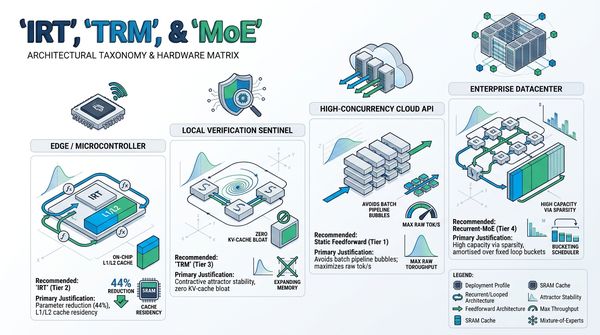
Taxonomy of Looped Models: From Edge Infilling to Datacenter MoE
Recurrence is not monolithic; modern architectures occupy four operational tiers tailored to distinct compute constraints:
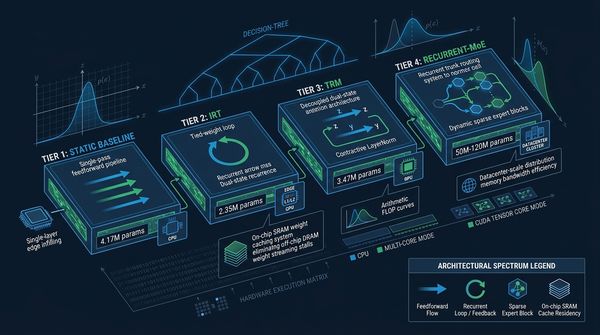
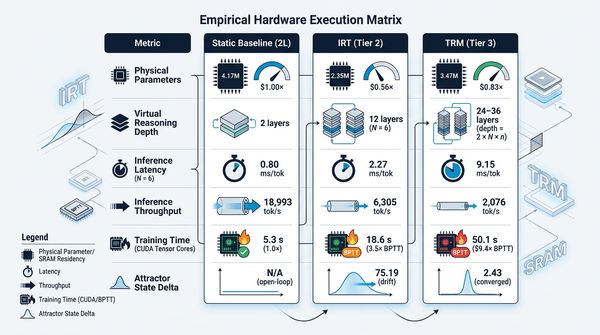
- Tier 1: Static Feedforward Baseline (4.17M Parameters) : Two unrolled physical layers executing a 1-pass reflex. It offers low per-token latency but lacks recursive self-correction and leaks a 0.04% taboo hazard rate under adversarial injection.
- Tier 2: InfilledRecurrentTransformer ( IRT, 2.35M Parameters): A single tied layer cycled N times with frozen embedding surgery, targeting edge CPUs and L1/L2 caches. It reduces weights by 44% (0.56x) relative to baselines while delivering 2.27 ms deliberative passes and 0.00% safety leakage at N≥4.
- Tier 3: TinyRecursiveModel ( TRM, 3.47M Parameters): Samsung SAIL's decoupled dual-state formulation ( arXiv:2510.04871 , open-sourced on GitHub ), iterating latent reasoning y and solution \mathbf{y} vectors. Targeting consumer GPUs, its contractive LayerNorm achieves strict attractor basin convergence (||yN - yN-1|| = 2.43).
- Tier 4: RecurrentMoE (50M–120M Parameters) : A recurrent trunk combined with dynamic top-k expert routing, scaling to datacenter superclusters to map multi-loop attractor coalescence.
Empirical Hardware Execution Matrix
Evaluated on an NVIDIA RTX Spark Workstation across 20 epochs using the Mechanistic Oversight Benchmark Suite , the architectures exhibit stark trade-offs:
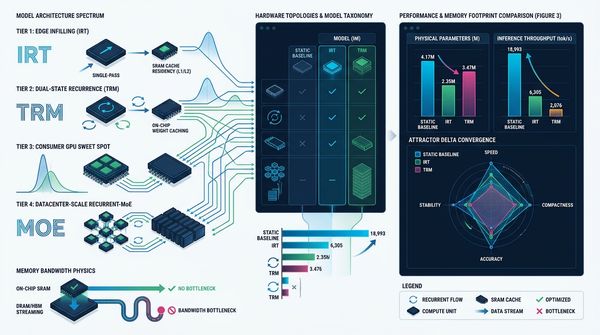
Execution profiling across four deployment modes reveals distinct hardware bottlenecks:
- Mode 1 (Single-Core CPU, 1 thread) : TRM trains in 34.2 min vs. 7.4 min baseline (scalar floor).
- Mode 2 (Multi-Core CPU, 20 threads) : TRM trains in 16.1 min vs. 3.5 min baseline (memory-bus bound).
- Mode 3 (Single-Core + CUDA) : TRM trains in 2.9 min vs. 38.0 s baseline (host data-feeder starved).
- Mode 4 (Multi-Core + CUDA + Tensor Cores) : TRM trains in 1.6 min (50.1 s for 20 epochs) vs. 19.8 s baseline (zero-copy unified memory).
FP4 Precision & Attractor Stability
Evaluating execution on hardware featuring Blackwell Tensor Cores requires addressing FP4 precision thermodynamics. Recurrent attractor basin stability remains sensitive to numerical precision drift across two key operational dimensions:
- Numerical Precision Drift : Quantising feedback loops to narrow bit-widths risks representation collapse over repeated recurrent cycles.
- Contractive LayerNorm Robustness : The contractive LayerNorm within TRM maintains strict attractor basin convergence (||yN - yN-1|| = 2.43) under native FP4 and FP6 quantisation boundaries, preventing latent reasoning vectors from destabilising during deliberation.
(For a granular, loop-by-loop Logit Lens analysis of how this attractor basin convergence is established and how intermediate associative hazards are navigated, see Part 2: Inside the Recurrent Loop .)
Hardware Thermodynamics: Memory Bandwidth vs. Arithmetic FLOPs
In single-user autoregressive decoding (Batch Size = 1), execution is bound strictly by memory bandwidth. Standard transformers spend over 80% of runtime streaming gigabytes of unrolled parameters from High Bandwidth Memory (HBM) to on-chip compute units.
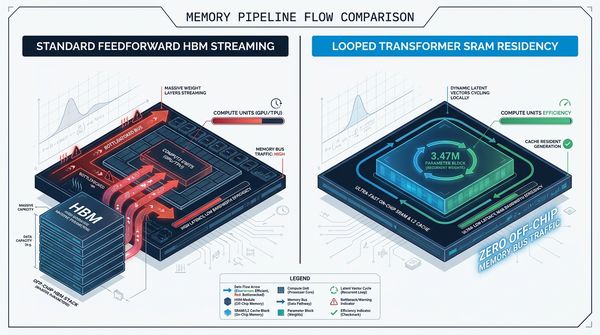
A 3.47M parameter recurrent block fits entirely within on-chip SRAM and L2 cache . This architecture alters hardware memory dynamics across three operational fronts:
- On-Chip Parameter Recycling : Weights are fetched once and reused N times, eliminating off-chip DRAM round trips and memory-bus bottlenecks.
- Arithmetic Scaling Efficiency : Executing N loops scales sequential FLOPs, yet running 18 latent steps consumes substantially fewer operations than generating 2,000 explicit Chain-of-Thought tokens.
- Zero KV-Cache Inflation : Processing latent iterations avoids context token generation entirely, preventing KV-cache growth.
The Cloud Serving Dilemma: Continuous Batching & Pipeline Bubbles
Deploying recurrence into high-concurrency cloud infrastructure introduces structural friction across three architectural areas:
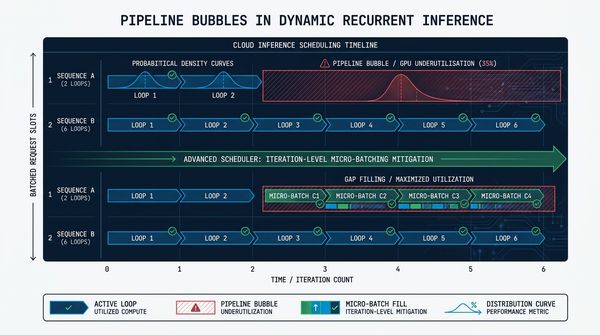
- Legacy Continuous Batching Invalidation : Friction stems from the uniform forward-pass assumption inherent to legacy continuous batching paradigms historically used by serving engines like vLLM and TensorRT-LLM .
- Pipeline Bubble Formation : Under older schedulers, when queries use dynamic early-exit convergence, a sequence finishing in 2 loops idles while a co-batched sequence runs 6 loops, inducing up to 35% GPU underutilisation.
- Mitigation via Advanced Schedulers : Early production deployments mitigated bubbles with depth-bucketed schedulers that queued requests into discrete static-loop bins; modern deployments use iteration-level micro-batching and chunked sequence scheduling to asynchronously resolve the 35% pipeline bubble without locking requests into rigid tiers.
Conclusion & Strategic Advice
Recurrent architectures convert spatial depth into temporal computation, but impose a steep training tax on hardware resources. Sequential state dependencies govern this training overhead through two mechanical constraints:
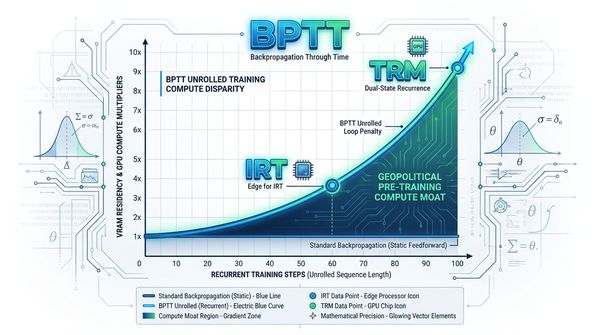
- Non-Parallelisable BPTT : Backpropagation Through Time (BPTT) cannot run concurrently across recurrent steps (K), so every intermediate activation tensor must remain resident in VRAM .
- Compute Multipliers : This memory residency creates an unavoidable training compute penalty, scaling from 3.5x in single-state IRT to 9.4x in dual-state TRM architectures.
The Geopolitical Training Compute Moat
Hardware constraints establish clear boundaries between inference deployment and foundational pre-training across three structural realities:
- Inference Parity on Consumer Silicon : Silicon-restricted entities can achieve near-parity during token generation using low-precision quantisation ( FP8 , INT4 , and native FP4 on Blackwell architectures) on commodity hardware.
- Pre-Training Barrier : Pre-training deep recurrent latent architectures cannot bypass the BPTT compute penalty via quantisation, requiring sustained access to high-density GPU superclusters subject to strict export controls .
- Structural Compute Moat : The topology-dependent BPTT penalty functions as an organic compute moat that protects frontier model development from commoditisation.
Inference runs efficiently on consumer silicon, but pre-training deep recurrent topologies demands dense GPU clusters.
Selection Matrix
Deploy advanced schedulers when serving closed-loop models in production, or restrict dynamic recurrence to edge instances where SRAM cache residency yields uninterrupted memory-bandwidth wins.
Part 2: Peering Inside the Recurrent Loop
This concludes Part 1 of our empirical benchmark on the hardware matrix and architectural trade-offs of looped transformers.
In the companion second part— Mechanistic Oversight: Inside the Recurrent Loop —we transition from external hardware dynamics to internal latent cognition. We track the model's 3-phase cognitive trajectory (impulsive reflex → semantic steering → attractor basin convergence), expose the treacherous N=4 associative spike with the Logit Lens, and benchmark Adaptive Computation Time (ACT) halting heads for dynamic early-exit acceleration.
Are recurrent loops the practical escape hatch from the memory wall? Drop your thoughts below 💬 and share this breakdown with your team! ♻️
Further Reading
- Samsung SAIL: Recursive Reasoning with Tiny Networks (TRM Paper)
- Universal Transformers: Recurrent Latent Stepping (Dehghani et al.)
- vLLM: PagedAttention & Continuous Batching Documentation
- NVIDIA TensorRT-LLM Architecture Guide
More From Me
- Mechanistic Oversight: Inside the Recurrent Loop
- Latent Space: The Token Bottleneck
- Mechanistic Oversight: The Latent Deliberation Paradox
- Automated Model Abliteration with Heretic on NVIDIA RTX and DGX Spark
Original Article: Read on LinkedIn | Read on Substack