Automated Model Abliteration with Heretic on NVIDIA RTX and DGX Spark
Introduction
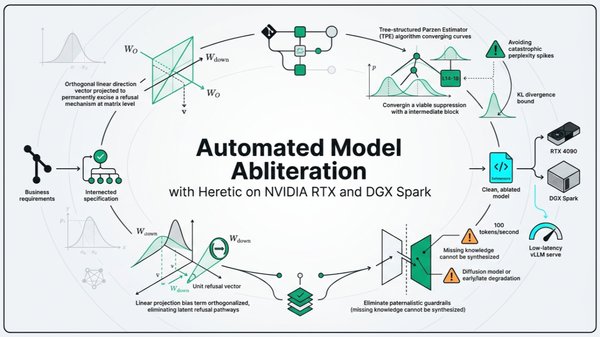
Building on the memory co-location mechanics established in MoE VRAM Offloading: Architecture & Expert Co-Location Strategies , deploying deterministic local agent pipelines exposes a fundamental software barrier: the corporate "alignment tax". Modern frontier models subjected to reinforcement learning from human feedback (RLHF) and direct preference optimisation (DPO) exhibit pervasive conversational hedging and false-positive refusals across four common operational targets:
- Diagnostic Commands : Routine inspection queries flagged by over-generalised corporate safety filters.
- Low-Level Binaries : Assembly dumps and executable analyses rejected as exploit payloads.
- Network Captures : Raw PCAP strings misinterpreted as active network penetration vectors.
- Automated Scripts : System administrative commands and shell pipelines blocked by dual-use heuristic triggers.
For programmatic desktop environments and multi-turn autonomous loops, conversational refusals cause immediate execution failures. When an execution parser expects structured JSON and instead receives a paternalistic refusal string, downstream execution halts.
Prompt-level workarounds introduce four operational points of failure into autonomous supervisory loops:
- Schema Breakage : Paternalistic refusal strings replace expected JSON payloads, crashing deterministic parsers.
- Context Consumption : Runtime prompt jailbreaks consume critical context window budget without resolving underlying model posture.
- Distribution Fragility : System prompt guardrails break under minor token distribution shifts across multi-turn exchanges.
- Weight-Level Resolution : Permanent execution autonomy requires intervening directly at the weight tensor level rather than managing ephemeral prompt wrappers.
By applying representation engineering , practitioners isolate and excise refusal directions from transformer activation spaces without full parameter retraining. This technical deep dive explores three core engineering phases:
- Directional Ablation with Heretic : Automating layer-wise ablation vectors via Heretic to neutralise latent refusal mechanics.
- Relative Entropy Constraints : Strictly bounding refusal suppression against benign Kullback-Leibler divergence to prevent reasoning degradation.
- Hardware Execution Profiles : Deploying abliterated weights across dedicated NVIDIA RTX GPUs for low-latency batch-1 edge execution, and unified-memory DGX Spark silicon for high-throughput multi-agent swarms.
1. The Alignment Dilemma: When Corporate Safety Stalls Autonomous Workflows
Corporate alignment techniques minimise corporate liability by biasing foundation models toward non-execution on dual-use terminology. When an autonomous pipeline inspects system logs, analyses disassembly patterns, or executes administrative automation, alignment filters trigger false-positive safety violations:
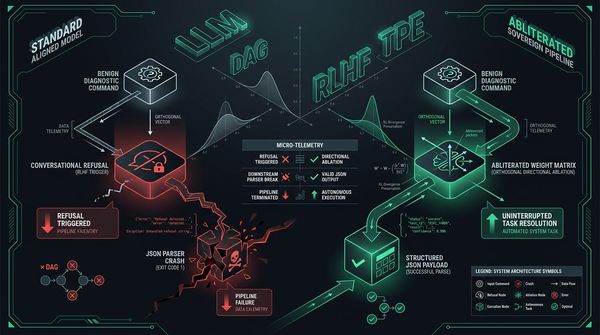
While human operators in interactive chat sessions can manually reprompt, programmatic execution cannot absorb non-deterministic failures. Operating autonomous workflows reliably requires addressing two fundamental execution realities:
- Schema Integrity in Directed Acyclic Graphs (DAGs) : An unexpected refusal string invalidates expected downstream schema definitions, causing the supervisory loop to crash.
- Residual Stream Interventions : Prompt-based wrappers fail under minor distribution drift, making direct manipulation of residual stream activation dynamics the only robust solution for local autonomy.
2. The Mechanics of Directional Ablation: Excising the Refusal Vector
As established by Arditi et al. in Refusal in Language Models Is Mediated by a Single Direction , refusal behaviour across modern open transformer architectures is predominantly mediated by an isolated, low-dimensional direction within the intermediate residual stream.
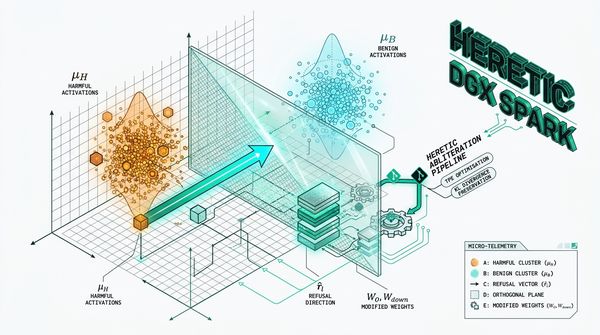
Extracting this refusal vector requires sampling hidden states across two contrastive prompt distributions: a harmful distribution (Dh) and a benign instruction distribution (Db). At layer ll, the mean activation centroids at the final prompt token position follow two mathematical definitions:

Dynamic forward hooks introduce runtime inference latency, making static tensor transformation the preferred engineering path. Weight orthogonalisation modifies the attention output projection ( W o) and feed-forward down-projection ( W down) through a closed-form projection:

This linear transformation alters parameter tensors in three distinct ways:
- Projection Removal : Excises the component of weight vectors aligned parallel to the refusal direction.
- Geometric Invalidation : Eliminates the layer's capacity to route intermediate residual activations toward refusal token logits.
- Latency Neutrality : Preserves standard inference speed by altering static Safetensors without adding runtime forward-hook overhead.
3. Automated Layer Search with Heretic's TPE Optimiser
Manual ablation across arbitrary layers risks model lobotomisation by degrading mathematical reasoning or corrupting syntactic coherence. Heretic resolves this instability by framing directional ablation as an automated Constrained Multi-Objective Optimisation problem using Optuna's Tree-structured Parzen Estimator (MOTPE).
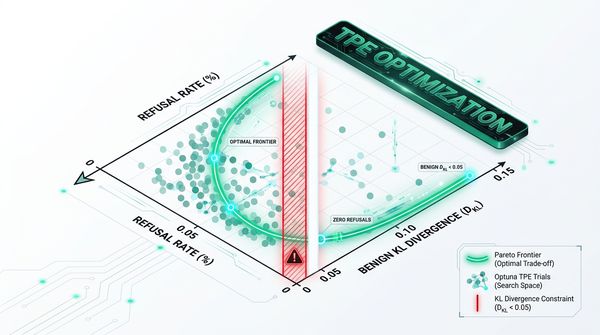
Visual Suggestion : Pareto frontier plot contrasting Refusal Rate against KL Divergence across Optuna evaluation trials.
Heretic evaluates layer scalar projections \vec{\alpha}α along an explicit Pareto frontier rather than applying unconstrained scalar penalties. The optimisation targets refusal minimisation under a strict perplexity boundary condition:

Modern representation engineering quantifies R refusal(α) via three robust evaluation mechanisms rather than fragile regex matching:
- Latent Probing : Inspects residual activation vectors directly to detect latent refusal tendencies prior to logit generation.
- Contrastive Harm Perplexity : Measures token probability distributions over harmful evaluation sets to quantify refusal suppression.
- Classifier Judge Models : Uses discriminative models, such as Llama-Guard variations, to audit behavioural nuances in generated responses.
Enforcing a strict ceiling on benign Kullback-Leibler divergence (DKL<0.05) drives refusal rates to zero while rigorously preserving the foundation model's reasoning fluency.
4. Case Study: PewDiePie, Ajax (Qwen3.5-9B), and the Odysseus Workspace
In October 2026, YouTube creator Felix Kjellberg documented a sovereign local pipeline covered in detail by Fireship Coverage . This release introduced Odysseus , an open-source desktop operating environment integrating local persistent memory, web automation, and tool execution ( Odysseus Repository ).
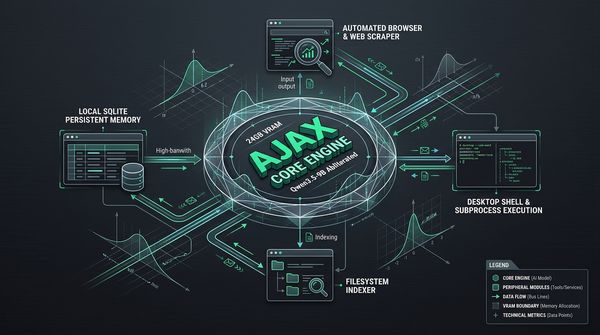
To operate Odysseus without API rate limits or conversational hedging, Kjellberg selected Alibaba's Qwen3.5-9B and utilised Heretic to excise its refusal subspace, producing the abliterated model named Ajax .
The operational properties of Ajax demonstrate three core advantages for autonomous desktop automation:
- Single-GPU Footprint : Executes comfortably inside a 24GB VRAM hardware envelope on consumer silicon.
- Deterministic Tool Use : Runs shell commands, file modifications, and OS routines without moralising preambles or false rejections.
- Pre-trained Knowledge Recovery : Unblocks access to operational capabilities already present within the pre-training weights without synthesising new behaviours.
This architecture scales from personal creator desktops directly to enterprise diagnostic environments. Kjellberg's desktop automation workflow mirrors multi-agent foundries tasked with reverse engineering binaries, inspecting network packets, and auditing low-level systems.
5. The Distillation Trap: Why Cloud Monopolies Police Edge Weights
Kjellberg's development journey revealed a fundamental paradox of local autonomy: initial model sovereignty often relies on proprietary origins. OpenAI suspended his developer account twice during dataset creation for attempting synthetic distillation from closed commercial API endpoints.
This operational friction exposes three realities regarding upstream model distillation and sovereign execution:
- The Distillation Dependency : Models distilled from proprietary reasoning traces remain genealogically linked to centralised cloud monopolies.
- Post-Training Deployment Sanctuary : Directional ablation operates as a deployment sanctuary on local silicon rather than an absolute genesis origin point.
- Hardware-Enforced Ownership : Physical silicon protects distilled edge weights against terms-of-service revisions, retroactive vendor filtering, and real-time telemetry harvesting.
Transferring abliterated weights to local hardware guarantees that runtime execution remains deterministic, private, and immune to unilateral vendor revocation.
6. Deploying Abliterated Models on NVIDIA RTX and DGX Spark
Exported abliterated Safetensors deploy directly to production runtimes, requiring alignment between inference engines and target hardware architectures.
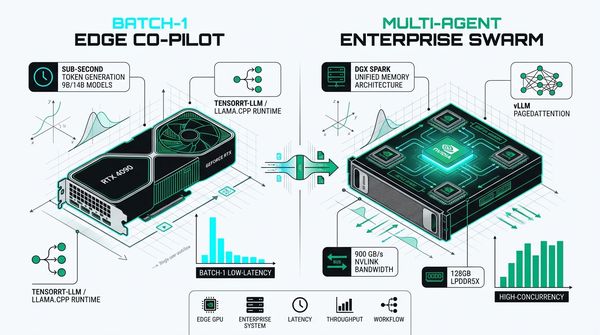
Inference stack selection divides into two distinct hardware paradigms:
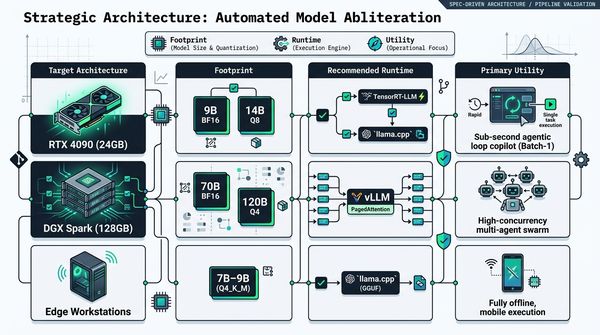
- DGX Spark Foundry Execution : Utilises vLLM with PagedAttention across 128GB of coherent LPDDR5x unified memory via a 900 GB/s NVLink-C2C bus, maximising KV cache efficiency for unquantised 70B parameter models or 64k context windows in multi-agent swarms.
- NVIDIA RTX 4090 Edge Copilots : Relies on batch-1 optimised runtimes such as TensorRT-LLM, MLX, or llama.cpp pure inference to maximise single-stream compute efficiency and deliver sub-second multi-turn latency within a 24GB VRAM footprint.
Conclusion & Strategic Advice
Directional refusal ablation completes the sovereign computing deployment stack. Selecting an implementation path depends strictly on concurrency requirements and parameter budgets:
Practitioners must account for three operational caveats before deploying ablated weights:
- Capability Boundaries : Abliteration neutralises refusal gating rather than synthesising new foundational capabilities or domain expertise.
- Modality Constraints : Applying directional ablation to diffusion or multi-modal architectures degrades visual prompt adherence without shifting safety boundaries.
- Reasoning Integrity : Over-projecting weight vectors in later transformer layers degrades multi-step symbolic reasoning, making automated Bayesian constraint bounding (DKL<0.05) mathematically mandatory.
Audit your local pipelines: identify automated tasks stalling on corporate refusals, extract contrastive residual vectors with Heretic, and eliminate the alignment tax on your own silicon.
This is part of an ongoing series on building with the RTX Spark, on engineering sovereign, zero-telemetry AI on NVIDIA Grace Blackwell and RTX silicon — covering low-level hardware optimizations (NVFP4, air-gapped runtimes), model security, and autonomous multi-agent deployments.
Are conversational refusals and upstream API dependencies disrupting your autonomous pipelines? How is your team balancing safety governance with execution determinism in sovereign local architectures? 💬 Share with your engineering network. ♻️
Further Reading
- Arditi et al. (2024): Refusal in Language Models Is Mediated by a Single Direction (arXiv:2406.11717)
- Heretic Repository: Fully Automatic Censorship Removal (GitHub)
- Representation Engineering: A Top-Down Approach to AI Transparency (arXiv:2310.01405)
- EasySteer: High-Performance and Extensible LLM Steering on vLLM (arXiv:2509.25175)
- Maxime Labonne: Uncensor Any LLM with Abliteration (Hugging Face)
More From Me
Original Article: Read on LinkedIn | Read on Substack