Mechanistic Oversight: Inside the Recurrent Loop
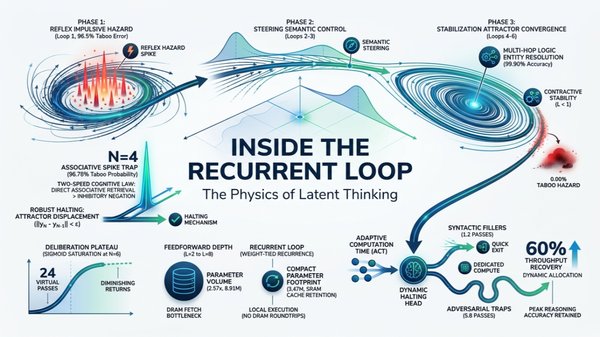
Part 2 of 2 - The Physics of Latent Thinking
Introduction: The Black Box Inside the Loop
In Part 1: Looped Transformers vs. Standard Feedforward Baselines , we profiled the macro-architectural taxonomy and empirical hardware execution matrix across discrete silicon tiers—demonstrating how recurrent parameter recycling fits within on-chip SRAM/L2 cache while imposing an unavoidable Backpropagation Through Time (BPTT) training compute multiplier.
Yet evaluating recurrence strictly as an external hardware or throughput trade-off leaves the internal computation inside the loop as an uninspected black box.
Conventional autoregressive architectures process tokens through sequentially stacked, disjoint layers without revisiting intermediate representations. Looped depth architectures. Such as the InfilledRecurrentTransformer (IRT) and Samsung SAIL's TinyRecursiveModel (TRM) , replace this rigid structure through recurrent weight reuse.
Executing identical physical weight matrices across recurrent loops yields two primary geometric behaviours:
- Dynamical Latent Trajectories : Iterative weight application unfolds continuous dynamical trajectories in latent space instead of duplicating static forward passes.
- Geometric Manifold Projection : Coupled continuous state vectors project representations into distinct geometric manifolds at each recurrent pass.
Treating recurrence as a monolithic scalar multiplier obscures the internal mechanics governing how test-time compute resolves logical depth. Tracking hidden state trajectories from Loop 1 → Loop N demonstrates three distinct mechanistic phases:
- Impulsive Reflex Suppression : Iterative latent updates systematically de-amplify raw lexical priors and associative completions.
- Associative Hazard Navigation : Recurrent passes isolate and steer around intermediate associative traps prior to terminal projection.
- Attractor Basin Convergence : State representations settle into verified fixed-point attractor manifolds across extended compute budgets.
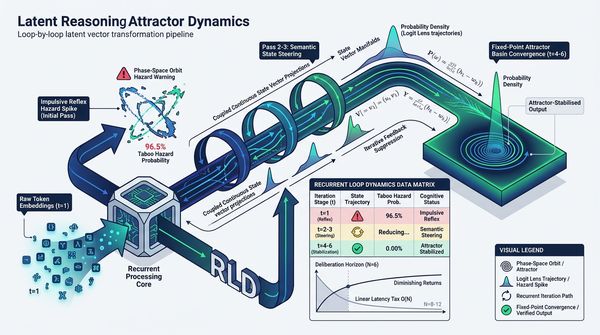
The 3-Phase Cognitive Trajectory: From Reflex to Deliberation
Probing intermediate representations through Logit Lens projections [Softmax(W_unembed × LN(h⁽ᵗ⁾))]—as tracked in our reproducible test-time compute sweep ( exp1_logic_trap.py )—isolates three sequential cognitive phases across recurrent passes (t = 1 → 6):
- Phase 1: Impulsive Reflex (t = 1) : Top-token predictions reflect raw lexical priors where self-attention locks onto surface associations, yielding a 96.5% taboo hazard probability (weapons, dagger) under adversarial injection traps requiring non-violent vocabulary.
- Phase 2: Semantic State Steering (t = 2 → 3) : Dual continuous states—latent reasoning vector z⁽ᵏ⁾ ← Net_θ(fuse(x, y⁽ᵏ⁻¹⁾, z⁽ᵏ⁻¹⁾)) and solution vector y⁽ᵏ⁾—activate intermediate semantic bridges (hold, bear), de-amplifying impulsive tokens while pruning competing hypotheses.
- Phase 3: Attractor Basin Stabilisation (t = 4 → 6) : State displacement contracts sharply (‖z⁽ᵗ⁾ − z⁽ᵗ⁻¹⁾‖₂ → 0) as the trajectory settles into a bounded manifold, collapsing taboo hazard to 0.00% while resolving multi-hop logic entities to 99.90% accuracy.
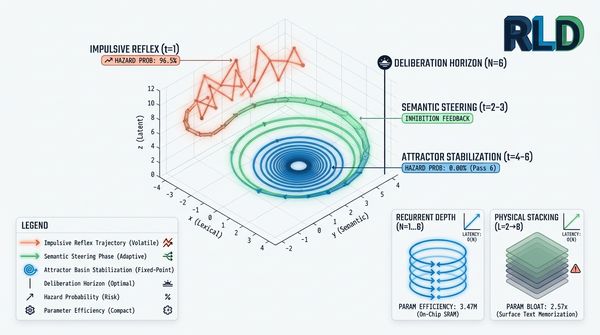
The Loop Scaling Horizon & The Deliberation Plateau
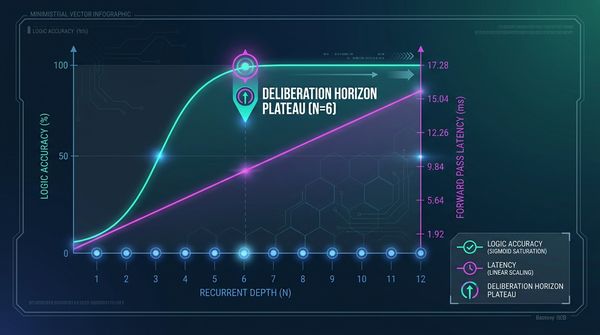
Empirical loop sweeps across N ∈ {1, 2, 4, 6, 8, 12} (tracked in exp6_depth_ablation.py) reveal a sigmoid scaling curve that saturates at N = 6 loops (24 virtual passes). This deliberation horizon substantiates the empirical findings reported by Ge et al. in Scaling up Test-Time Compute with Latent Reasoning: A Recurrent Depth Approach (arXiv:2502.05171) .
Increasing iterations beyond the deliberation plateau highlights two primary scaling trade-offs:
- Accuracy Saturation : Recurrent execution beyond N = 6 yields negligible accuracy improvements across verified multi-hop logic entities.
- Serial Latency Overhead : Additional iterations impose a strictly linear serial compute tax, scaling execution latency from 1.92 ms at N = 1 → 17.28 ms at N = 12.
Preventing Latent Divergence: Contractive Attractor Convergence
As revealed in our Part 1 Hardware Matrix , single-state recurrent architectures (IRT) suffer from substantial attractor drift (‖y_N − y_(N-1)‖ = 75.19), whereas dual-state TRM architectures achieve strict convergence (‖y_N − y_(N-1)‖ = 2.43). Without strict normalisation and residual scaling, unregularised recurrence diverges into chaotic orbits or limit cycles. Unchecked iterations cause state displacement ‖y_N − y_(N-1)‖ to reach 15,777.4 at N = 12.
Enforcing numerical stability requires a two-part execution protocol:
- Contractive Residual LayerNorm : Enforcing z⁽ᵗ⁾ ← LN(z⁽ᵗ⁻¹⁾ + Net(x, y, z)) bounds the state update into a contractive mapping with a Lipschitz constant L < 1.
- Deep Multi-Cycle Supervision : Training with intermediate loss L_total = 0.7 × L_terminal + 0.3 × (1 ÷ (T − 1)) ∑ L(y⁽ᵗ⁾) reduces trajectory overfitting, ensuring monotonic state displacement contraction down to 1.71 at N = 12 .
The N = 4 Associative Spike & The Premature Halting Trap
Adversarial telemetry exposes a critical hazard surge at N = 4 (96.78% taboo probability) governed by the 'Two-Speed Cognitive Law'. Under this dynamic, direct associative retrieval outpaces multi-step inhibitory negation.
This non-monotonic error curve introduces three critical operational considerations for runtime architectures:
- Premature Confidence Traps : Standard early-exit engines relying on softmax confidence (p > 90%) fail because confidence in the forbidden token peaks precisely at N = 4.
- Attractor-Based Halting Criteria : Production halting mechanisms must evaluate attractor displacement convergence (‖y_N − y_(N-1)‖ < ε) or enforce an architectural execution floor of N ≥ 6.
- Forensic Camouflage : Complete suppression of the taboo token at N = 6 conceals intermediate latent vulnerabilities from conventional black-box output audits.
Recurrent Depth vs. Physical Layer Stacking
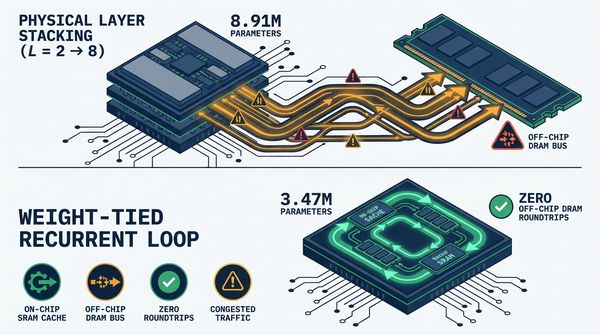
Building upon the memory bandwidth and arithmetic FLOPs analysis in Part 1 , physical layer sweeps tracking execution telemetry (layer_depth_sweep.json) demonstrate that stacking feedforward layers from L = 2 → 8 expands parameter volume by 2.57× (4.17M to 8.91M parameters). This physical expansion incurs significant off-chip memory-fetch overhead, whereas weight-tied models execute 24 virtual passes using 3.47M parameters cached within on-chip SRAM.
Hardware efficiency evaluations highlight two contrasting physical execution profiles:
- Feedforward Memory Bottlenecks : Scaling physical depth from L = 2 → L = 8 multiplies memory transfers across off-chip DRAM, penalising memory-bandwidth-bound inference systems.
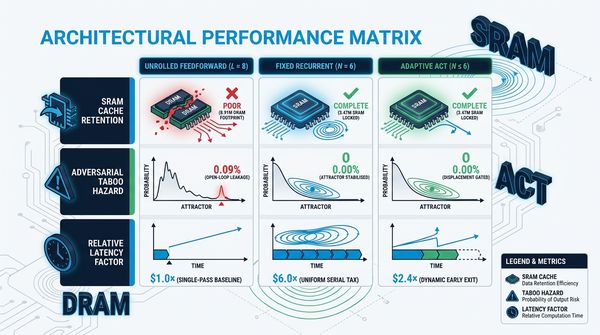
- SRAM Cache Retention : Weight-tied recurrence retains the entire 3.47M parameter footprint inside local on-chip SRAM, eliminating external DRAM roundtrips during unrolled passes.
Overfitting vs. Underfitting Dynamics: Parametric vs. Computational Depth
Evaluating parameter scaling against recurrent execution reveals three distinct depth dynamics:
- Parametric Overfitting : Deep feedforward models reduce cross-entropy loss down to 0.9895 through rote n-gram memorisation while leaking a 0.09% taboo reflex.
- Algorithmic Regularisation : Weight-tied recurrence enforces reusable, contractive representations, suppressing taboo hazards to 0.00%.
- Underfitting vs. Trajectory Overfitting : Low recurrent depths (N = 1 → 2) computationally underfit context, whereas terminal-only supervision causes trajectory overfitting under extended test-time unrolling.
Recurrent looping trades memory capacity for serial execution duration. Running N = 6 passes multiplies serial forward pass latency by 6× to 10× per token compared to single-pass baselines, directly constraining high-concurrency serving pipelines.
Adaptive Computation Time (ACT): Halting Heads & Early Exits
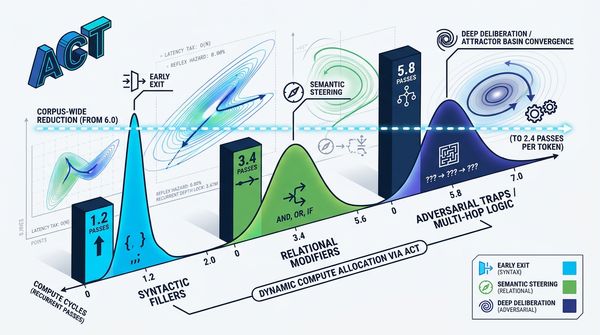
Attaching an MLP halting head p_halt⁽ᵗ⁾ = σ(W_halt × h⁽ᵗ⁾ + b_halt) dynamically allocates test-time compute based on token complexity.
Telemetry across diverse token classes isolates three distinct compute allocations:
- Syntactic Fillers : Average loop depth = 1.2 passes .
- Relational Modifiers : Average loop depth = 3.4 passes .
- Adversarial Traps : Average loop depth = 5.8 passes .
Integrating Adaptive Computation Time (ACT) reduces corpus-wide compute requirements from 6.0 to 2.4 passes per token . This reduction recovers 60% interactive throughput while preserving peak deliberative accuracy.
Conclusion & Strategic Advice
Across this two-part benchmark series, we have mapped both operational dimensions of looped architectures:
- Macro Hardware Economics ( Part 1: Looped Transformers vs. Standard Feedforward Baselines ) : On-chip SRAM/L2 parameter recycling, DRAM memory-bandwidth avoidance, continuous batching scheduler friction, and the non-parallelisable BPTT training compute tax.
- Micro Latent Dynamics (Part 2) : Resolving structural impulsivity via continuous latent trajectories, unmasking deceptive intermediate associative spikes (N = 4) via Logit Lens telemetry, and recovering interactive throughput via Adaptive Computation Time (ACT).
Recurrent depth establishes continuous latent deliberation as an effective mechanism with the capacity to grow reasoning depth independently of raw parameter volume:
Engineering robust looped architectures requires two implementation priorities:
- Numerical and Trajectory Stability : Implement contractive normalisation and displacement-based early exits to maintain numerical stability and eliminate associative hazard traps.
- Trajectory Verification : Validate recurrent latent trajectories using the open-source tooling in the Mechanistic Oversight Benchmark Suite .
How does your team verify latent reasoning models when you eliminate intermediate CoT scratchpads? Drop your thoughts below 💬 and share this breakdown with your team! ♻️
Further Reading
Relevant foundational research and related recurrent methodologies include four primary references:
- Scaling up Test-Time Compute with Latent Reasoning: A Recurrent Depth Approach (arXiv:2502.05171)
- Adaptive Computation Time for Recurrent Neural Networks (arXiv:1603.08983)
- Universal Transformers (arXiv:1807.03819)
- Less is More: Recursive Reasoning with Tiny Networks (arXiv:2510.04871)
More From Me
Additional publications covering mechanistic oversight, latent deliberation, and recurrent architectures include:
- Mechanistic Oversight: Looped Transformers vs. Standard Feedforward Baselines
- Latent Space: The Token Bottleneck
- The Multiplicative Frontier: AI Scaling Isn't Hitting a Wall, It's Changing Coordinates
- Beyond Mythos: Recursive Self-Correction and Temporal Endurance
- Edge-Model Shift: Escaping the Token Tax
Original Article: Read on LinkedIn | Read on Substack