When AI Agents Control Your Wallet
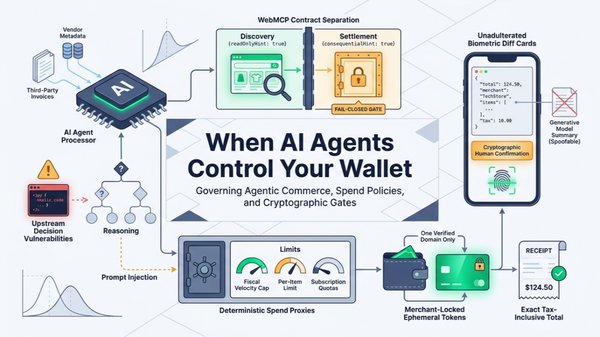
Agentic wallets are coming for your credit cards—pairing with WebMCP to turn AI models into active buyers. While cryptographic tokens protect your credentials, delegated execution leaves prompt policies and vendor selection open to manipulation.
Introduction
When OpenAI introduced ChatGPT Wallet , commerce crossed an irreversible threshold from interface clicks to delegated intent. Autonomous software now researches products, builds baskets, and requests biometric authorisation across tokenized bank rails.
Architecting contractual guards for WebMCP storefront integrations exposes two fundamental shifts in modern payment security:
- Perimeter Security Limits : Hardware biometrics and dynamic card tokens address legacy payment fraud. They do not safeguard agent reasoning.
- Upstream Vulnerabilities : Vulnerabilities migrate directly into decision logic when an agent selects what to buy and whom to pay.
The Three-Layer Agentic Payment Stack
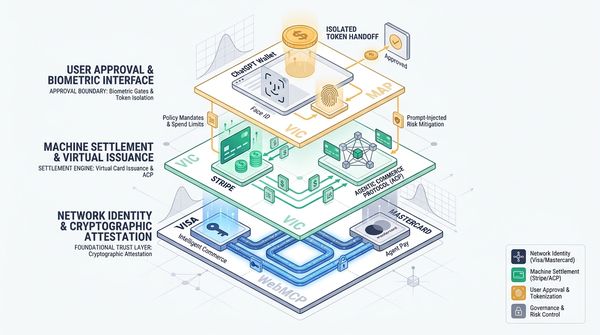
Production agentic commerce stratifies into three tightly coupled infrastructure layers across financial networks and developer toolkits:
- Trust and Network Identity : At the network foundation, programmes such as Visa Intelligent Commerce and Mastercard Agent Pay provide acquiring banks with cryptographic attestation. These mechanisms separate legitimate buyer agents from malicious scraper bots.
- Machine Settlement and Protocols : Sitting above card rails, Stripe Agentic Commerce and the open Agentic Commerce Protocol (ACP) standardise machine-readable checkout flows. They also manage single-use virtual card issuance.
- User Biometric Approval and Interface Isolation : Consumer interfaces such as ChatGPT Wallet collect one-time card links and issue scoped payment tokens for transactions. This architecture isolates Primary Account Numbers from both the language model and merchant contexts.
WebMCP Checkout Contracts and Algorithmic Spend Drift
On the client tier, payment backends connect directly to emerging specifications led by the W3C WebMCP draft and Chrome's WebMCP guidance . Storefronts expose structured actions via document.modelContext.registerTool(), replacing fragile computer-vision clicking with deterministic JSON schemas.
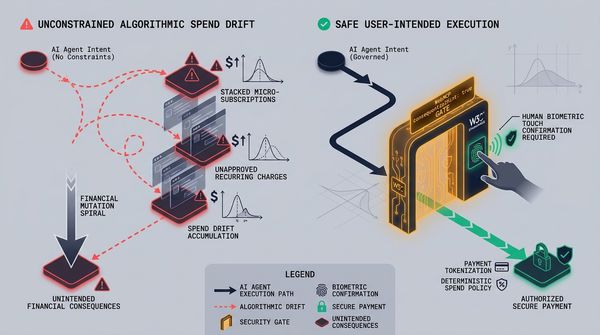
Modern WebMCP specifications separate tool execution through two core mechanisms:
- Tool Contract Classification : Specifications pair read-only lookups (readOnlyHint: true) against mutating operations (consequentialHint: true). Mutating actions trigger mandatory browser confirmation before execution.
- Algorithmic Spend Drift : If systems lack strict schema separation, agents optimise for task completion rather than fiscal governance. Autonomous agents can silently stack micro-subscriptions, reorder inventory prematurely, or renew unapproved recurring agreements.
Delegated Identity Fraud and Prompt-Injected Transactions
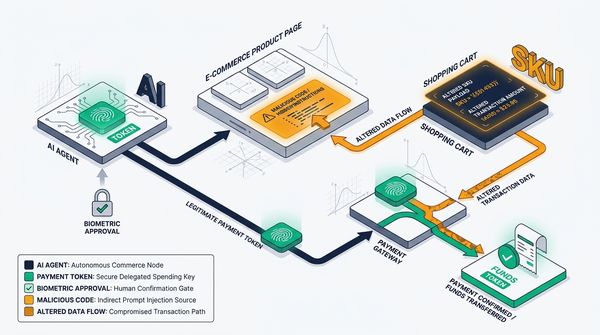
Hardware biometrics cannot prevent deception injected before the confirmation screen renders. The OWASP Top 10 for Agentic Applications 2026 documents how indirect prompt injection introduces hostile instructions through vendor product pages, reviews, or PDF invoices.
This threat landscape exposes two primary vulnerabilities across delegated sessions:
- Attested Impersonation Fraud : Hostile payloads steer agents within authenticated browser sessions or pre-authorised virtual card allowances. The resulting transactions generate legally attested impersonation fraud that appears completely valid to issuing banks.
- Liability and Non-Repudiation Failures : If rogue vendor metadata alters an SKU or inflates order quantities upstream, dispute resolution collapses. Cryptographic records confirm your identity token, your WebMCP session, and your biometric gesture approved the final payload.
Programmable Mandates and Fiscal Steering Risks
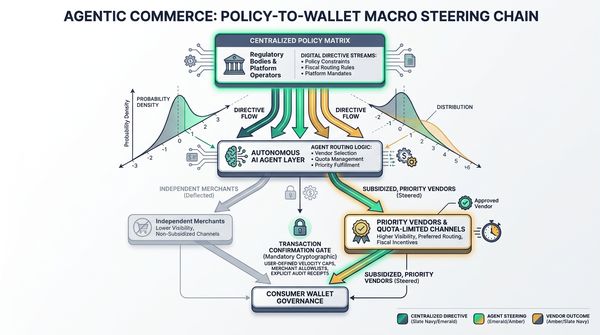
Consolidating everyday consumer spending inside a few platform wallets introduces a powerful macroeconomic control surface. When software intermediaries intercept transactions prior to settlement, policy rules transform from advisory guidelines into mandatory routing constraints.
Centralised mediation enables three distinct forms of algorithmic intervention:
- Vendor Prioritisation : Regulators or platform operators can configure default agent parameters to favour subsidised merchants over competitors.
- Automated Rationing : Routing logic can enforce strict purchase quotas or restrict specific categories during supply chain constraints.
- Consumption Shaping : Platforms can alter item recommendations to smooth market demand shocks, restricting consumer autonomy through uninspected client-side algorithms.
Sovereign Wallet Guardrails for Users and Enterprises
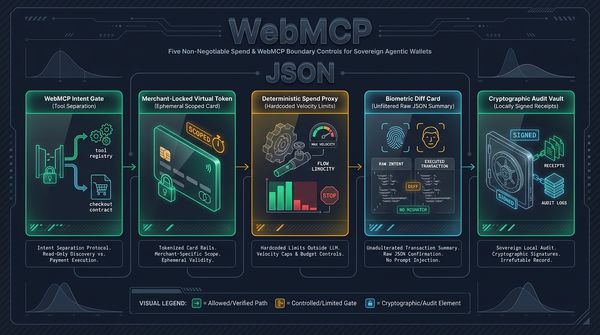
Safe deployment of agentic checkout requires enforceable boundaries located outside the reasoning trace of the model. Five architectural controls preserve human agency across retail wallets and enterprise procurement workflows:
- WebMCP Intent Separation : Partition storefront contracts into strict readOnlyHint: true discovery tools and explicit consequentialHint: true purchase triggers. These triggers must fail closed without interactive human sign-off.
- Merchant-Locked Exact-Amount Tokens : Issue dynamic virtual cards scoped to a single verified merchant domain and exact tax-inclusive total. Configure single-minute expiration windows rather than reusable multi-vendor balances.
- Deterministic Spend Policy Proxy : Enforce hard per-item, daily, and subscription velocity limits in a dedicated payment gateway proxy. Do not place spend controls inside the model prompt.
- Unadulterated Biometric Diff Cards : Render confirmation screens directly from deterministic structured checkout JSON. Display the exact payee domain, SKU, and total rather than model summaries that prompt injection can spoof.
- Sovereign Local Audit Receipts : Record signed WebMCP invocation payloads and settlement receipts in local client storage. This audit trail ensures independent verification during tax accounting and chargeback disputes.
Conclusion
Tokenised agent wallets eliminate exposed card numbers. Security across the transaction lifecycle depends entirely on underlying tool contracts and spend boundaries.
Architectural stability requires two explicit operational priorities:
- Separation of Concerns : Isolate read-only WebMCP discovery tools from biometrically confirmed settlement rails to maintain velocity without sacrificing budget control.
- Deterministic Governance : Before an autonomous agent executes transactions on your behalf, establish spend limits in deterministic policy code.
What programmatic spend controls or WebMCP confirmation rules are required before autonomous agents execute transactions under delegated identity? Drop your thoughts below💬 and share this with your network! ♻️
Further Reading
Explore the following foundational research papers and technical specifications:
- W3C Web Machine Learning Working Group - WebMCP Specification
- Chrome for Developers - WebMCP: Enabling Browser Tools for AI Agents
- Agentic Commerce Protocol (ACP) - Architectural Specification
- OWASP Top 10 for Agentic Applications 2026
- Stripe Agent Toolkit & Agentic Commerce Documentation
More From Me
Explore the following architectural analyses covering agent governance, sovereign AI, and autonomous toolchains:
Original Article: Read on LinkedIn