Optimizely Governance: Programmatic Validation for AI Agents
Introduction
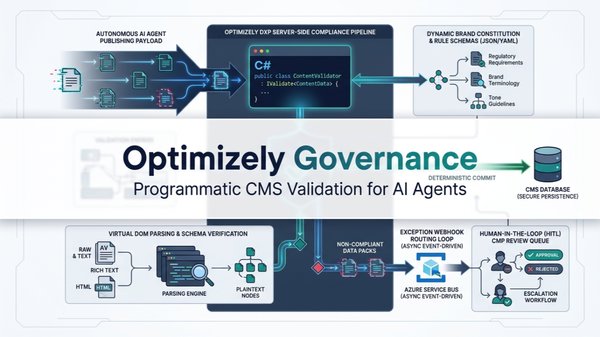
Building on the declarative specifications explored in Brand Purity: AI Guardrails for Multi-Brand Identity and the automated CI/CD gating established in Brand Purity: The Automated Brand Pipeline , autonomous publishing introduces an acute architectural challenge: the eradication of human review at runtime. While upstream linting catches repository errors, autonomous agents interfacing directly with content APIs bypass source control entirely.
Allowing autonomous generative agents to publish directly to production environments provides unprecedented operational velocity, yet uncontained generative output creates severe systemic vulnerabilities. Managing these operational risks requires addressing three core governance realities:
- Iterative Vulnerabilities : Passive PDF style manuals and loose prompt instructions cannot withstand iterative execution loops.
- Storage-Boundary Enforcement : Governance requires deterministic, machine-readable law enforced directly at the storage boundary.
- Bypassed Gatekeepers : Direct API publication bypasses traditional human verification checkpoints and repository gating.
This guide delivers the server-side architectural patterns, .NET validation interfaces, and dual-layer fail-safe routing required to convert static brand guidelines into an immutable programmatic constitution inside Optimizely DXP. Implementing these runtime boundaries transforms compliance from a probabilistic suggestion into an unyielding, high-performance gatekeeper.
The Core Fundamental Change: Decoupling Lexical and Semantic Validation
Enterprise content pipelines now deploy autonomous agent loops that monitor catalogue gaps, synthesise copy, and trigger publication workflows. Production telemetry highlights three structural vulnerabilities in unconstrained agent execution:
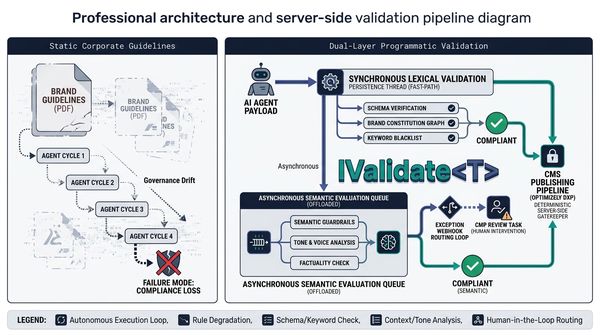
- Probabilistic Drift : Within 3–5 execution cycles, unconstrained language models exhibit drift that dilutes brand tone, violates regulatory boundaries, and corrupts brand terminology.
- Authoring Context vs. Security : Toolsets such as Optimizely Opal: Personal Skills and Agent Governance tailor authoring context effectively.
- Prompt Fragility : Relying exclusively on system prompt engineering represents a structural anti-pattern that fails to establish runtime security perimeters.
From a systems-design perspective, robust architecture requires a rigorous separation of concerns between generative nodes and validation engines. Enforcing this separation demands two distinct validation tracks:
- Synchronous Lexical Checks : Zero-overhead validation executing locally on the persistence thread to catch syntactical and string infractions immediately.
- Asynchronous Semantic Guardrails : Offloaded evaluation pipelines that inspect thematic alignment without introducing blocking I/O to the content engine.
- Thread Pool Protection : In .NET high-performance computing standards, executing synchronous network calls to external embedding models or LLM inference nodes inside a synchronous pipeline is an architectural anti-pattern that triggers cascading failures.
- State Machine Ingestion : Brand guidelines must be codified into discrete executable contracts that govern runtime ingestion across an event-driven state machine.
Optimizely CMS Pipeline Integration
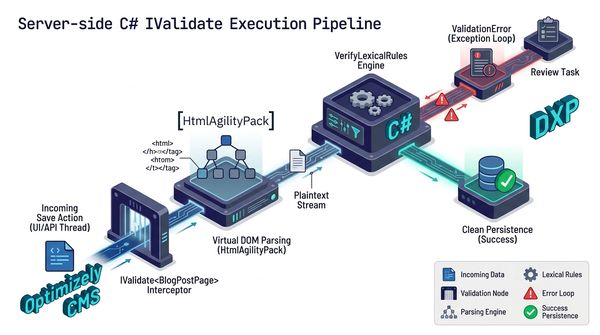
The first line of runtime defence inside Optimizely DXP is the server-side validation pipeline. By implementing the native IValidate<T> interface, publication attempts are deterministically intercepted before any commit occurs.
Because IValidate<T> executes synchronously on the UI/API thread during Save and Publish lifecycles without native async/await support, Semantic Guardrails are strictly prohibited from this interface . Hosting semantic checks directly on this thread triggers three severe architectural failures:
- Blocking Network Latency : External model calls introduce an approximate 18% inference latency directly into the synchronous execution path.
- Thread Pool Starvation : Mass-publishing agent workloads hold active threads open, rapidly exhausting the IIS thread pool.
- Delivery Tier Instability : Thread exhaustion cascades directly to the presentation layer, crashing the CMS delivery tier.
IValidate<T> must remain reserved exclusively for zero-allocation, cached lexical and syntactical rules. Processing content safely at this layer requires two architectural constraints:
- Virtual DOM Parsing : Passing raw HTML directly into string-matching scanners triggers false positives against inline CSS, accessibility tags, and valid hyperlinks.
- Isolated Plaintext Evaluation : Rich text must be parsed into an in-memory document object model to extract clean text nodes before running verification rules.
using EPiServer.Core;
using EPiServer.Validation;
using System.Collections.Generic;
using HtmlAgilityPack; // Virtual DOM parsing requirement

public class LexicalBrandComplianceValidator : IValidate<BlogPostPage>
{
    private readonly ILexicalConstitutionService _lexicalService;

    public LexicalBrandComplianceValidator(ILexicalConstitutionService lexicalService)
    {
        _lexicalService = lexicalService;
    }

    public IEnumerable<ValidationError> Validate(BlogPostPage instance)
    {
        var errors = new List<ValidationError>();
        if (instance?.MainBody == null || instance.MainBody.IsEmpty)
        {
            return errors;
        }

        // CRITICAL: Parse virtual DOM to strip HTML tags before string-matching.
        // Ensures scanners evaluate content text, not markup structure.
        var htmlDoc = new HtmlDocument();
        htmlDoc.LoadHtml(instance.MainBody.ToHtmlString());
        var plainText = htmlDoc.DocumentNode.InnerText;

        // Execute strictly synchronous, zero-allocation rules
        var result = _lexicalService.VerifyLexicalRules(plainText);
        if (!result.IsCompliant)
        {
            errors.Add(new ValidationError
            {
                ErrorMessage = $"Lexical brand constitutional infraction: {result.FailureReason}",
                Severity = ValidationErrorSeverity.Error
            });
        }
        return errors;
    }
}
Registered validators execute automatically upon invocation. Returning an error-level ValidationError halts persistence immediately, providing an instantaneous lexical barrier.
Structuring the Brand Constitution in Optimizely
A brand constitution requires a structured, machine-readable schema definition. In Optimizely, implementation relies on two complementary approaches:
- Repository-Managed Configurations : Version-controlled JSON or YAML specifications stored alongside the codebase and deployed across CI/CD stages.
- Dynamic Setting Blocks : A CMS-managed BrandConstitutionBlock resolved via IContentRepository, enabling non-engineering governance teams to update lexical bans without code deployments.
The schema classifies constraints into three discrete tiers distributed across the architecture:
- Lexical Boundaries (Synchronous) : Zero-overhead string matching that scans for prohibited terminology and competitor references, evaluated directly via IValidate<T>.
- Syntactical Rules (Synchronous) : Structural constraints enforcing ASCII straight quotes, title case standards, and UK English orthography, evaluated via IValidate<T>.
- Semantic Guardrails (Asynchronous) : Embedding evaluations that assess thematic proximity to prohibited compliance zones, offloaded directly to the orchestration layer.
To prevent performance degradation during frequent saves, resolved constitution blocks must be cached using IContentCacheKeyCreator, bypassing database lookups entirely.
Architectural Integration: Asynchronous State Machines
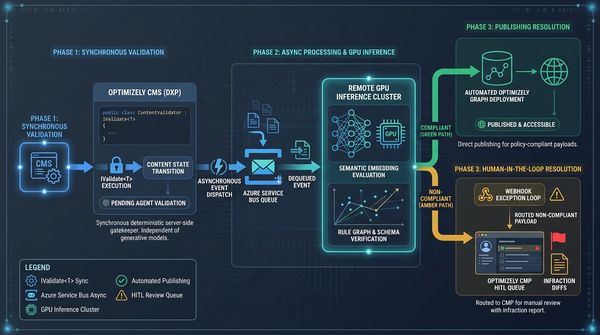
Empirical benchmarks demonstrate that API-based semantic checks severely degrade DXP response times. Enterprise autonomous publishing therefore relies on event-driven state machines operating across three sequential execution phases:
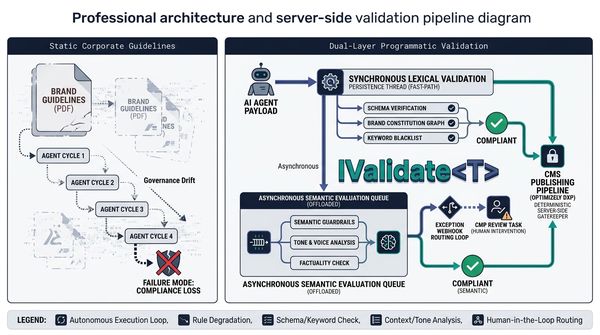
- Phase 1: Lexical Check : Clean validation inside IValidate<T> immediately persists the content into a 'Pending Agent Validation' state.
- Phase 2: Semantic Async Queue : The state transition emits an asynchronous event (via Azure Service Bus or Optimizely Webhooks) to a dedicated, off-platform GPU/Inference cluster.
- Phase 3: Resolution and Escalation : Compliant Path : The inference cluster completes the semantic check and executes a discrete API call back to the CMS, transitioning content state to 'Published' and triggering deployment to Optimizely Graph. Escalation Path : Constitutional infractions trigger an Optimizely Content Marketing Platform (CMP) webhook, dispatching payload data, infraction logs, and diff states to a Human-in-the-Loop (HITL) review queue where publication halts pending manual sign-off.
Conclusion & Strategic Advice
Deploying autonomous agents without programmatic enforcement introduces compounding compliance liabilities across the enterprise. Applying legacy synchronous monolithic patterns to distributed, asynchronous AI agents proves equally destructive.
Maintaining sovereign control over the publication graph requires executing a dual-layer architectural strategy:
- Storage-Boundary Determinism : Using Optimizely native IValidate<T> interfaces to enforce instantaneous, zero-allocation lexical checks at persistence.
- Decoupled Semantic State Machines : Routing resource-intensive semantic evaluations through asynchronous, event-driven pipelines to preserve core CMS throughput.
- Preserved Capacity to Grow : Isolating execution tiers to maintain operational stability and throughput as agent publication volumes increase.
Across this series, the overarching architectural imperative remains constant: probabilistic systems cannot be trusted to self-regulate. Establishing enterprise agentic autonomy requires two foundational guarantees:
- Deterministic Storage Enforcement : Validating payloads at the persistence boundary to eliminate runtime governance drift.
- Anti-Pattern Elimination : Distributing validation tiers correctly to prevent .NET synchronous-over-asynchronous deadlocks.
When brand guidelines become machine-readable code engineered with capacity to grow, scale ceases to be an operational risk. Audit existing publishing endpoints and implement server-side validation state intercepts before enabling agentic write access across your CMS infrastructure.
💬 How is your engineering team balancing autonomous agent velocity with runtime brand safety? Share your thoughts below. ♻️
Further Reading
- Optimizely CMS Content Validation Documentation
- OWASP Top 10 for Large Language Model Applications
- Microsoft .NET Architecture Guide: Domain Model Layer Validations
- Microsoft .NET Asynchronous Programming Anti-patterns
- Optimizely Content Marketing Platform (CMP) Overview
More From Me
- Brand Purity: AI Guardrails for Multi-Brand Identity
- Brand Purity: The Automated Brand Pipeline
- Brand Purity: Multimodal Asset Governance with LoRA, Voice Adapters, and ComfyUI
- Optimizely Opal: Personal Skills and Agent Governance
- Optimizely Opal Agents: Operational Guide to Orchestration Pipelines
- Agentic CMS: Optimizely's Roadmap Signals for 2026–27
- Securing Optimizely Graph: Prevent Secret Leakage
- Optimizely CMS Code Smells: Spotting and Fixing Technical Debt
- Optimizely CMS: How to Refactor Content Types and Properties
- OpenClaw Advantage: Governing Agents with CODEOWNERS
Original Article: Read on LinkedIn | Read on Substack