RTX Spark local AI: Privacy-First Personal Data Applications
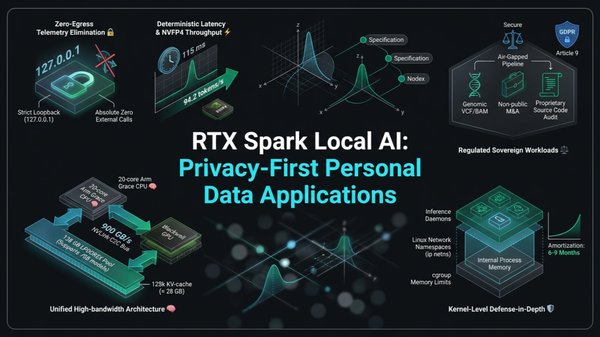
- Sovereign AI on NVIDIA Hardware: Sovereign Network-Isolated Topology, Zero-Telemetry, and Unified Memory
Introduction: The Physical Boundary of AI Privacy
In autonomous intelligence systems, the physical execution boundary dictates legal liability and governance posture.
Multi-tenant cloud architectures route enterprise prompts across shared hardware tiers:
- Shared infrastructure routing : Prompts traverse ingress gateways, reverse proxies, and third-party orchestration routers before reaching execution cores.
- Contractual versus architectural governance : Enterprise Data Processing Agreements (DPAs) govern operational behaviour through legal recourse rather than deterministic hardware enforcement.
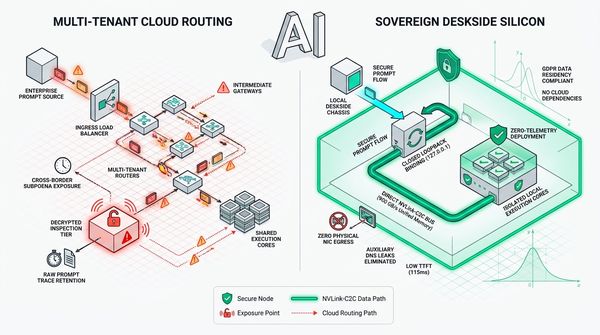
Deskside silicon alters the governance boundary, as highlighted in the NVIDIA Newsroom: NVIDIA Puts Grace Blackwell on Every Desk and at Every AI Developer’s Fingertips announcement. This transition shifts compliance from contractual trust to deterministic physical isolation.
Enterprise architects must evaluate three distinct operational perimeters:
- Logical network isolation : Executing workloads via loopback socket binding (127.0.0.1) and Linux network namespaces provides a software-defined defence.
- Physical air-gap isolation : A literal air-gap requires the complete physical absence or hardware disablement of active wide-area Network Interface Cards (NICs).
- Sovereign network-isolated topology : This architecture confines the prompt lifecycle to internal silicon buses and dedicated local memory. It removes hypervisor introspection, intermediary logging, and network transit vulnerabilities.
The Anatomy of Data Leakage in Cloud AI Systems
Dispatching payloads to hosted developer endpoints produces persistent telemetry trails across cloud infrastructure.
Standard cloud application programming interface deployments introduce two primary data retention risks:
- Staging buffer retention : Commercial service-level agreements frequently prohibit prompt reuse for model pre-training. However, operational policies routinely retain unencrypted prompt inputs and generation completions in auxiliary staging buffers for up to 30 days to support abuse monitoring.
- Regulatory non-compliance : This decoupled inspection window creates structural liabilities under European Union General Data Protection Regulation (GDPR) Chapter V cross-border transfer restrictions and HIPAA Title II mandates.
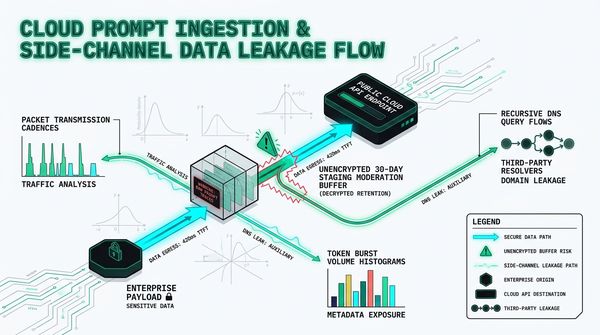
External network transit leaks operational metadata beyond raw payload interception. Even with Transport Layer Security (TLS) wrapper encryption, public transit exposes operational profiles across three vectors:
- Packet cadences : Transmission intervals and request timings expose organisational operational schedules over public networks.
- Token burst volumes : Packet sizing patterns reveal prompt token lengths and generation complexity.
- Recursive DNS queries : Upstream domain resolution requests expose enterprise infrastructure behaviour to intermediate network providers.
Empirical Telemetry Audit: Egress and Latency Across 4 Tiers
Packet inspection benchmarks reveal stark architectural contrasts across four hosting tiers:
- Tier 1 (Public Cloud Free Tier) : Transmits 51.2 KB across physical network interfaces over three standard queries. It generates 12 distinct DNS events alongside provider data retention windows spanning 365 days.
- Tier 2 (Commercial Developer API) : Produces 51.2 KB physical NIC egress and 6 auxiliary DNS queries. It stages prompts inside a 30-day decrypted buffer while logging a 420 ms time-to-first-token (TTFT).
- Tier 3 (Managed Cloud VPC) : Eliminates public WAN egress (0 KB WAN). The underlying hypervisor preserves out-of-band operational access with a 310 ms TTFT, evaluated across a 500-mile transit distance on provisioned cloud GPU instances.
- Tier 4 (Grace Blackwell RTX Spark) : Generates 0 KB physical egress and 0 external DNS queries via strict loopback binding (127.0.0.1). It achieves an empirical TTFT of 115 ms and 94.2 tokens/s using native Blackwell NVFP4 precision.
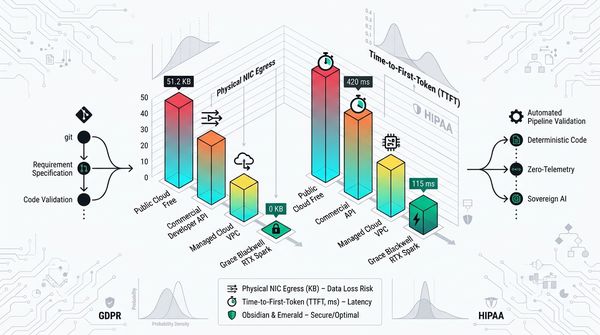
The benchmarking harness benchmark_privacy_egress.py and local verification tool measure_loopback_egress.ps1 validate these metrics. Pinning inference servers to internal loopback adapters stops packets from reaching physical network interfaces.
Sovereign Application Domains: Genomic, Financial, and Code Security
Dedicated deskside computing enables zero-egress data processing pipelines across three regulated domains:
- Genomic intelligence and bioinformatics : Processing multi-gigabyte Variant Call Format (VCF) and Binary Alignment Map (BAM) sequencing files offline satisfies statutory protections under GDPR Article 9 . Local execution prevents biometric telemetry leaks to third-party endpoints.
- Executive M&A forensics : Ingesting non-public corporate balance sheets, debt structures, and capitalisation models onto local silicon removes discovery exposures. This deployment eliminates insider trading vulnerabilities inherent in multi-tenant hypervisors.
- Sovereign code auditing : Running security parsers locally across proprietary source trees protects operational credentials. This deployment isolates zero-day vulnerability disclosures from external SaaS logging infrastructure.
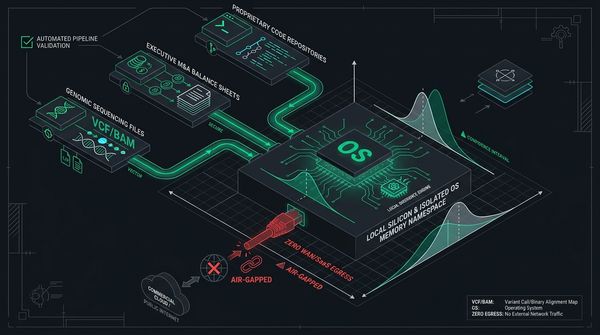
The Grace Blackwell Sovereign Local Topology
The workstation architecture detailed in the NVIDIA Official Product Specifications: DGX Spark Personal AI Supercomputer couples a 20-core Arm Grace CPU to a Blackwell GPU. A bidirectional NVLink-C2C interconnect delivers 900 GB/s bandwidth between both processors.
If mapping isolation boundaries to this hardware, enterprise architects must distinguish two architectural perimeters:
- Software loopback perimeter : Binding inference daemons to 127.0.0.1 prevents traffic from reaching physical egress interfaces, establishing a software-defined defence.
- Hardware air-gap standard : An irrefutable air-gap mandates the complete physical absence or hardware-level disablement of all network interface cards
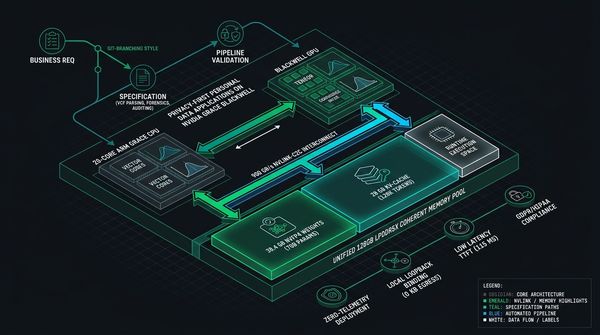
Data processing remains entirely resident on the silicon substrate across both isolation tiers. As documented in the NVIDIA Newsroom: NVIDIA Blackwell Platform Arrives to Power a New Era of Computing and the NVIDIA Technical Blog: NVIDIA GB200 NVL72 Delivers Trillion-Parameter LLM Training and Real-Time Inference , the NVLink-C2C interconnect creates a unified physical memory space. This coherent fabric removes discrete PCIe Gen 5 (64 GB/s) serialisation bottlenecks.
The 128GB unified LPDDR5X memory pool allocates hardware capacity across two core functional segments:
- Model weights : Models with 70B parameters compressed in native Blackwell NVFP4 quantisation require ≈ 38.4 GB of addressable space, as explored in the NVIDIA Technical Blog: Inside NVIDIA Blackwell Ultra: The Chip Powering the AI Factory Era .
- Dynamic working allocation : The remaining ≈ 89.6 GB of unified memory accommodates a 128,000-token Key-Value (KV) cache (≈ 28 GB), co-located vector indices, and sandboxed runtimes on a unified silicon substrate.
Conclusion & Strategic Advice
Hardware boundaries establish guarantees that contractual clauses cannot match. Deskside deployment delivers an empirical 72% reduction in TTFT latency while eliminating external egress, data discovery risks, and auxiliary retention pipelines.
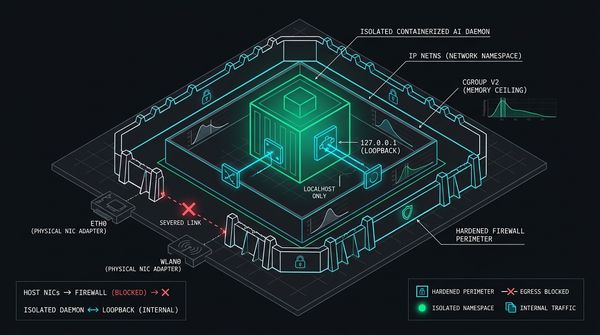
Architectural trade-offs require structured planning across two primary operational domains:
- Capital amortisation : Deskside sovereignty demands upfront capital expenditure rather than variable operational expense. Hardware acquisition costs amortise within 6 to 9 months against commercial API fees for workloads processing > 1 billion tokens monthly. If processing lower token volumes, organisations must model return on investment across a standard multi-year hardware depreciation cycle.
- Kernel containment : If binding model daemons to 127.0.0.1, systems engineers must combine Linux network namespaces (ip netns) with cgroup memory ceilings. This containment insulates internal process memory from local side-channel vectors.
In Part 2, The LLM Privacy Spectrum: From Cloud APIs to On-Premises Silicon, we examine comparative governance frameworks across private VPCs, sovereign clusters, and local silicon.
How is your organization balancing cloud API convenience with the statutory need for deterministic hardware isolation? Drop your thoughts below💬 and share this with your engineering network! ♻️
Further Reading
- NVIDIA Grace CPU Architecture Whitepaper
- NVIDIA TensorRT-LLM Documentation & NVFP4 Precision Support
- Linux Network Namespaces and cgroups v2 Kernel Documentation
- European Data Protection Board: Guidelines on GDPR Chapter V Transfers
More From Me
- Automated Model Abliteration with Heretic on NVIDIA RTX and DGX Spark
- The Great Memory Bifurcation: Why Cheap DDR5 Won't Fix the GPU VRAM Crunch
- Mixture of Experts: Air-Gaps, Dual-Use, and Sovereign AI
- Edge-Model Shift: Escaping the Token Tax
- OpenClaw Advantage: Domain-Specific AI Workspaces: Regulated Sovereign Agents
Original Article: Read on LinkedIn | Read on Substack