Aether Pine: Authoring a Children's Books with a Software IDE
- Part 1 of 4 - Cinnamon Hollows
Introduction
Writing a cohesive, deeply detailed book usually relies on a mountain of sketchpads and messy, unstructured brainstorming. But if you've ever tried using Large Language Models (LLMs) for long-form creative writing, you know they have a massive limitation: without strict boundaries, generative text quickly suffers from narrative drift (losing the plot) and structural collapse over long chat histories.
To solve this for my children's book series, Cinnamon Hollows (Aether Pine Book 1), I shifted away from crossing my fingers with massive, open-ended prompts. Instead, I started treating the manuscript like software—using structured YAML configurations, state-aware pipelines, and cryptographic Git signatures to turn unpredictable AI text into a disciplined, automated assembly line.
To combine human creativity with engineering guardrails, we need to bring together three specific things:
- An Orchestration Engine : Using the LangGraph framework to manage a network of specialised AI agents.
- Automated Guardrails : Implementing code-style prose linters and version-control ledgers to enforce quality and formatting automatically.
- A Clear Paper Trail : Building a verifiable record that proves human authorship and protects your creative intellectual property. (Note: I cover the exact legal mechanics in part 3 of this LinkedIn series of articles, which I've applied to my Aether Pine stories)
Breaking Down the "God Prompt"
The standard approach to AI workflows is to dump a massive, unstructured prompt into a chatbot and hope for the best. The result? Generic clichés, weird pacing, and a story that falls apart after a few chapters—challenges I wrote about in Beyond 'Vibe Coding': Kiro Brings Discipline to AI Development . Relying entirely on "vibes" without solid metrics often leads to a classic case of overconfidence masking poor quality, as described by Dunning-Kruger or when confidence equals incompetence .
To build a reliable storytelling pipeline, I look at the process through three simple rules:
- Treat Outlines Like Source Code : Treat your world-building files and narrative outlines as your ultimate source of truth.
- Use Models as Specialised Workers : Don't ask one model to do everything. Use language models purely as tightly constrained nodes tasked with one job at a time.
- Keep the Focus Narrow : Lock down the story's boundaries programmatically—the exact strategy I used to keep the narrative tight in The Cinnamon Hollows - Short Stories: Warmth of Sharing (Aether Pine Book 1) .
Managing the Story with LangGraph
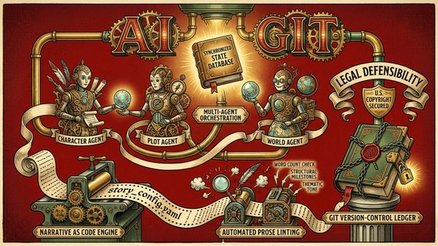
Scaling this approach requires a smart way to handle state management (keeping track of your story data as it grows and changes). The LangGraph Orchestration Framework is perfect for this, letting you distribute distinct creative tasks across three specialised agent nodes:
- The Character Agent : Focuses entirely on character psychology and dialogue registers.
- The Plot Agent : Tracks pacing, tension arcs, and page-by-page beats.
- The World Agent : Keeps the lore consistent and prevents the model from hallucinating made-up facts.
These nodes communicate through a synchronised state database, drawing their rules from a central story_config.yaml file. By running a quick propagation command, you sync the rules across the entire project, unlocking the kind of flexible scaffolding I explored in Bridging the Gap: Programming Tools for All :
- Instant Synchronisation : Running python -m src.cli.main propagate pushes configuration updates to every downstream agent simultaneously.
- The Trade-Off : Breaking the work into smaller pieces means more network roundtrips and slightly higher API costs, but the structural payoff is massive.
- Rock-Solid Stability : Leaning into LangGraph's architecture keeps the entire narrative structure incredibly stable over thousands of words.
Prose Linting: Catching Flaws Automatically
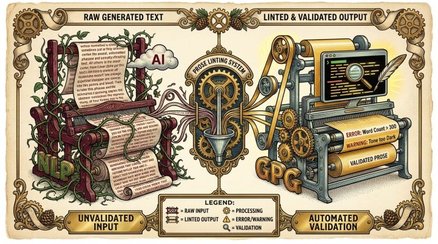
Once the text is generated, it goes through a double-check validation system split between Static Analysis (checking mechanical formatting rules) and Heuristic Evaluation (grading quality based on style guidelines). Instead of reading every line manually to catch basic mistakes, automated prose linters do the heavy lifting.
Running python -m src.cli.main lint "novel/novel.md" --config "story_config.yaml" runs three immediate checks:
- Word Counts : Ensures a strict density of 250–300 words per page—perfect for early middle-grade readers.
- Plot Consistency : Checks the text against plot_points.yaml to ensure no major story beats were accidentally skipped.
- Tone Testing : Uses targeted AI personas to scan the text's reading level and flags any moments where the tone gets too dark or complex.
By offloading these mechanical checks to an automated pipeline, editing becomes incredibly fast. The system blends fast, rule-based linting with smarter, fluid grading to polish the prose seamlessly.
Proving Ownership: Git Logs as Creative Trails
Protecting a co-authored work requires clear proof of your creative process. According to the US Copyright Office AI Registration Guidelines , copyright strictly requires human authorship—meaning completely raw, unedited AI text can't be copyrighted.
However, the landmark ruling on Kristina Kashtanova's Zarya of the Dawn confirmed that you can protect how a human selects, arranges, and coordinates those elements. To protect the story of Aether Pine , I am actively using standard development tools to create a verifiable, cryptographically signed chain of custody. This proves exactly where the agents' unprotectable rough generation ends and my direct, line-by-line manual editing passes take over:
- Track Everything : Keep your story files in a Git repository to save every single iteration and prompt change.
- Export the Trail : Run git log --pretty=format:"%h [%G?] %GK - %an, %ar, %ae : %s" -n 20 -- "novel/" > authorship.log to generate a clean terminal record of your work.
- Sign Your Work : Use GPG keys to add a secure, timestamped digital signature to your history, creating a bulletproof record of your design choices.
While the law still requires you to be upfront about using AI tools, a cryptographically signed commit log gives you an invaluable, proactive defence of your creative effort:
- Be Transparent : You still need to disclose AI assistance, but my current logs for this book prove exactly where my human curation and manual rewrites took the wheel.
- An Evolving Strategy : Using version control as legal evidence is a fresh approach, but it is quickly becoming a tech-forward baseline.
- Your Defensive Anchor : A clean, signed ledger provides clear, unarguable documentation of your creative journey.
Conclusion & Next Steps
By combining smart orchestration with code-style validation, we can completely reinvent how we create content. Multi-agent systems keep your story on track, while automated linters and digital ledgers protect your quality and your rights.
Treating a manuscript like source code doesn't replace imagination—it protects it, taking the tedious procedural work off your plate so you can focus entirely on human taste and vision.
If you're looking to smooth out your own creation pipelines, start with these three steps:
- Centralise Your Rules : Use a single configuration file to manage your world's boundaries.
- Automate the Basics : Swap slow, manual grammar and formatting reviews for automated prose linters.
- Secure Your History : Set up a clean version-control system to track, prove, and protect your intellectual property.
Part 2, Closed-Loop VLM Feedback for Visual Consistency, details how to deploy Vision-Language Models in automated feedback loops to eliminate character mutation, asset drift, and style shifts across generated illustrations.
💬 Do you believe multi-agent workflows and code-driven tools are the future of creative writing? Drop your insights below and ♻️ share this post with your network!
Further Reading
- Copyright and Artificial Intelligence - U.S. Copyright Office
- Vale Documentation: Syntax-Aware Prose Linting
- LangGraph Documentation: Stateful Multi-Agent Frameworks
More From Me
Original Article: Read on LinkedIn | Read on Substack