Aether-Pine: Closed-Loop VLM Feedback for Visual Consistency
- Part 2 of 4 - Snowflake Planes
Introduction
👈 In Part 1, Authoring a Children's Book with a Software IDE, we explored treating manuscripts like software architecture using LangGraph orchestration and automated linters to eliminate narrative drift. Now, we turn to visual consistency.
Building on those foundational concepts, ensuring a narrative flows well structurally is only half the equation. Bringing a story to life visually presents an entirely different set of technical hurdles.
While working on the illustrated project The Snowflake Plane: Unraveling Seams (Aether Pine Book 2) , standard diffusion models demonstrated a pervasive lack of spatial memory. The models exhibit three distinct types of structural drift across sequential pages:
- Facial Integrity : Characters spontaneously mutate distinct facial features.
- Asset Variation : Signature attire and clothing elements change unexpectedly.
- Environmental Shift : Background environments drift uncontrollably between scenes.
Generative AI alone cannot produce the predictable, repeatable visual assets required for high-fidelity publishing. Creating a cohesive visual narrative demands a programmatic approach that maps conceptual descriptions to precise spatial realities.
This guide details how to engineer an automated, self-correcting generation loop using Vision-Language Models (VLMs) . Mapping these models to strict spatial conditioning enables predictable and infinite visual continuity across an entire project.
Note on Technical Terminology: Orchestrating closed-loop systems requires specialised concepts in machine learning, computer vision, and data pipelines. A Technical Glossary & Reference Links section at the end provides foundational research papers and documentation supporting these architectures.
1. The Generative Visual Inconsistency Problem
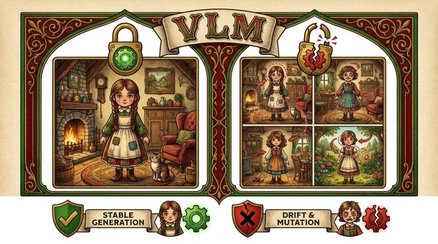
Generative diffusion models lack an internal spatial representation and temporal memory. The architecture forces the models to render each image as an isolated event, disconnected from preceding outputs.
In practical applications that require long-form illustration, this fundamental architecture imposes core visual limitations. This systemic issue is explored comprehensively in Choosing AI Image Models: Essential Factors in Comic Creation .
Resolving spatial errors requires managing the reality of prompt entanglement . Because standard diffusion models process text prompts holistically, any semantic modification triggers two adverse reactions:
- Latent Space Rerolling : Altering a text prompt forces a total recalibration of the foundational noise trajectory.
- Asset Mutation : Attempting to fix one spatial error inadvertently destroys previously acceptable backgrounds, clothing, and lighting.
Raw models require systematic, code-enforced spatial constraints to bound the generation space. Without these explicit structures, the system cannot maintain structural integrity over time.
2. Vision-Language Models (VLM) as Automated Art Directors

Traditional visual consistency pipelines rely heavily on manual post-processing and strict mathematical seed parameters. These static methods severely restrict creative flexibility and break down when handling dynamic cinematic posing.
Modern rendering pipelines bypass static limitations by deploying high-reasoning Vision-Language Models (VLMs) as automated art directors. Integrating the multimodal analysis engines of platforms like Google DeepMind Gemini Technologies enables detailed programmatic visual audits.
Passing raw generated image outputs and strict configuration criteria to the VLM triggers two specific evaluation protocols:
- Geometry Audits : The system evaluates complex spatial arrangements and camera depth against structural rules.
- Detail Verification : The engine cross-references intricate character details with predefined master models.
Advanced multimodal architectures export precise spatial context data required for automated image alignment. The model's output structural bounding boxes and localised segmentation masks to bridge VLM logic and the diffusion model.
Executing precise image alignment requires Spatial Conditioning via established structural bridges. Industry research in Vision-Language Model for Object Detection and Segmentation: A Review and Evaluation documents three primary integration methods:
- Structural Control : Utilising ControlNet to enforce strict pose and edge mapping.
- Visual Prompting : Deploying IP-Adapters to inject direct reference imagery into the pipeline.
- Targeted Modification : Applying localised inpainting masks for precise regional corrections.
3. Designing Closed-Loop Feedback and Dynamic Self-Correction
Standard text-to-image prompt engineering lacks the detailed coordinate vocabulary necessary to guarantee exact physical layout accuracy. This technical limitation is discussed extensively in Overcoming AI Image Limits: Experience for Comic Creator .
Relying on semantic text alone to drive a dynamic self-correction loop creates a fatal structural vulnerability. Commanding a model to turn a character's head via text forces a total reroll of clothing and background, burning API credits in a non-converging loop.
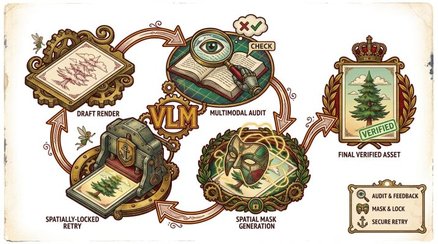
Wrapping generation APIs within robust, spatially-anchored verification structures forces the system to converge successfully. Executing a rendering command triggers an automated four-step cycle:
- Draft Generation : The system builds an initial image draft using established character models and scene profiles.
- Multimodal Auditing : The VLM parses the draft image to evaluate pose, scale, and thematic compliance against storyboard criteria.
- Mask Creation : The VLM generates a localised spatial mask over any non-compliant region and pairs it with an OpenPose skeleton or targeted inpainting prompt.
- Automated Retries : The pipeline injects these spatial constraints to trigger a localised regeneration, preventing prompt entanglement until visual compliance is met.
Operating high-frequency multimodal loops requires strict management of computing resources, API costs, and rate limits. Resolving drastic background-to-foreground scale differences requires a layered digital architecture mirroring the historical cinematic Multiplane Camera :
- Differential Masking : The system renders complex foreground elements entirely independent of the background plates.
- Composite Assembly : The pipeline merges the independent layers to preserve absolute spatial integrity across varying depths.
4. Programmatic Prompt-Bridges and Temporal Continuity
Ensuring each frame is anatomically accurate is just the initial step in visual composition. To sustain atmospheric lighting, consistent colour palettes, and seamless motion throughout a project, strict temporal continuity must be maintained.
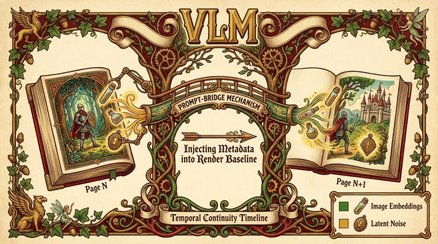
Engineering pipelines implement a Prompt-Bridge mechanism powered by visual latent caching and cross-frame attention . When the render for page $N$ compiles successfully, the software executes two extraction protocols:
- Visual Extraction : The system isolates lighting shifts, character orientation, and environmental time of day.
- Data Compilation : The pipeline packages this isolated data into a discrete metadata object.
The metadata object explicitly injects image embeddings or latent noise maps directly into the render baseline for page $N+1$. Carrying these latent embeddings forward guides the diffusion process at the mathematical level, eliminating jarring style shifts between sequential outputs.
Conclusion & Strategic Advice
Achieving reliable visual consistency requires robust systems engineering to override default generative behaviours. Pairing generative image models with the high-level reasoning of VLMs in a recursive feedback loop constrains the unpredictable nature of diffusion engines.
Integrating spatially-locked, closed-loop correction mechanisms with latent Prompt-Bridges provides a stable framework for orchestrating professional-grade media. From an architectural perspective, production environments require strict calibration of VLM audits to available API budgets and compute capabilities.
From a systems-design perspective, maintaining an auditable, systems-level approach to human-led visual direction strengthens intellectual property defensibility. The necessity of this explicit human orchestration is evident in legal precedents such as Zarya of the Dawn - Wikipedia .
Part 3, The Author's Shield - Legal Protections for Gen AI, details how to deploy publishing kits and cryptographic code signatures to navigate copyright and protect human-led creativity.
💬 How are you managing visual consistency in your AI-assisted creative workflows? Drop your thoughts below and ♻️ share this post with your network!
Further Reading
Expand your technical understanding of multimodal pipelines through these three research papers:
- Exploring the Frontier of Vision-Language Models: A Survey of Current Methodologies and Future Directions
- Vision-Language-Vision Auto-Encoder: Scalable Knowledge Distillation from Diffusion Models
- Object Detection with Multimodal Large Vision-Language Models: An In-depth Review
More From Me
Review these eight practical engineering guides for additional strategies in AI-assisted creative workflows:
- The Indie Creator's 2026 Survival Guide: My Comic Creator Blueprint
- Sovereign Vision: Mastering Taste and Synthetic Orchestration in AI
- Sovereign Vision: Practical Guide to Tailored Generative AI
- From Gamebooks to Generative Worlds: The LLM Storytelling Revolution
Glossary
Here is the updated glossary compiled into a clean, single-level bulleted list. You can drop this straight into your post as a technical addendum:
- Prompt Entanglement: A limitation in text-to-image models where words in a text prompt cross-contaminate. Changing a single detail (such as a character's shoes) forces a complete recalibration of the model's noise trajectory, inadvertently mutating unrelated elements like facial features or backgrounds. Reference: Mind the Gap: On the Confounding Effects of Prompts in Text-to-Image Diffusion Models (arXiv) .
- Prompt-Bridges: An engineering pipeline pattern that programmatically extracts visual state metadata (lighting values, character orientation, environmental maps) from a successfully generated frame and injects it into the initialisation layer of the next frame's generation cycle to guarantee stylistic continuity. Reference: StoryDiffusion: Consistent Self-Attention for Long-Range Image and Video Generation (arXiv) .
- Latent Space Rerolling: Altering text inputs or seed parameters to force a complete recalculation of mathematical vectors within a model's high-dimensional space ("latent space"), which completely rewrites the structural and compositional foundation of the output image. Reference: Hugging Face Stable Diffusion Mechanics Documentation .
- Spatial Conditioning / Constraints: The practice of feeding explicit geometric, structural, or coordinate-based guidelines into an image model to strictly dictate layout, composition, and anatomy, bypassing the unpredictability of pure text descriptions. Reference: Layout-Guided Text-to-Image Generation (Papers with Code) .
- Geometry Audits: Automated processing tasks executed by Vision-Language Models (VLMs) to visually calculate depth maps, camera perspectives, and spatial arrangements against a rigid layout template to catch structural errors. Reference: An Evaluation of Vision-Language Models for Spatial Reasoning (arXiv) .
- Detail Verification: Automated fine-grained image evaluations where a VLM audits localised patches of a newly generated image against predefined master reference sheets to flag character mutations or structural drift. Reference: VLM-based Visual Fine-Grained Evaluation and Verification (arXiv) .
- Differential Masking: A graphics pipeline process that isolates an image into separate multi-plane layers (e.g., decoupling dynamic foreground characters from static environmental backdrops) so they can be regenerated or modified without bleeding into neighbouring assets. Reference: Segment Anything Project by Meta AI .
- Composite Assembly: The final algorithmic step of an image rendering loop, where independent, layer-isolated elements are mathematically stitched back together into a single, cohesive frame. Reference: OpenCV Image Compositing and Pyramidal Blending .
- Metadata Object: A structured, machine-readable data format (such as JSON or YAML) used to compile, carry, and inject the exact prompt embeddings, noise maps, and spatial coordinates required to replicate a consistent visual style across multiple generations. Reference: W3C Metadata Activity Standards .
Original Article: Read on LinkedIn | Read on Substack