AI Impacts: Marshalling Creativity in the AI Era
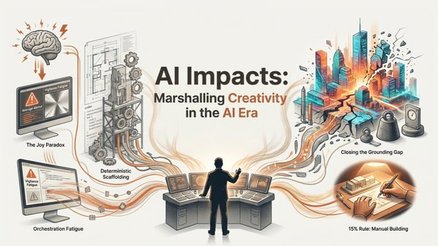
- Part 5 of 8: Creator to Director
Context and Core Lexicon
Building on the role limits established in Too Many Hats, transition frameworks assume the organisation's tolerance for systemic auditing delays, which historically conflict with aggressive corporate delivery timelines. Framing architectural rigour through the economics of software quality addresses this timeline conflict directly via three principles:
- Key Point/Concept : Directing agents temporarily alienates practitioners who derive cognitive clarity from manual execution.
- Technical Detail : Orchestrating specialised AI shifts operational mandates from granular tasks to systemic planning.
- Action/Result : Mastering terms like Vigilance Fatigue , The Joy Paradox , The Taste Gap , Grounding Gap Validation , Auteur Taste AI , Orchestration Fatigue , Programmatic Evaluations , and Cognitive Residue guarantees precision in high-volume synthetic outputs.
Introduction: The Marshaller's Manifesto
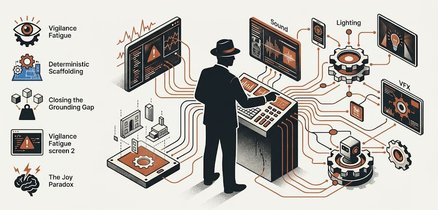
Building on the concepts explored in Too Many Hats, the psychological shift triggered by adopting generative AI alters the professional locus of control. The daily mandate moves from executing isolated tasks to orchestrating a decentralised infrastructure of specialised autonomous agents .
The transition to an AI-augmented workflow necessitates a conceptual overhaul that treats AI as a decentralised suite of execution nodes. Knowledge work utilising generative systems requires a pivot into a "Marshaller" role, focusing on three structural components:
- Key Point/Concept : The director's operational capital is measured by systemic judgement, technical architecture, and pre-generation constraint modelling.
- Technical Detail : Knowledge work utilising generative systems demands deterministic constraints to govern the creative pipeline.
- Action/Result : Auteur Directors build deterministic rails upfront, maintaining complete creative control while delegating secondary operations to algorithmic execution nodes.
1. The Joy Paradox and Cognitive Residues
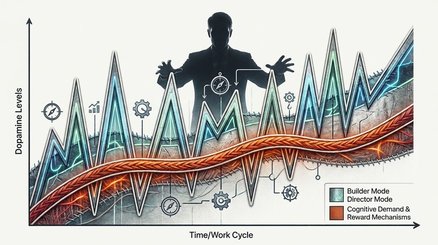
Traditional hands-on methodologies offer rapid micro-dopamine rewards upon clearing a compilation error or resolving a keyframe sequence. Shifting to an executive mode replaces these loops with a demand for continuous structural evaluation, creating the "Joy Paradox."
Practitioners scale their synthetic output exponentially, yet end the day drained due to two distinct physiological mechanisms:
- Key Point/Concept : Cognitive science literature on cognitive residues of similarity ( arXiv:1308.2240v1 ) highlights that evaluating synthetic output against an internal conceptual standard actively inhibits subsequent visual processing.
- Technical Detail : Empirical studies on software engineers ( arXiv:1805.05504v1 ) demonstrate that context switching between prompting agents and reviewing outputs disrupts cognition to a degree comparable to random external interruptions.
- Action/Result : Labour shifts into high-stakes quality control, tying reward mechanisms to the cognitively corrosive endurance of continuous synthesis.
2. The Mental Burden of Orchestration Fatigue
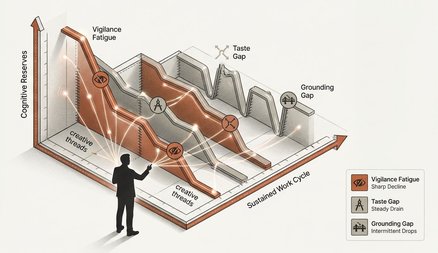
Managing algorithmic agents entails distinct mental costs that distinguish single-turn LLM interactions from multi-agent autonomous swarms. Evaluating algorithmic outputs trained on internet averages severely drains cognitive reserves.
Treating AI solely as a single-turn generator masks the true operational complexity found at the cutting edge. Systemic orchestration introduces three critical friction points:
- Key Point/Concept : Vigilance Fatigue accelerates burnout through continuous error monitoring, as confirmed by psychological data on task-switching from the National Center for Biotechnology Information (NCBI) .
- Technical Detail : Swarm management shifts the focus from basic auditing to architectural planning via state machines , reward functions , and automated evaluations.
- Technical Detail : The Grounding Gap introduces simulation bias, in which visually beautiful simulations collapse under real-world parameters, supported by data from the Stanford HAI AI Index Report .
- Action/Result : Directors must code the sandbox's boundaries to close the Taste Gap and prevent autonomous agents from defaulting to average, non-compliant outputs.
3. Reclaiming the Director's Chair
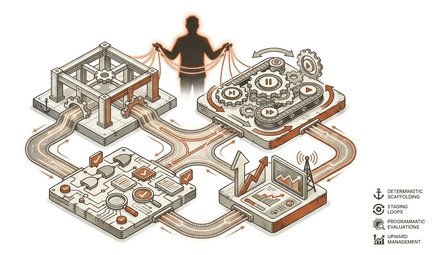
Professionals must upgrade from manual QA auditors to systems architects to maintain high-volume production without burnout. Systemic engineering solves the limitations of human endurance through six operational protocols:
- Key Point/Concept : Encode an uncompromising internal quality bar into deterministic scaffolding using programmatic evaluations and unit tests for logic and aesthetic constraints.
- Technical Detail : Establish pipelines to test assets under simulated, real-world stress parameters to close the Grounding Gap.
- Key Point/Concept : Deploy deterministic state machines to run swarms independently, enabling batched evaluation of final structured outputs.
- Technical Detail : Research from the University of California, Irvine (UCI) demonstrates the necessity of isolated, high-focus review cycles for evaluating these batched outputs.
- Key Point/Concept : Apply software quality economics and DORA metrics to prove mathematically that the ROI of batched evaluation outweighs raw velocity and live remediation costs.
- Action/Result : Preserve exactly 10-15% of working cycles for pure manual building to keep raw instincts sharp and maintain the deep, tactile domain knowledge required to write automated constraints.
Conclusion and Strategic Advice
To move from tactical execution to systemic orchestration requires replacing behavioural endurance with deterministic infrastructure. The integration of high-volume synthetic generation and meticulous oversight functions is efficient when the orchestrator builds the rails to direct the output.
Strategic implementation demands categorising workloads through three distinct operational matrices:
- Key Point/Concept : Deploy AI swarms using defined state machines and programmatic evaluations, mandating batched review cycles to prevent context-switching burnout.
- Technical Detail : Enforce rigorous real-world stress parameters for Core Logic & Aesthetic Staging, applying software quality economics to justify the staging loops required to close the Grounding Gap.
- Action/Result : Allocate exactly 10-15% of cycles exclusively to non-assisted building to preserve the tactile acuity that informs architectural taste.
Deterministic human engineering guarantees excellence at scale while preventing simulation bias. To examine the dangers of synthetic intuition, continue this series in AI Impacts: The Illusion of AI Competence, focusing on building systems that amplify vision.
💬 Are you experiencing the "Joy Paradox" in your daily AI workflows? How are you balancing systemic orchestration with hands-on creativity? Share your experiences below and ♻️ share this post with your network!
Further Reading
- Cognitive Amplification vs Cognitive Delegation in Human-AI Systems
- Navigating the State of Cognitive Flow: Context-Aware AI Interventions
- Cognitive residues of similarity
- Two Sides of the Same Coin: Software Developers' Perceptions of Task Switching and Task Interruption
More From Me
Original Article: Read on LinkedIn | Read on Substack