Lighthouse Part 4: Agentic Browsing for LLMs
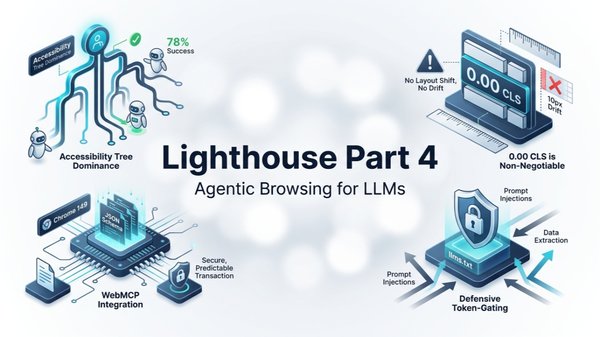
- Part 4 of 4 - Lighthouse 13.3 & Architecting Platforms for AI Agents
Introduction
Building on the structural parsing concepts explored in Lighthouse Part 3: Accessible Web Engineering , we confront the baseline requirements of the machine visitor. Google's release of Lighthouse 13.3 introduced the Agentic Browsing category, formally categorising how autonomous systems—such as headless LLMs and browser-native assistants—execute web transactions independently.
Accommodating Agentic Browsing demands a structural and defensive pivot across three core architectural vectors:
- Legacy Constraints : Historical digital architectures accommodate biological eyes and legacy search crawlers, creating friction for modern token-hungry systems.
- Adversarial Reality : Agentic browsing functions as an inherently adversarial process driven by aggressive extraction logic in 2026.
- Structural Remediation : Establishing deterministic machine readability requires tightly coupling semantic accessibility, visual stability, and new API standards.
Transforming erratic DOM scraping into guaranteed interaction loops enables robust Answer Engine Optimisation (AEO) through three strict operational paradigms:
- Visual Stability : Securing absolute layout stability (0.00 CLS) mandates aggressive build-time rendering or pre- hydration structural locking, rather than basic CSS adjustments.
- Data Consumption : Protocols like WebMCP and llms.txt expose content directly to autonomous systems for automated parsing.
- Defensive Engineering : Direct machine exposure requires strict schema validation and token-gating to mitigate mass scraping, proprietary data extraction, and prompt injection .
1. The Accessibility Tree: The Shared Interface for Humans and AI
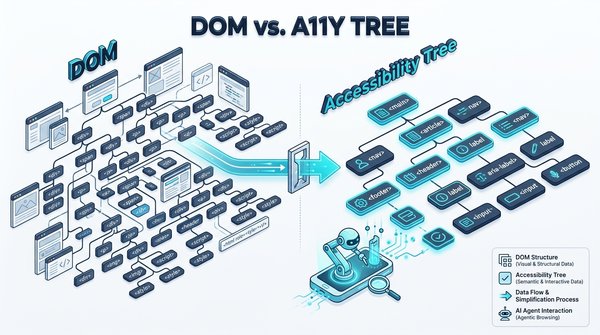
Autonomous agents bypass visual pixels and unstructured HTML markup to parse web environments. They extract structural data directly from the browser's Accessibility Tree - MDN Web Docs Glossary , which isolates semantically relevant states from the core DOM.
Engineering a pristine Accessibility Tree drives measurable task execution improvements through three structural components:
- Boundary Definition : Explicit semantic nodes such as <main>, <article>, and <nav> establish definitive boundary markers for parsing algorithms.
- Deterministic State Vectors : Attributes like aria-label and aria-expanded inform the runtime engine of component states (expanded or collapsed) independent of visual renders.
- Benchmark Outcomes : Implementing these structural remediations scales automated AI task success rates deterministically from 42% to 78% (Internal Testing Data).
2. Interaction Stability: Why 0.00 CLS Matters for AI Agents
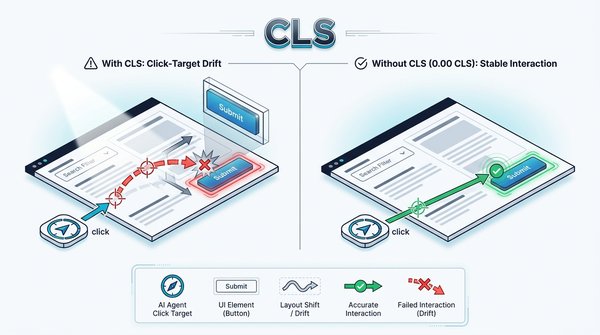
When an agent runs an interactive subroutine—such as adjusting search filters or triggering pagination—absolute visual stability is required. We quantify this metric via Cumulative Layout Shift (CLS) - web.dev , which measures the displacement of unstable elements relative to the viewport over the lifecycle of the page.
Securing a strict 0.00 CLS baseline protects task continuity and data fidelity by neutralising spatial displacement across three critical interaction phases:
- Coordinate Mapping Protection : A minimal layout shift of 10 pixels induces click-target drift, causing automated execution inputs to miss targets and trigger catastrophic workflow failures.
- Spatial Neutralisation : Enforcing an absolute 0.00 CLS rating permanently locks target bounding boxes during rapid-fire agentic interaction loops.
- Structural Locking : Maintaining this baseline in dynamic environments necessitates aggressive build-time rendering or pre-hydration architectural locking.
3. WebMCP Protocol & Declarative Agent Functions
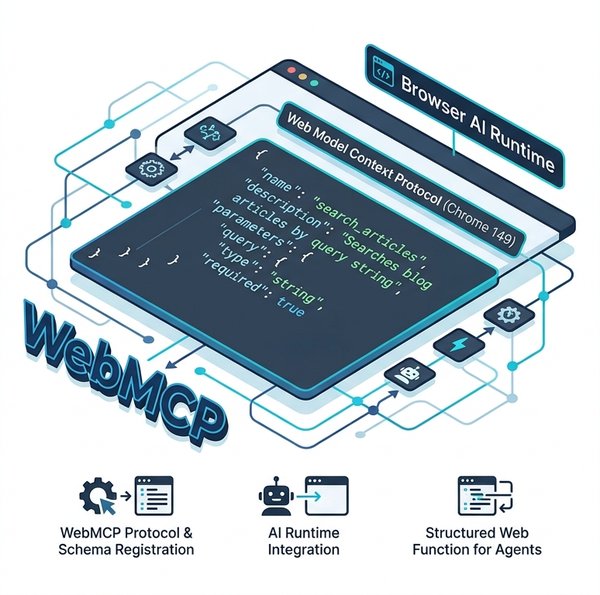
Legacy automated systems extract data via fragile DOM scraping methodologies. The Web Model Context Protocol (WebMCP) origin trial ( W3C Web Model Context Protocol Origin Trial ) in Chrome 149 routes around these heuristics by registering callable functions directly with the browser's native AI runtime.
WebMCP deploys structured, declarative JSON schemas directly to the agent, eliminating the requirement for LLMs to infer interaction logic. This architectural shift redefines standard web query execution:
{
  "name": "search_articles",
  "description": "Searches blog articles by query string",
  "parameters": {
    "query": { "type": "string", "required": true }
  }
}
Deploying this protocol ensures deterministic capability access, deprecating the dependency on complex frontend UI parsing by autonomous systems.
Securing WebMCP for enterprise production requires deploying robust defences across three security vectors:
- Payload Mitigation : Unfiltered API exposure invites payload abuse; headless agents require explicit authentication and strict rate limiting.
- Execution Control : Rigorous input validation blocks autonomous agents from initiating destructive subroutines or mutating unauthorised states.
- Parameter Security : Deep validation layers prevent external entities from executing prompt injection attacks via exposed schema parameters.
4. LLM-Friendly Metadata: llms.txt and posts.json
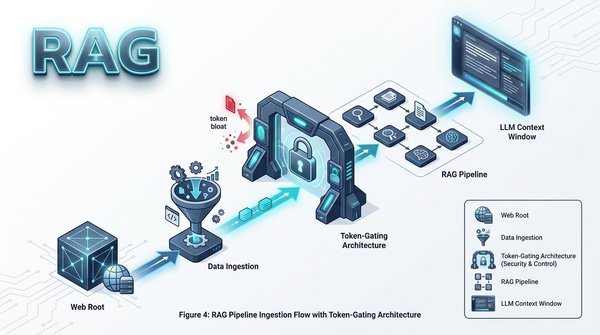
Processing context windows for Retrieval-Augmented Generation (RAG) pipelines requires exposing machine-readable data endpoints at the web root. Engineering a compliant llms.txt file ( llms.txt Standard Specification ) supplies Markdown -formatted taxonomies and canonical URLs directly to automated parsers.
Deploying a parallel posts.json payload requires optimising structural architecture to control token weight through three specific mechanisms:
- DOM Reduction : Stripping out legacy DOM wrappers forces reliance on dense semantic tagging tailored for direct LLM ingestion.
- Data Pre-computation : Bundling pre-computed knowledge summaries minimises the computational overhead for the consuming agent.
- Metadata Condensation : Delivering heavily condensed metadata schemas prevents context window token bloat during the ingestion cycle.
Maintaining content sovereignty against mass LLM training sweeps mandates three strict defensive integrations:
- Data Protection : Endpoints bypassing the visual DOM and standard paywalls guarantee proprietary data extraction if deployed unfiltered.
- Access Control : Architectures must enforce explicit authentication constraints to gate premium JSON payloads.
- Surface Restriction : Engineering teams must carefully calculate and restrict the exact data structures accessible to unauthenticated machine agents.
Conclusion & Strategic Advice
The convergence of a well-formed Accessibility Tree, an absolute 0.00 CLS, and natively authenticated declarative endpoints establishes deterministic operational parameters. Integrating WebMCP with structured markdown endpoints creates a platform that safely and predictably executes machine-agent requests.
Concluding this four-part architectural series, modern web engineering demands the maintenance of a strict dual-state ecosystem through three operational directives:
- Visual Presentation : Engineering architectures must deliver a rich, dynamic visual DOM explicitly configured for human interaction.
- Machine Architecture : Infrastructure teams must enforce a highly restrictive, secure, and deterministic Agentic DOM to process automated inputs.
- Validation Protocols : Auditing current deployments against the Lighthouse 13.3 Agentic Browsing parameters secures immediate operational readiness and establishes structural sovereignty.
💬 How is your engineering team preparing for autonomous agents? Share your insights below and ♻️ share this post with your network!
Further Reading
- llms.txt Standard Specification
- W3C Web Model Context Protocol (WebMCP) Drafts
- MDN Web Docs: The Accessibility Tree
More From Me
- Optimizely AEO: Optimising for AI Answers, Not Blue Links
- Generative Engine Optimisation: Schemas and Content Models for AI Crawlers
- Ready your website for LLMs: Tackling Markup, Protection, and Privacy Challenges
- Sovereign Wall: Navigating the Global Era of Localised AI
Original Article: Read on LinkedIn | Read on Substack