Optimizely Cloud: Azure Functions for CMS Integration
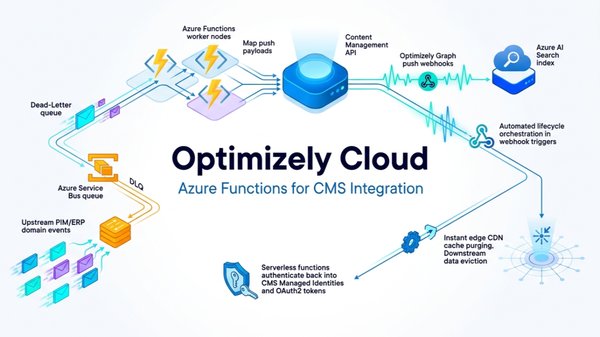
- Part 3 of 7 : Decoupling PIM Sync, Search Indexing, and Webhooks from the Monolith Core
Introduction
Building on the infrastructure explored in Optimizely Cloud: CMS Out-of-the-Box on Azure , enterprise digital experience platforms cannot operate as isolated monoliths . Optimizely CMS relies on persistent PaaS instances on Azure App Service .
While this hosting model excels at serving predictable web workloads, routing high-volume data synchronisation through in-process background workers introduces severe architectural fragility.
In-process background execution introduces three critical resource bottlenecks:
- Shared Resource Contention : Internal scheduled jobs compete directly for memory space, database connection pools , and thread allocations alongside live user traffic.
- Pipeline Fragility : Enterprise synchronisation spikes trigger hard HTTP timeouts and expose limited retry policies.
- Database Deadlocks : Heavy batch updates generate severe database lock contention , directly degrading transactional web performance.
To achieve resilient scalability, the integration boundary must move to an event-driven serverless edge. Deploying Azure Functions alongside Azure Service Bus and Optimizely Graph webhooks executes integration workloads asynchronously without destabilising the CMS core.
Establishing this decoupled Azure edge requires two core architectural standards:
- Strict Security Ingress : External serverless functions authenticate back into the PaaS core using Azure Managed Identities or OAuth2 tokens to authorise ingress via the Optimizely ServiceAPI or Content Management API.
- Trigger Hierarchy : Native push events (webhooks) are the primary architectural standard, while timer-based polling remains strictly a fallback mechanism for systems lacking webhook capabilities.
This guide details how to implement three decoupled integration patterns and navigate runtime hosting constraints.
Why the CMS PaaS Core Needs an Event-Driven Edge
Optimizely CMS operates as a persistent PaaS runtime rather than a serverless topology. The CMS application engine includes an internal scheduler ( ScheduledJobBase ), but running heavy ETL jobs within this container creates direct resource competition with customer-facing HTTP pipelines.
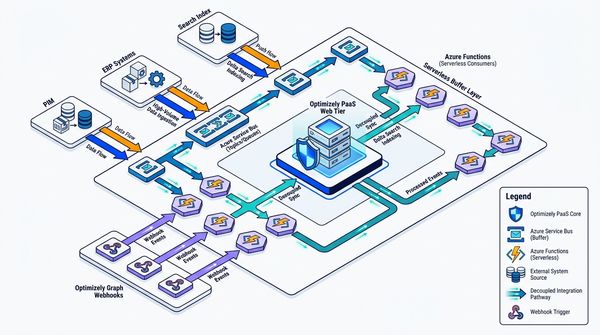
Executing large-scale catalogue updates or batch delta extractions in-process introduces three systemic operational risks:
- Compute Isolation : Offloading data workloads to Azure Functions eliminates thread starvation and prevents request queue exhaustion across the web tier.
- Independent Scalability : Serverless edge components provide autonomous horizontal scaling without requiring PaaS App Service plan overprovisioning.
- Telemetry and Observability : Dedicated function executions emit granular diagnostic traces via Azure Application Insights , ensuring edge synchronisation cannot degrade page generation or checkout responsiveness.
Pattern 1: PIM/ERP Catalogue Sync via Azure Functions and Service Bus
Enterprise catalogue integrations require fault-tolerant, asynchronous buffering. Instead of pushing bulk payloads directly to the CMS, upstream PIM or ERP platforms publish domain events to an Azure Service Bus topic.
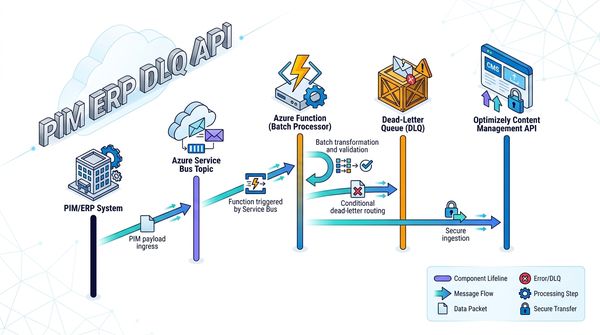
The asynchronous catalogue integration pipeline operates across three discrete execution stages:
- Ingest and Buffer : Upstream systems emit catalogue deltas to Azure Service Bus topics configured with message deduplication and dead-letter queues (DLQ) .
- Process and Map : An Azure Function triggered by Service Bus messages batches payloads, maps schemas into target Optimizely content models, and validates data integrity.
- Persist via Supported APIs : The function securely authenticates via OAuth2 tokens or Azure Managed Identities and pushes transformed entities via the Optimizely Content Management API or Commerce ServiceAPI, as established in; Azure Service Bus Messaging for transferring data between external PIM/ERP to Optimizely .
Failed records are isolated directly to the DLQ for non-blocking inspection, insulating the live CMS database from schema anomalies.
Pattern 2: Incremental Content Indexing into Azure AI Search
Full re-indexing of expansive multi-language estates is computationally wasteful. A resilient pattern pairs Azure Functions with Optimizely's REST -based ServiceAPI to extract only modified content fragments.
The choice of trigger mechanism dictates architectural efficiency across two distinct maturity models:
The Modern Standard: Event-Driven Indexing: In a unified event-driven architecture, native push events trigger this indexing workflow—such as CMS Content Events or Optimizely Graph webhooks. Triggering Azure AI Search updates via webhooks eliminates polling latency and compute overhead, establishing a deterministic real-time synchronisation state machine .
The Legacy Fallback: Delta Polling: While modern architectures utilise webhooks to trigger Azure AI Search extractions, legacy API constraints sometimes mandate timer-triggered polling (as documented in April 2025 Perficient technical briefs on Optimizely and Azure AI Search integration). When real-time webhooks are unavailable, the fallback rolling delta pattern executes across three sequential steps:
- Delta Polling : A timer-triggered Azure Function queries the Optimizely ServiceAPI for content instances modified within a trailing operational window (such as the preceding five minutes).
- Payload Extraction : The function fetches modified content fragments via read-only REST endpoints, bypassing direct SQL database queries.
- Index Mutation : The function normalises the content schema and pushes index mutations directly to the Azure AI Search push API.
While delta polling reduces search synchronisation latency relative to full scheduled re-indexes, it remains computationally inefficient and serves strictly as a fallback when native webhook orchestration is unavailable.
Pattern 3: Optimizely Graph Webhooks Triggering Downstream Pipelines
Optimizely Graph eliminates polling overhead by providing native webhooks for content lifecycle milestones. This mechanism provides real-time orchestration, firing specifically on bulk synchronisation completions and expired content transitions.
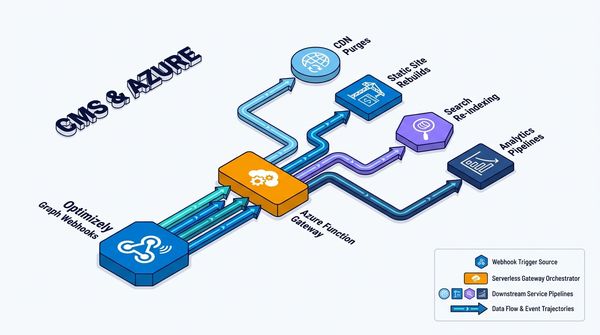
As detailed in Optimizely Graph Webhooks for Bulk and Expired Content , an HTTP-triggered Azure Function operates as the orchestration gateway across two event types:
- Bulk Sync Handlers : Invalidate edge CDN caches, re-index search endpoints, and warm static frontend generation pipelines once bulk content uploads finish.
- Expiration Handlers : Evict unpublished assets from downstream distribution caches precisely when content reaches its StopPublish timestamp.
Cold Starts and When Not to Use Functions
While serverless functions provide modular compute isolation, deploying critical receiver pipelines on standard Consumption plans introduces cold-start latency (typically 2–5 seconds) following idle periods.
Managing serverless execution boundaries requires evaluating two primary architectural considerations:
- Mitigating Cold Starts : Implement scheduled keep-alive synthetic pings or host critical ingestion paths on Azure Functions Flex Consumption or Premium plans, as analysed in Avoiding Azure Functions Cold Starts - Gosso Optimizely devblog .
- Anti-Patterns : Functions serve bursty, asynchronous integration pipelines; latency-critical, synchronous transactional rendering must remain within persistent web application infrastructure.
Conclusion & Strategic Advice
Decoupling integration pipelines from the Optimizely PaaS core transforms brittle batch schedules into a durable, reactive ecosystem.
Implementation Matrix
Architectural selection across integration tiers follows three definitive patterns:
- High-Volume Catalogue Synchronisation : Deploy Azure Service Bus queues paired with ServiceAPI ingestion functions on Flex Consumption plans to guarantee delivery and DLQ isolation, secured by Azure Managed Identities.
- Search & Static Synchronisation : Trigger indexing and invalidation functions via Optimizely Graph webhooks as the primary standard to eliminate polling overhead entirely.
- Latency-Sensitive Webhook Receivers : Use Premium or App Service Dedicated plans to prevent upstream webhook timeouts caused by cold starts.
In the next instalment, Optimizely Cloud: Commerce on Azure and AWS Media AI , the focus shifts to cross-cloud topologies—pairing Azure Commerce transactions with AWS AI pipelines for dynamic asset intelligence.
Evaluate current scheduled jobs: isolate high-latency synchronisation workloads and migrate them to an event-driven Service Bus pipeline.
Are you still running batch ETL jobs inside your core CMS web container, or have you shifted integrations to a serverless queue? Drop your architectural insights below💬 and share this with your engineering network! ♻️
Further Reading
- Azure Functions Service Bus Trigger Documentation (Microsoft Learn)
- Optimizely Content Management API Documentation
- Azure AI Search REST API Reference (Microsoft Learn)
More From Me
Original Article: Read on LinkedIn | Read on Substack