Optimizely Cloud: Opal AI on Google Gemini
- Part 7 of 7 : Multi-Vendor LLM Architecture, DALL-E Generation, and BYOAI Strategy
Introduction
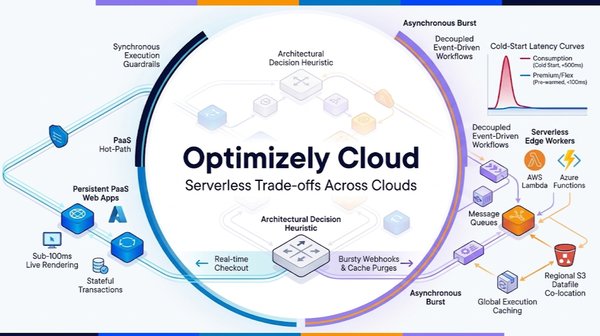
Building on the cross-cloud compute paradigms explored in Optimizely Cloud: Serverless Trade-offs Across Clouds , the operational boundary of modern digital experience platform (DXP) architecture centres on the foundation models that execute generative intelligence .
When evaluating enterprise AI capabilities within a platform rooted in Microsoft Azure hosting, architectural planning often assumes the embedded intelligence tier mirrors the underlying infrastructure.
Enterprise roadmaps frequently draft compliance, data governance , and prompt-routing frameworks under the assumption that Azure OpenAI Service powers platform workflows end-to-end:
- Infrastructure Decoupling : In production, commercial SaaS platforms decouple intelligence services from hosting infrastructure, treating underlying LLMs as ephemeral compute layers rather than static dependencies.
- Dynamic Orchestration : Optimizely Opal—the embedded intelligence orchestration layer across Content Marketing Platform (CMP), CMS , and Experimentation—bypasses monolithic cloud alignment by dynamically routing workloads to best-of-breed models.
- Architectural Scope : This analysis maps the multi-vendor foundation model topology powering Opal, evaluates the Bring Your Own AI (BYOAI) pattern, and delivers the architectural synthesis for multi-cloud platform strategy.
- Egress Economics : This reality directly impacts enterprise data egress , where total operational cost spans baseline compute alongside the legal, security, and governance overhead of corporate data crossing hyperscaler boundaries.
What Opal Actually Runs On
Opal functions as an orchestration tier for contextual copywriting, automated experimentation hypotheses, and editorial workflows.
The multi-vendor engine backing Opal distributes specialised AI workloads across four distinct foundation capabilities:
- Text and Reasoning Engine : Rather than natively routing conversational tasks to Azure OpenAI Service, Opal executes text generation via Google Gemini , as highlighted in partner ecosystem analysis ( Verndale: Current State of Digital Experience Platform AI ).
- Orchestration Abstraction : SaaS platforms abstract underlying models for operational agility and cost optimisation, enabling silent, backwards-compatible model swapping that makes BYOAI essential for guaranteed model persistence.
- Generative Media Routing : Synthetic image creation routes directly to OpenAI DALL-E , bypassing both Microsoft Azure AI image suites and Google Imagen .
- Computer Vision and Media Metadata : AWS Rekognition executes automated metadata tagging and focal-point detection within the digital asset management (DAM) tier.
Through this configuration, Optimizely executes model calls across Google, OpenAI, and AWS before an editorial payload completes processing.
Why This Contradicts the Obvious Assumption
Because CMS and Commerce PaaS instances run in Azure App Services , backed by Microsoft Entra ID and Azure Service Bus , organisations routinely assume conversational telemetry remains within Microsoft boundaries.
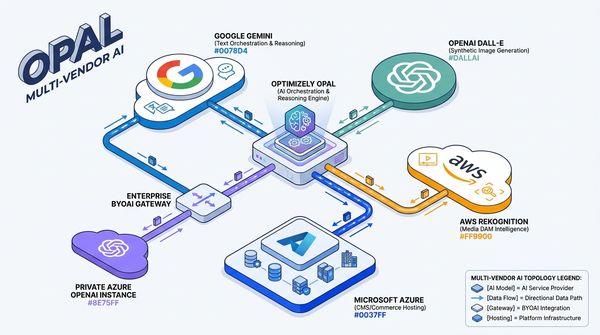
Official platform architecture descriptions confirm that conversational pipelines operate independently from Azure AI services across three key operational dimensions:
- Decoupled Service Baselines : Optimizely architectural specifications outline platform runtime parameters without binding generative or conversational services to Azure OpenAI.
- Data Ingestion Boundaries : Microsoft-centric surfaces—including connectors for Dynamics 365 , SharePoint , and Teams —function as discrete data ingestion and collaboration conduits rather than AI telemetry backbones.
- Distributed Hyperscaler Footprint : The production operational model distributes live compute across four distinct services spanning three major hyperscalers.
The "Bring Your Own AI" Escape Hatch
To accommodate regulated environments and bespoke governance requirements, Optimizely provides a documented "Bring Your Own AI" (BYOAI) integration pattern.
BYOAI enables engineering teams to replace default Gemini or DALL-E endpoints with managed private instances, including dedicated Azure OpenAI deployments or private virtual private cloud (VPC) endpoints.
This architectural integration addresses three core enterprise requirements:
- Regulatory and Egress Compliance : Retains content payloads within approved enterprise tenant perimeters without third-party model routing, mitigating cross-cloud data egress risks.
- Commercial Alignment : Consumes existing enterprise hyperscaler commitments and applies custom content safety filters rather than default shared platform allocations.
- Model Consistency : Mitigates automated, silent upstream model swaps executed by SaaS providers for cost optimisation, guaranteeing deterministic prompt interpretation and schema stability.
While Opal operates on a credit-based consumption model transitioning to tiered enterprise volume billing, deploying BYOAI requires careful evaluation of token-consumption mechanics:
- Dual Billing Considerations : Teams must manage overlapping cost structures by funding native hyperscaler API tokens (such as Azure OpenAI inference costs) alongside Optimizely platform credits consumed for orchestration workflow execution.
- Governance and TCO Control : Custom model routing establishes direct control over total cost of ownership (TCO) while enforcing strict compliance boundaries across enterprise deployments.
What Multi-Cloud Actually Looks Like in Production
Production multi-cloud architectures rarely deploy as abstract, cross-cloud failover meshes.
In enterprise environments, multi-cloud represents an intentional aggregation of decoupled services mapped across four distinct tiers:
- Application Hosting : Microsoft Azure delivers managed infrastructure tailored for .NET , based CMS and Commerce runtimes.
- Conversational Intelligence : Google Gemini executes structured reasoning and high-context agentic generation.
- Generative Media : OpenAI DALL-E handles discrete synthetic asset creation.
- Asset Taxonomy : AWS Rekognition delivers specialised visual categorisation inside the DAM pipeline.
Each vendor selection operates independently at the runtime layer without introducing circular cross-cloud dependencies.
The Practical Implication for Your AI Strategy
Infrastructure hosting agreements do not govern foundation model lineage. Assuming Azure infrastructure guarantees Microsoft AI data governance introduces operational and compliance risks when default requests route to Google Gemini.
If your engineering teams standardise on Anthropic Claude , custom fine-tuned models, or internal Azure OpenAI deployments, you'll need to implement the BYOAI pathway to maintain deterministic data flow and commercial efficiency.
Conclusion & Strategic Advice
Across this seven-part series, the operational reality of modern enterprise software remains consistent: multi-cloud operates as the direct outcome of selecting specialised cloud services for distinct operational workloads.
From Azure application hosting and AWS experimentation pipelines to Google Gemini model orchestration, resilient architecture requires treating every cloud capability as an unbundled, modular component.
Engineering leaders should align platform roadmaps around three core architectural principles:
- Audit Egress Boundaries : Map every AI workflow across CMS, CMP, and DAM to its true destination model.
- Implement BYOAI Early : Move from default vendor models to private enterprise endpoints with strict data governance.
- Decouple Infrastructure Assumptions : Evaluate each hyperscaler service on runtime performance and security isolation, not vendor branding.
How is your engineering team governing data egress across multi-vendor SaaS? Drop your thoughts below💬and share this breakdown with your cloud architecture network ♻️.
Further Reading
- Verndale: Current State of Digital Experience Platform AI: How Optimizely is Making Intelligence Actionable
- Google Cloud Vertex AI: Generative AI Architecture Patterns
- OpenAI: Enterprise Privacy and Governance in API Deployments
More From Me
Original Article: Read on LinkedIn | Read on Substack