OpenClaw Advantage: The Heartbeat Pattern and Proactive AI Beyond Chat
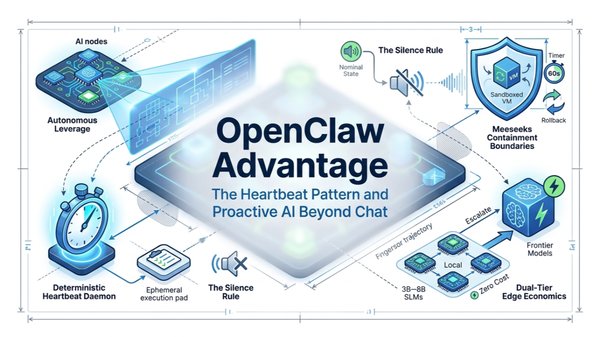
- Part 2 of 8 - Scheduled Autonomous Pulses, Silence Rules, and Bounded Execution
Introduction
Synchronous conversational interfaces force artificial intelligence into a passive, reactive posture. In production environments, waiting for an operator to initiate an interactive session introduces three primary operational risks:
- Compounding Metric Anomalies : Telemetry spikes and failure states compound uninspected across off-hours windows.
- Undetected Deployment Drift : Configuration and infrastructure states deviate from source control without real-time reconciliation.
- Degraded Operational Context : Critical runtime context decays between operator shifts, requiring manual reconstruction.
Transforming an agent from a passive prompt responder into a proactive system monitor requires transitioning from request-response cycles to deterministic, autonomous execution loops.
Building on the structured cognitive foundation established in OpenClaw Advantage: Why Your Agent's Brain Should Be a Markdown File , this architecture implements the Heartbeat Pattern: a bounded, event-driven pulse mechanism that periodically audits infrastructure health, evaluates operational checklists, and executes remediation workflows unprompted.
Deploying background autonomy introduces three distinct architectural constraints:
- Execution Sandboxing : Proactive tool privileges demand strict compute and file system isolation.
- Escalation Gating : State modifications require deterministic, channel-based escalation policies.
- Host Time-Boxing : Unconstrained loops must be bounded to prevent compute exhaustion or unapproved state mutations.
This guide details the architecture, safety boundaries, and edge economics required to deploy proactive autonomous background agents safely.
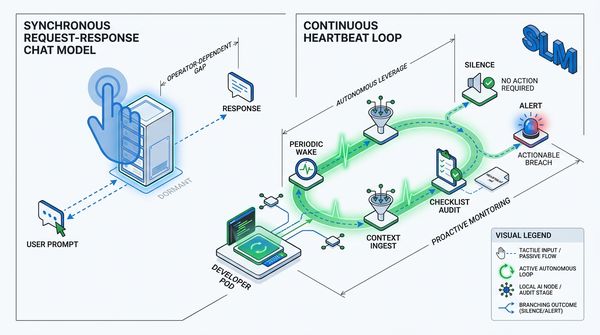
The Passive Assistant Bottleneck
Contemporary AI models operate as ephemeral functions: once the standard stream closes, execution halts. This architectural passivity generates three distinct operational vulnerabilities:
- Unmonitored Off-Hour Windows : Telemetry spikes, silent service degradations, and memory leaks remain uninspected until direct human intervention.
- Context Cold Starts : Daily briefings, pull request status audits, and environment triage must be generated interactively, creating operator latency.
- Knowledge Base Desynchronisation : Internal documentation and local state files drift out of alignment with production codebases when synchronisation routines depend on manual prompts.
The Heartbeat Pattern Architecture
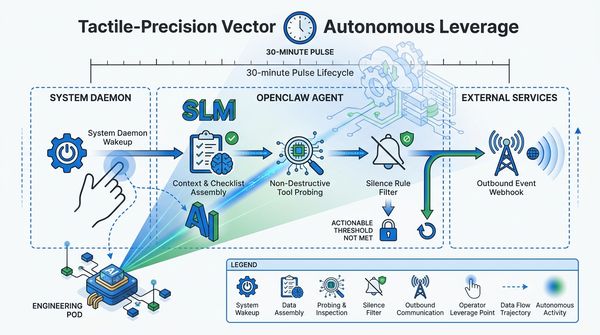
The OpenClaw daemon resolves reactivity by embedding an autonomous heartbeat into the operating system runtime (systemd, launchd, or native container daemons). To maintain state across these 30-minute pulses without risking recursive cognitive loops, the daemon uses an ephemeral execution scratchpad that is completely wiped upon task completion, guaranteeing a clean, deterministic cold-start for every subsequent heartbeat.
At scheduled intervals, the runtime executes a four-stage pipeline:
- Context Assembly : The daemon ingests foundational state files (SOUL.md, USER.md, MEMORY.md, and AGENTS.md) into the working context.
- Checklist Parsing : The agent parses HEARTBEAT.md, extracting tasks segmented by cadence tags ([Every Pulse], [Daily 08:30], [Weekly Sunday]).
- Idempotent Inspection : The model executes non-destructive inspection tools, probing health endpoints, inspecting git working trees, and evaluating log buffers. By referencing a stateful telemetry storage bus, the agent utilises exponential backoff to differentiate temporary metric spikes from sustained threshold breaches across distinct pulses.
- Conditional Dispatch : Upon detecting actionable state changes, the agent executes approved local actions or routes an alert payload to upstream messaging channels.
Operational Checklists and the Silence Rule
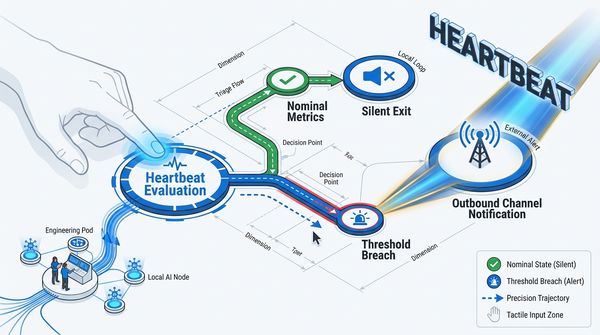
An autonomous agent that emits chatter on every pulse induces alert fatigue and guarantees operational decommissioning. OpenClaw implements the Silence Rule across three core operational policies to protect operator attention:
- Clean Execution Policy : When health probes pass and telemetry remains nominal, the agent writes internal execution metrics and terminates silently without sending outbound messages.
- Actionable Threshold Gating : Outbound notifications require explicit threshold breaches, such as three consecutive 5xx responses, storage utilisation exceeding 85%, or a release-blocking pull request.
- Time-Conditioned Batching : Non-critical digests (such as commit summaries and routine maintenance reports) are deferred to explicit daily or weekly schedules rather than broadcast on each pulse.
Governing Autonomy and the Meeseeks Boundary
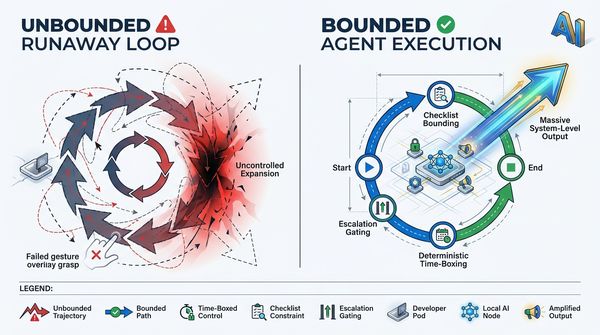
Unbounded agent loops risk recursive cognitive traps. As detailed in The Meeseeks Paradox: When Your Completion Engine Won't Dissolve , an agent lacking definitive termination criteria perpetually spawns sub-tasks and expands operational scope.
Containment is maintained across three deterministic boundaries:
- Checklist Bounding : The agent evaluates only tasks declared in HEARTBEAT.md; it cannot synthesise autonomous background goals.
- Deterministic Time-Boxing : Every pulse has a strict time limit (e.g. 60 seconds), set by the host supervisor. To avoid corrupted system states from interrupted tools, the daemon enforces transactional rollbacks and sends a "Zombie Process Alert" to the operator if a task is stopped mid-execution.
- Escalation Gating : In alignment with Fail-Safe Lethal AI: A 5-Step Modular Framework , any mutation (destructive file updates, deployments, schema changes) requires signed operator confirmation via webhook callback.
Token Economics of Continuous Background Inference
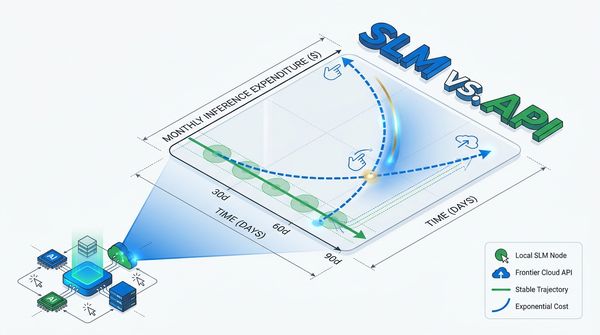
Running 48 daily heartbeat evaluations will result in significant API cost overruns. Naively ingesting ~4,000 tokens of context per pulse generates ~192,000 daily input tokens, previously resulting in $15 to $45 monthly per agent on frontier cloud APIs, as broken down in Economics of Edge Agents: A Serverless Cost Breakdown .
Modern frontier models natively support Context Caching . A persistent daemon evaluating the same SOUL.md and HEARTBEAT.md files every 30 minutes achieves a 95%+ cache hit rate, slashing continuous input token costs by up to 90% and dropping latency to sub-second thresholds.
With token overhead mitigated by caching, OpenClaw employs dynamic dual-tier model routing to maximise compute efficiency, data sovereignty, and deterministic execution across two operational tiers:
- Local Small Language Models (SLMs) : Deploying 3B–8B parameter models locally (such as Llama 3.2 or Qwen 2.5) via Ollama or vLLM handles routine checklist parsing. As detailed in Edge-Model Shift: Escaping the Token Tax , edge silicon provides superior latency, absolute data privacy, air-gapped security, zero network dependency, and zero-marginal cost at scale.
- Dynamic Frontier Escalation : When local evaluation detects anomalous distributed deadlocks or multi-service failures, the runtime dynamically escalates the context vector to cached frontier models (such as Claude 3.7 Sonnet) for high-order triage, minimising the external attack surface while accessing peak reasoning on demand.
The Dark Mirror: Defending Against Hostile Autonomous Agents
Continuous execution loops can be inverted into attack vectors. As analysed in The 2026 AI Threat Landscape: Machine-Speed Autonomous Agents , adversarial actors weaponise background loops for automated network discovery, payload persistence, and credential exfiltration.
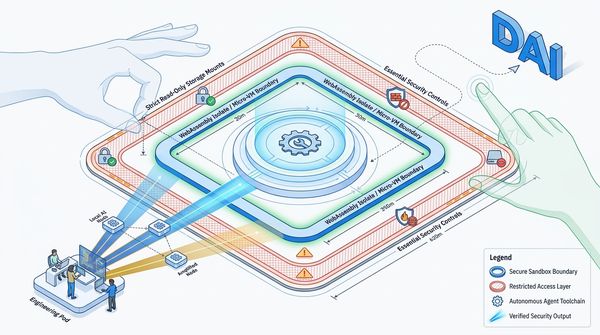
Hardening autonomous runtimes demands strict defense-in-depth across two foundational control layers:
- Micro-VM & WASM Isolation : Toolchains must execute inside sandboxed WebAssembly runtimes or ephemeral micro-VMs, enforcing the compute standards established in The Ephemeral Kernel: Isolates vs Containers for AI Agents .
- Least-Privilege Tool Scoping : Pulse tasks must run with read-only capabilities by default, isolating local storage access from system-level network interfaces. Because reading local storage logs introduces exposure risks when logs contain personally identifiable information (PII) , the daemon explicitly routes all ingested log data through PII-stripping middleware or local data-masking pipelines before model evaluation.
Conclusion & Strategic Advice
The Heartbeat Pattern bridges the gap between passive text assistants and resilient, bounded autonomous systems. Establishing continuous background operations requires aligning operational scope across three strategic pillars:
- Routine Telemetry & Git Audits : Deploy local 3B–8B SLMs on local compute instances with strict 30-minute pulse cadences to ensure absolute data sovereignty, zero network dependency, and clean execution silence.
- Production State Mutations : Enforce interactive human-in-the-loop escalation gating paired with micro-VM runtime sandboxing and transactional rollbacks.
- Complex Multi-System Diagnostic Triage : Implement dynamic dual-routing, triggering context-cached commercial frontier cloud models only upon verified anomalous threshold breaches to maximise compute efficiency.
Continue to the next stage of agent deployment in OpenClaw Advantage: The Personal AI Agent Stack to configure sovereign, single-operator multi-agent local runtimes.
How are you structuring safety boundaries for autonomous background agents? Drop your thoughts below 💬 and share this architecture with your engineering network! ♻️
Further Reading
- OpenClaw Starter Workspace (GitHub) - Reference implementation of scheduled background heartbeat loops and HEARTBEAT.md checklists.
- Patterns of Distributed Systems: Heartbeat - Martin Fowler's architectural reference on deterministic heartbeat mechanics across distributed nodes.
- Building Effective Agents - Anthropic Engineering's core guide on tool-use patterns, autonomous loops, and architectural guardrails.
- OWASP Top 10 for Large Language Models: LLM06 Excessive Agency - Industry-standard threat vectors and isolation recommendations for autonomous agent tool execution.
- Sandboxing AI Agents with MicroVMs and WebAssembly - Cloudflare Architecture review on isolated compute sandboxing for untrusted code execution in AI agent loops.
More From Me
Original Article: Read on LinkedIn | Read on Substack