OpenClaw Advantage: Six AI Agents One Box
- Part 6 of 8 - Multi-Instance Topology, Shared Inference, and Domain-Isolated Operations
Introduction
Moving cognitive runtimes from isolated prototypes to multi-domain production introduces severe infrastructure challenges, expanding upon the regulatory and architectural frameworks established in Part 5: Domain-Specific AI Workspaces .
When enterprise workloads span software engineering, cybersecurity operations, quantitative risk, healthcare records, corporate legal governance, and logistics, running tasks sequentially inside a monolithic process fails under sustained operational loads.
Treating multi-domain operations as dynamic context swaps introduces three critical failure modes:
- State Bleed : Cross-contamination of memory buffers and runtime contexts between sensitive tenants.
- Resource Starvation : High-frequency operational routines blocking mission-critical analytical jobs.
- Regulatory Exposure : Co-locating regulated data streams within unsegmented process boundaries.
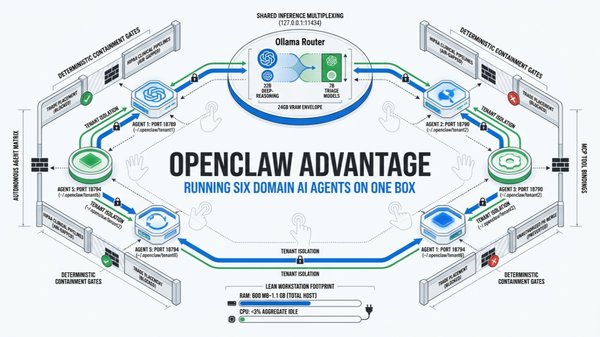
True operational autonomy requires a sovereign agent fleet. This architecture deploys independent background daemons across dedicated port ranges and partitioned filesystem trees, integrated exclusively through a shared local inference tier.
This technical guide details the deployment topology, process sandboxing, and GPU memory management necessary to run six concurrent, domain-isolated OpenClaw daemons on consumer workstation hardware with zero external data egress.
1. The Hot-Swap Illusion
A naive deployment attempts multi-domain execution by sequentially toggling workspace parameters on a single running daemon:
openclaw chat --workspace ./sample-workspaces/cybersecurity-soc
openclaw chat --workspace ./sample-workspaces/healthcare-clinical
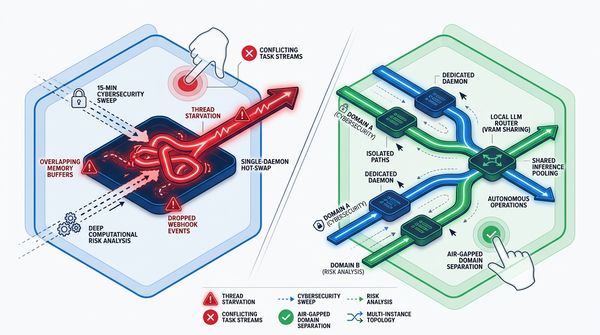
This interaction pattern hot-swaps memory contexts across a single execution loop. In enterprise production environments, this topology fails across four specific vectors:
- Queue Starvation : High-frequency 15-minute telemetry sweeps block low-frequency, compute-intensive risk calculations.
- Audit Entanglement : Logs, telemetry metrics, and forensic session transcripts coalesce into a single stream, destroying the evidentiary chain of custody.
- Regulatory Spillover : A HIPAA -governed clinical agent sharing operating system heap allocations or environment scopes with an internet-connected build agent introduces immediate compliance violations.
- Ingress Collision : Dedicated webhooks, such as Slack SOC alerts versus legal contract webhooks, cannot bind independently to isolated ingress routes.
2. Fleet Architecture: One Daemon Per Industry Domain
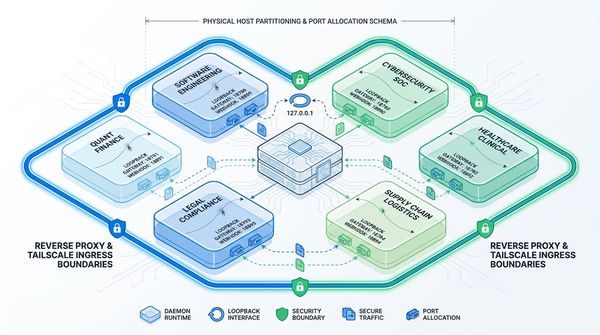
To enforce strict process boundaries, six isolated background daemons replace the monolithic runtime on a single physical host, scaling the design principles of the OpenClaw Personal AI Agent Stack :
- Software Engineering : Gateway Port 18789 | Webhook Port 18889 | 30m Heartbeat cadence.
- Cybersecurity SOC : Gateway Port 18790 | Webhook Port 18890 | 15m Heartbeat cadence.
- Quant Finance : Gateway Port 18791 | Webhook Port 18891 | 30m Heartbeat cadence (Market Hours).
- Healthcare Clinical : Gateway Port 18792 | Webhook Port 18892 | 60m Heartbeat cadence (Air-gapped).
- Legal Compliance : Gateway Port 18793 | Webhook Port 18893 | 60m Heartbeat cadence.
- Supply Chain Logistics : Gateway Port 18794 | Webhook Port 18894 | 30m Heartbeat cadence.
All gateway endpoints bind strictly to the loopback interface 127.0.0.1. Network ingress pathways remain restricted to per-instance reverse proxy access control policies or authenticated Tailscale tags.
3. Six Agents, Six Missions: Domain Sample Topics & Operational Scenarios
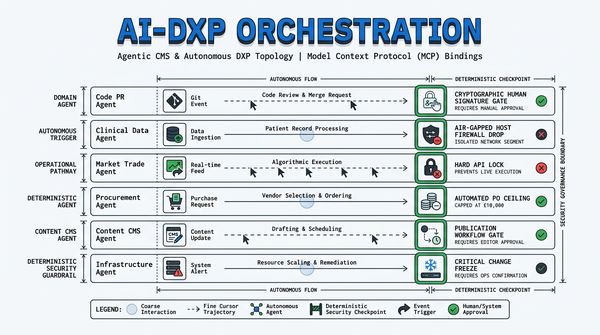
Each fleet instance runs a dedicated operational profile governed by deterministic guardrails:
- Software Engineering (Port 18789) : Evaluates abstract syntax trees (ASTs) on incoming pull requests for breaking changes. — Deterministic Guardrail : Hard execution restriction; prohibited from merging pull requests without human cryptographic sign-off.
- Cybersecurity SOC (Port 18790) : Ingests edge firewall syslog streams to detect anomalies matching MITRE ATT&CK T1110.001 (Password Guessing) , cross-referencing model reasoning structures for payload fingerprinting to identify adversary scripts. — Deterministic Guardrail : Prohibited from revoking enterprise root credentials or cycling host network interfaces without authenticated escalation.
- Quant Finance (Port 18791) : Runs local Monte Carlo factor stress calculations when it detects intraday market volatility. — Deterministic Guardrail : Absolute execution barrier; maintains zero exchange API access and cannot issue live trade orders.
- Healthcare Clinical (Port 18792) : Strips 18 Protected Health Information (PHI) identifiers from unstructured clinical notes according to HHS De-identification Guidance and codes symptoms against MedDRA taxonomies. — Deterministic Guardrail : Network egress drops at the host firewall level guarantee complete air-gapping.
- Legal Compliance (Port 18793) : Evaluates Master Services Agreements (MSAs) against corporate negotiation playbooks to highlight unbounded liability clauses. — Deterministic Guardrail : Advisory diff generation only; non-binding without General Counsel authorisation.
- Supply Chain Logistics (Port 18794) : Ingests port congestion metrics and cold chain temperature telemetry to recalculate multi-modal freight routes. — Deterministic Guardrail : Financial ceiling blocking automated purchase orders exceeding £10,000.
4. Filesystem and Process Isolation
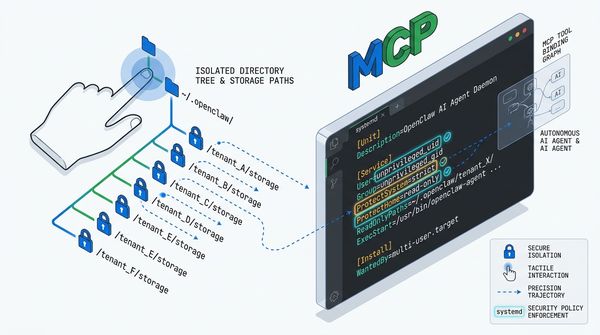
State isolation relies on partitioning configurations, memory vaults, and logs into discrete directories under ~/.openclaw/:
~/.openclaw/
├── software-engineering/    # config.json (18789), .env (scoped tokens), logs/
├── cybersecurity-soc/       # config.json (18790), SIEM credentials, logs/
├── quant-finance/           # config.json (18791), portfolio memory, logs/
├── healthcare-clinical/     # config.json (18792), air-gapped HIPAA vault, logs/
├── legal-compliance/        # config.json (18793), playbook vault, logs/
└── supply-chain-logistics/  # config.json (18794), logistics manifests, logs/
On Linux systems, execution isolation is maintained via dedicated unprivileged system users and sandboxed systemd service units governed by systemd.service Documentation :
[Unit]
Description=OpenClaw SOC Agent Daemon
After=network.target ollama.service

[Service]
Type=simple
User=openclaw-soc
Group=openclaw-soc
Environment=OPENCLAW_CONFIG=/home/openclaw-soc/.openclaw/cybersecurity-soc/config.json
ExecStart=/usr/local/bin/openclaw gateway start --config $OPENCLAW_CONFIG
Restart=always
RestartSec=5s
StandardOutput=append:/var/log/openclaw/soc/gateway.log
StandardError=append:/var/log/openclaw/soc/gateway.log
ProtectSystem=strict
ProtectHome=read-only
ReadWritePaths=/home/openclaw-soc/.openclaw/cybersecurity-soc

[Install]
WantedBy=multi-user.target
Pairing strict user isolation with these sandboxing directives locks each daemon to its own workspace—as illustrated in the directory tree and unit definition breakdown below:
5. The Shared Inference Hub: VRAM Economics and Model Eviction
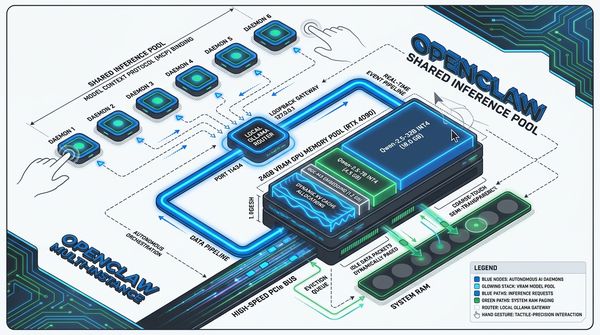
Running six concurrent daemons does not require six distinct LLM instances in memory. All daemons direct their inference requests to a single local router on 127.0.0.1:11434.
Hardware constraints govern memory allocation on a standard 24GB VRAM frame buffer (such as an RTX 4090). System architects must account for distinct LLM engine behaviours:
- vLLM Pre-allocation : vLLM implements PagedAttention (arXiv:2309.06180) to greedily pre-allocate up to 90% of available VRAM for its KV cache, causing instantaneous Out-Of-Memory (OOM) faults when loading multiple models on a 24GB card.
- Ollama Dynamic Mapping : Ollama (llama.cpp) dynamically allocates memory spaces and enforces aggressive model eviction policies, enabling stable multi-model workloads within fixed memory bounds.
VRAM Budget Mathematics
The deployment footprint allocates memory across five functional components:
- Qwen-2.5-32B-Instruct : Format: INT4 Activation-aware Weight Quantization (arXiv:2306.00978) (~18.0 GB VRAM). Serves deep legal redlining and financial risk modelling.
- Qwen-2.5-7B-Instruct : Format: INT4 AWQ (~4.5 GB VRAM). Executes rapid syslog triage and webhook event evaluation.
- BGE-M3 Embedding : Format: FP16 BGE M3-Embedding (arXiv:2402.03216) (~1.2 GB VRAM). Powers local vector retrieval across workspace documents.
- CUDA Context Overhead : Baseline runtime memory reservation (~1.0 GB VRAM).
- Dynamic KV Cache Envelope : Context expansion allocation (~2.0–4.0 GB VRAM, scaling with active token generation).
- Total Operational Envelope : Combined hardware requirement (~26.7–28.7 GB).
Operational Caveat: The Blocking Gateway & Swapping Mechanics
Because this operational envelope exceeds the physical 24GB VRAM threshold, the Ollama runtime dynamically evicts inactive weights into system RAM.
Hardware architectures handle this weight eviction differently:
- Apple Silicon Systems : A unified memory architecture reduces transfer overhead across shared memory pools.
- Discrete NVIDIA GPUs : Model swapping introduces brief PCIe cold-start latency penalties during concurrent agent invocations.
- Adapter-Based Optimisation : Deploying a single 32B base model with domain-specific LoRA adapters eliminates weight swapping and lowers overall memory requirements.
Architects should avoid fragile cron staggering such as prime-minute offsets. The shared local LLM router operates as a blocking API gateway whose asynchronous queue buffers incoming requests, trading predictable event-loop latency for system stability.
6. Container-Based Fleet Orchestration & Resource Budget
In containerised environments, the fleet configuration uses the Docker Compose Specification with base extension anchors.
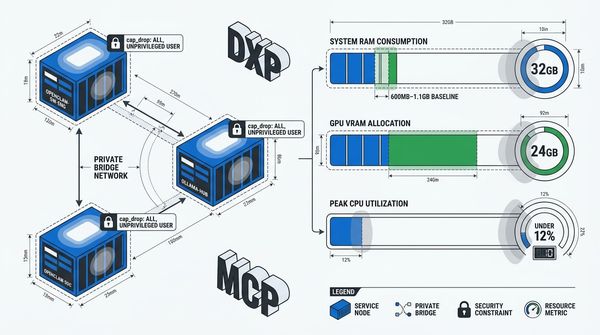
Security parity with systemd service isolation requires explicitly stripping container privileges:
x-openclaw-base: &openclaw-base
  image: openclaw/runtime:latest
  restart: unless-stopped
  read_only: true
  security_opt:
    - no-new-privileges:true
  user: "1000:1000"
  cap_drop:
    - ALL
  networks: [openclaw-net]

services:
  openclaw-sw-eng:
    <<: *openclaw-base
    container_name: openclaw-eng
    ports: ["127.0.0.1:18789:18789", "127.0.0.1:18889:18889"]
    volumes:
      - ./workspaces/software-engineering:/workspace:ro
      - ./config/software-engineering.json:/config.json:ro
      - ./logs/software-engineering:/logs

  openclaw-soc:
    <<: *openclaw-base
    container_name: openclaw-soc
    ports: ["127.0.0.1:18790:18790", "127.0.0.1:18890:18890"]
    volumes:
      - ./workspaces/cybersecurity-soc:/workspace:ro
      - ./config/cybersecurity-soc.json:/config.json:ro
      - ./logs/cybersecurity-soc:/logs

  ollama-hub:
    image: ollama/ollama:latest
    container_name: local-inference-hub
    ports: ["127.0.0.1:11434:11434"]
    volumes: [ollama_models:/root/.ollama]
    networks: [openclaw-net]
    deploy:
      resources:
        reservations:
          devices: [{driver: nvidia, count: 1, capabilities: [gpu]}]

networks:
  openclaw-net: {driver: bridge}
volumes:
  ollama_models:
Host Resource Footprint (32GB Host RAM / 24GB VRAM)
The physical compute demands across six concurrent daemons remain tightly bounded:
- Host RAM Allocation : Baseline memory consumption sits at ~80 MB idle and ~180 MB active per daemon, totalling 600 MB–1.1 GB across all six instances (excluding auxiliary system RAM allocated during Ollama model swaps).
- Host CPU Utilisation : Aggregate idle load registers below 3%, with peak multi-instance pulses reaching 12% across multi-core systems.
- Storage Footprint : Log growth across all six operating domains averages approximately 250 MB monthly.
7. Operator Ergonomics & Unified Fleet CLI
Systems operators manage the fleet via shell aliases declared in ~/.bashrc or ~/.zshrc , matching conventions from the OpenClaw Starter Workspace (GitHub) :
alias claw-soc="openclaw --config ~/.openclaw/cybersecurity-soc/config.json"
alias claw-med="openclaw --config ~/.openclaw/healthcare-clinical/config.json"

alias claw-status='for d in software-engineering cybersecurity-soc quant-finance healthcare-clinical legal-compliance supply-chain-logistics; do \
  echo -e "\n=== Domain: $d ==="; \
  openclaw --config ~/.openclaw/$d/config.json gateway status; \
done'
Ad-hoc administrative interventions and forced execution sweeps trigger directly from the command line without directory changes:
claw-soc heartbeat run --force
claw-med chat --query "Audit cohort 4 de-identification checksums"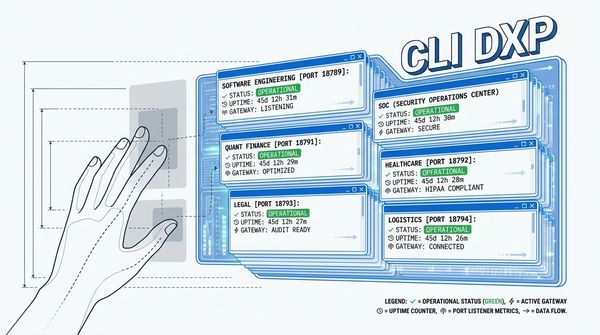
Conclusion & Strategic Advice
The single-box sovereign fleet design aligns regulatory governance with local hardware economics through three foundational pillars:
- Filesystem and Process Boundaries : Segregates audit logs, environmental secrets, and memory vectors at the operating system layer.
- Shared Inference Efficiency : Multiplexes specialised agent workloads through a unified routing engine, operating within physical VRAM boundaries via dynamic paging and asynchronous request queues.
- Deterministic Containment : Blocks credential exposure and prevents horizontal movement between internal restricted workloads and public-facing ingestion endpoints.
Architectural selection between daemons and containers depends on operational objectives: deploy unprivileged systemd daemons for continuous background tasks with strict isolation boundaries, and reserve containerisation for multi-tenant developer clusters.
In the upcoming Part 7: Governing Agents with CODEOWNERS , we examine how these isolated daemons establish inter-agent adjudication protocols to verify outputs across domains before executing infrastructure actions.
Audit your current runtime posture today: segregate multi-tenant agent scripts into dedicated systemd units, map your local inference endpoints, and establish deterministic boundaries for enterprise cognitive operations.
How are you isolating mission-critical AI workloads without blowing up your cloud infrastructure bill? Drop your perspective below💬 and share this blueprint with your engineering team! ♻️
Further Reading
- vLLM Distributed Serving and PagedAttention Documentation
- Ollama OpenAI Compatibility & Model Orchestration Guide
- Systemd Sandboxing: Hardening Service Security Profiles
More From Me
Original Article: Read on LinkedIn | Read on Substack