Your multi-vendor SaaS strategy is an illusion.
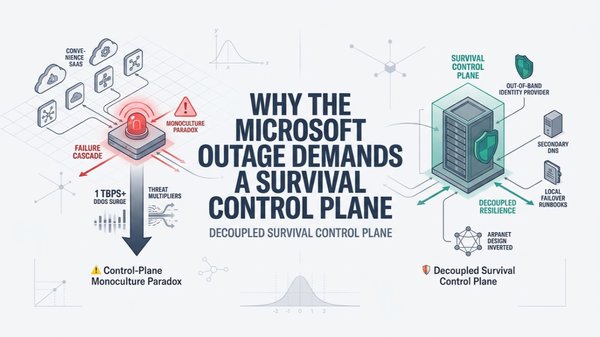
November 2026’s 24-hour Exchange Online outage across 74 countries downed multiple cloud services, while on-prem survived. This exposed the Control-Plane Monoculture: 20 vendors isn't a distributed system .
Introduction
Enterprise architecture diagrams often depict multi-vendor ecosystems that appear distributed on paper. The November 12-14, 2026 Microsoft 365 outage shattered that assumption within hours.
Tracked under incidents EX1550543 and MO1550821 ( Microsoft Service Health ), the cascading failure highlighted two operational realities:
- Root Cause and Blast Radius : A latent defect inside networking gateway processes impaired Exchange Online health checks. Collaboration suites, security telemetry, and third-party agent workflows failed simultaneously across 74 countries.
- On-Premises Resilience : Organisations retaining local messaging capacity maintained operational continuity throughout the incident. This divergence highlights a critical architectural adjustment required for modern cloud environments.
The Control-Plane Monoculture Paradox
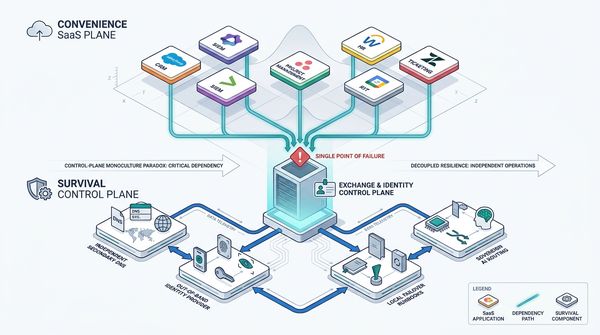
Modern engineering teams routinely mistake SaaS sprawl for fault tolerance. An enterprise can procure services from 20 independent software vendors while maintaining a single hidden point of failure.
This architecture creates the Control-Plane Monoculture Paradox through two structural vulnerabilities:
- Hidden Identity Centralisation : Workloads depend on identity federation , notification webhooks, and OAuth tokens anchored to one provider. If that directory fails, access collapses across CRM, ticketing, and SIEM platforms.
- Correlated Systemic Degradation : Downstream applications remain healthy in isolated compute regions. However, these applications degrade immediately when the upstream token broker stops responding.
Survivability First: What David Clark's 1988 Internet Design Rejected
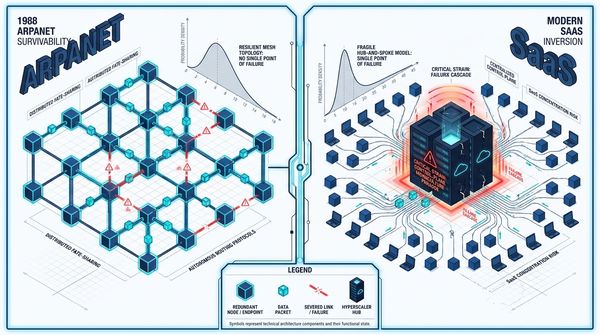
Early network architects engineered systems specifically to survive correlated hub failures. David Clark defined this principle in the Design Philosophy of the DARPA Internet Protocols .
The core DARPA specifications prioritised packet-switching survivability above uniform administration through two fundamental design choices:
- Autonomous Packet Routing : Single-point dependencies vanished through ARPANET distributed management . If intermediate gateways crashed, network traffic routed cleanly around damaged links.
- The Monolithic Inversion : Modern enterprise architectures concentrate messaging, administrative roles, and identity inside shared SaaS hubs. This concentration reverses the survivability invariant that preserved early internet connectivity.
Why Rising Software Complexity and DDoS Amplify Blast Radius
Microsoft confirmed that internal software defects caused the November disruption. However, external attack volumes make future unforced failures even more dangerous.
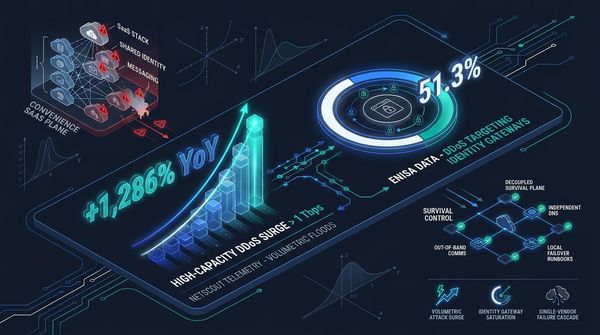
Two empirical threat metrics demonstrate the escalating risk to shared hyperscaler gateways:
- Volumetric Surge : Telemetry in the NETSCOUT Threat Intelligence Report documented over 9.1 million DDoS attacks in the first half of 2026. High-capacity floods exceeding 1 Tbps increased 1,286% year-over-year .
- Identity Gateway Saturation : The ENISA Threat Landscape 2026 report identified DDoS activity in 51.3% of analysed cybersecurity incidents. Adversaries routinely target authentication entry points using residential proxy botnets.
Layered SaaS abstractions enlarge the internal software defect surface. Simultaneously, external flood capacity stresses shared control planes under peak load.
Separating the Survival Control Plane from Convenience SaaS
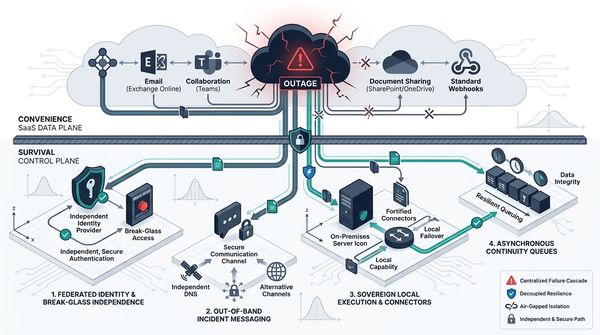
Resilience does not require complete on-premises hardware repatriation. Systems architects can retain SaaS tools for daily productivity within a Convenience SaaS Data Plane .
To prevent systemic paralysis, organisations must isolate an independent Survival Control Plane across four essential paths:
- Federated Identity with Break-Glass Independence : Maintain secondary identity federation and offline credentials outside the primary productivity tenant. If an Entra or Exchange outage occurs, responders can access administrative consoles without disruption.
- Out-of-Band Incident Messaging : Route priority alerts and incident coordination across independent transport networks. If Teams is down, your incident room cannot be on Teams. Maintain pre-provisioned Signal groups or a standalone Slack instance that does not rely on the primary SSO.
- Sovereign Local Execution and Agent Connectors : Run critical AI assistants and workflow orchestration on local infrastructure or a secondary cloud VPC. Your critical operational agents should not require a Microsoft token to function; isolate them to prevent failure during third-party SaaS token revocations.
- Asynchronous Continuity Queues : Buffer transactional messages and webhook payloads through multi-provider queues or local relays. If control-plane impairments occur, queues pause delivery gracefully rather than discarding events.
Conclusion
The November 2026 disruption did not weaken the economic case for SaaS. Instead, the outage exposed the hidden architectural cost of coupling control planes with routine productivity tools.
Achieving durable enterprise resilience requires two immediate architectural actions:
- Audit Shared Dependencies : Identify which identity mechanisms, notification webhooks, and AI orchestration paths share a single hyperscaler provider.
- Isolate the Survival Tier : Migrate essential control functions to an independent infrastructure tier. This decoupling preserves system resilience while retaining standard cloud velocity.
Before the next routine configuration defect disrupts your operations, isolate your Survival Control Plane .
Most enterprises have a 'break-glass' account for their cloud, but they've stored the password in a vault that requires that same cloud to be online to access. Have you actually tested your out-of-band access during a simulated total outage? Drop your thoughts below💬 and share this with your network! ♻️
Further Reading
Explore the following foundational research papers and technical reports on distributed systems resilience:
- David D. Clark (1988) - The Design Philosophy of the DARPA Internet Protocols (ACM SIGCOMM)
- DARPA - ARPANET and the Origins of Packet Switching Resiliency
- NETSCOUT - Threat Intelligence Report: Volumetric DDoS Trends
- ENISA - Threat Landscape 2026: Identity & Infrastructure Vulnerabilities
- Microsoft Cloud Service Health & Incident Tracking
More From Me
Explore the following architectural analyses covering cloud decoupling, edge infrastructure, and systems resilience:
Original Article: Read on LinkedIn