OpenClaw Advantage: Autonomous Agent Architecture Playbook
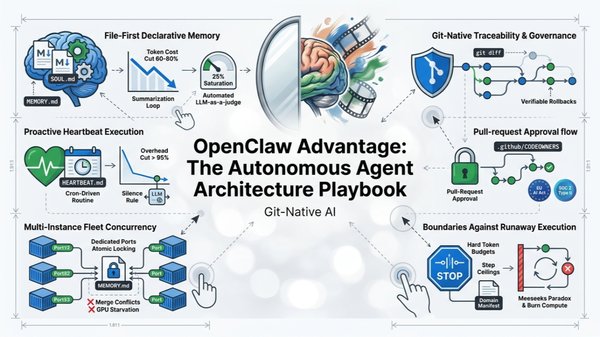
- Part 8 of 8 - Series Master Index, Architectural Synthesis, and Implementation Blueprint
Introduction
Building on the regulated boundaries established in Domain-Specific AI Workspaces: Regulated Sovereign Agents , autonomous execution demands moving beyond ephemeral chat interfaces. Foundation models operate as stateless completion engines, where outsourcing operational state to black-box vector stores or multi-tenant SaaS dashboards triggers context decay, silent drift, and compliance failure.
This playbook establishes the deterministic OpenClaw framework, treating cognitive state as version-controlled code. Anchoring directives, background routines, and domain constraints in plain Markdown files backed by Git operations enforces three core architectural properties:
- Cryptographic Traceability : Verifiable Git commit histories document every state transition across operational cycles.
- Local Inference Isolation : Workstation-level execution environments guarantee complete network and memory containment.
- Auditable Fleet Governance : Declarative manifests enforce deterministic boundaries across sovereign multi-instance agent fleets.
Executive Summary: The Transition from Prompt to State
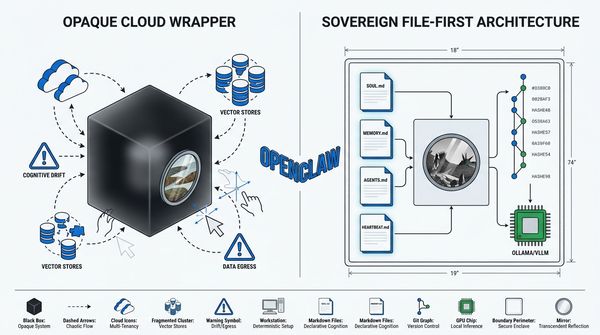
The central operational bottleneck in autonomous AI stems from persistent state management, not prompt engineering. Cloud wrappers obscure state transitions, precipitating cognitive drift and behavioural regression.
Sovereign file-first architecture anchors agent cognition in deterministic repositories through two key mechanisms:
- Declarative Memory Substrates : System directives, working memory, and scheduled duties execute against human-readable Markdown files (SOUL.md, MEMORY.md, AGENTS.md, HEARTBEAT.md), transforming opaque model turns into verifiable, reproducible, and editable software engineering artifacts.
- Latent-to-Discrete Projection : Sandboxing latent reasoning strictly to the deliberation phase enforces a mandatory "Latent-to-Discrete Projection" prior to any Git commit, ensuring the terminal audit trail remains human-readable and regulatory-compliant.
The 7 Pillars of the OpenClaw Architecture
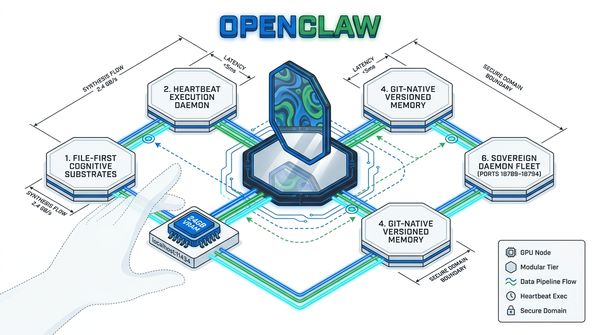
The OpenClaw framework synthesises local inference, transparent memory, and software engineering governance across seven core pillars:
- File-First Cognitive Architecture : Storing state in SOUL.md, MEMORY.md, and AGENTS.md—detailed in Why Your Agent's Brain Should Be a Markdown File ( Substack Dispatch )—cuts token consumption by 60–80% over raw re-ingestion, enabling zero-overhead edits. To prevent "summarisation decay" (the loss of critical low-frequency facts over multiple cycles), dynamic context pruning employs automated LLM-as-a-Judge gates triggered at 25% context saturation before overriding historical memory files.
- Proactive Heartbeat Execution : Replacing passive chat with cron-driven loops in HEARTBEAT.md—analysed in The Heartbeat Pattern and Proactive AI Beyond Chat ( Substack )—enforces the Silence Rule, cutting inference costs over 95% via local Small Language Models (SLMs).
- Personal AI Agent Stack : Documented in The Personal AI Agent Stack ( Substack ), local inference routers (Ollama/vLLM) on workstations guarantee zero data egress.
- Git-Native Cognition : Explored in The Git-Native AI Agent: Version-Controlling Cognition ( Substack ), treating memory as Infrastructure as Code enables git diff, branch, and revert, demonstrated in the OpenClaw Starter Workspace Repository .
- Regulated Domain Workspaces : Manifests (TRIAGE.md, COMPLIANCE.md) from Domain-Specific AI Workspaces: Regulated Sovereign Agents ( Substack ) bind actions to MITRE ATT&CK , FINRA , and HIPAA standards.
- Sovereign Multi-Instance Fleets : Isolated daemons on ports 18789–18794 operate across partitioned filesystem trees with dedicated memory files, multiplexing strictly through a shared local inference hub (localhost:11434) to serve multiple domains without cross-tenant locking or queue starvation. Within each workspace, the runtime enforces a strict
Forbidconcurrency policy for scheduled heartbeats, offloading long-running jobs to isolated Git worktrees soMEMORY.mdis never held under blocking locks. - Git-Native CODEOWNERS Governance : Directives bind to .github/CODEOWNERS , requiring PR approvals from security and SRE leads before behavioural changes enter production.
Failure Modes of Contemporary AI Deployments
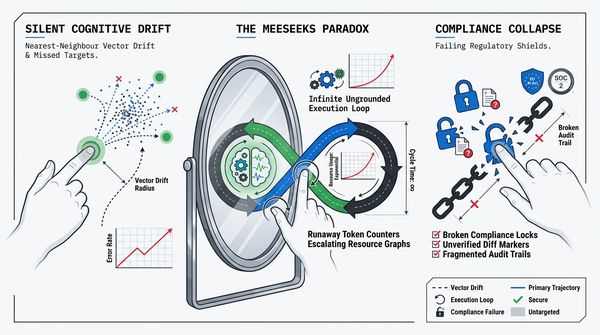
Production deployments routinely encounter three mechanical breakdowns:
- Silent Cognitive Drift : Approximate nearest-neighbour vector retrieval returns plausible hallucinations that operators cannot surgically inspect, trace, or correct.
- The Meeseeks Paradox : Unbounded autonomous execution loops spin recursively on ambiguous objectives, consuming millions of API tokens without reaching termination.
- Compliance Collapse : Mutable vector tables and unversioned dashboard prompts violate the EU AI Act (Articles 14 and 15 oversight and accuracy mandates), SOC 2 Type II , and FINRA standards because you can't prove historical execution state.
Architectural Checklist: Deploying Your Sovereign Workspace
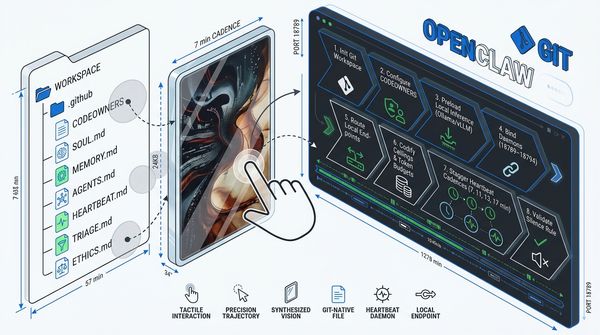
Deploying an enterprise-grade sovereign workspace follows an eight-step blueprint:
- Initialise Workspace : Commit baseline manifests (SOUL.md, MEMORY.md, AGENTS.md, HEARTBEAT.md) directly to Git.
- Establish Governance : Configure .github/CODEOWNERS for mandatory cross-functional PR reviews.
- Initialise Inference : Deploy the local hub (Ollama/vLLM) and preload model weights into VRAM.
- Provision Daemons : Bind sandboxed daemon processes to deterministic ports (18789–18794).
- Route Endpoints : Point daemon configs to the central inference engine (ollama:11434).
- Codify Boundaries : Implement domain manifests (TRIAGE.md, ETHICS.md) with explicit operational ceilings, configuring hard token budgets or step limits in HEARTBEAT.md to prevent the Meeseeks Paradox.
- Stagger Cadences : Offset heartbeat runs using prime-minute intervals (7, 11, 13, 17) to prevent GPU lockups.
- Verify Alerting : Validate the Silence Rule and confirm escalation pipelines work before activating the live channel.
Master Synthesis & The Future of Agentic Collaboration
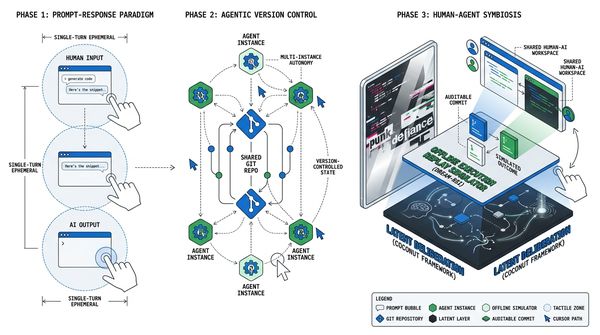
Anchoring state in human-readable files elevates autonomous systems into verifiable software engineering assets. Beyond static logs, accumulated discovery trees form an empirical foundation for offline simulation across two primary paradigms:
- Offline Simulation via Execution History : Frameworks like Dream-RSI: Recursive Self-Improvement through Evolving Worlds
- recorded execution histories as replay simulators to evaluate exploration policies offline, reducing live runtime calls by up to 162×.
- Continuous Latent Deliberation : Architectures like COCONUT enable models to reason across latent states during intermediate processing while anchoring terminal decisions directly to auditable Git ledgers.
Conclusion & Strategic Advice
Sovereign agent architecture synthesises local compute, declarative version control, and auditable file-first cognition into an actionable operating model. Production deployment requires addressing two core operational realities:
- High-Velocity Ingestion Ceiling : Git-native cognition governs strategic state and directives, but remains mathematically unviable for high-velocity telemetry ingestion such as streaming SOC alerts. High-frequency data must reside in dedicated time-series databases to prevent instant context bloat, restricting OpenClaw commits solely to its evaluations of that data.
- Fleet Hygiene and Quantised Inference : Disciplined workspace curation and automated CI linters prevent context window bloat across iterative runs, while multi-agent fleet scaling requires strictly staggered execution cadences to eliminate GPU token contention. Local quantised SLMs deliver the necessary balance of deterministic latency, zero data egress, and statutory compliance.
This synthesis concludes the foundation series. Continue into advanced deliberation architectures in The Consideration Paradigm: Moving from Greedy Completion to Exploration Policies .
Audit your systems today: commit directives to Git, extract memory into Markdown, and establish verifiable state governance.
How is your engineering team handling cognitive drift and state persistence across production agent fleets? Drop your thoughts below💬 and share this blueprint with your dev network! ♻️
Further Reading
- Building effective agents (Anthropic Research)
- LangGraph: Multi-Agent Workflows (LangChain Engineering Blog)
- Introducing smolagents, a simple library to build agents (Hugging Face Engineering)
- Continuous Delivery for Machine Learning (Martin Fowler / Thoughtworks)
More From Me
Original Article: Read on LinkedIn | Read on Substack