SEO, GEO and AEO: Web Accessibility Is Converging for ML Legibility
Introduction
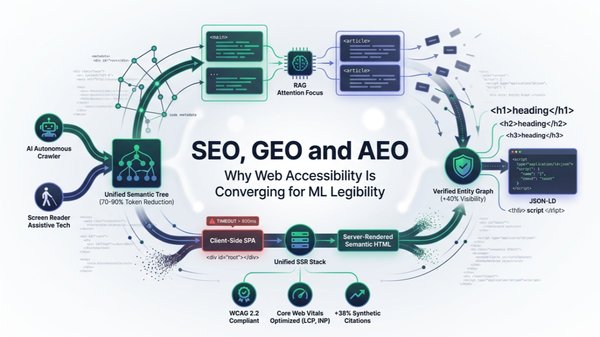
Enterprise web architecture faces a fundamental inflection point, building directly on the architectural patterns established in Generative Engine Optimisation: Schemas and Content Models for AI Crawlers . Modern content retrieval systems are actively transforming delivery requirements across two primary paradigms:
- Legacy Search Paradigms : Accessibility functioned historically as an isolated legal compliance checkbox, while search optimisation concentrated on metadata manipulation and link equity to harvest search-engine clicks.
- Generative Retrieval Engines : Generative discovery platforms—including OpenAI SearchGPT, Perplexity, and Google Gemini Grounding—supersede the traditional blue-link estate by ingesting, parsing, and synthesising source materials into direct answers.
Machine legibility represents the fundamental technical bottleneck for automated retrieval pipelines:
- DOM Semantic Flattening : Autonomous extraction agents and multimodal retrieval pipelines bypass visual CSS styling and client-side layout abstractions, flattening Document Object Models ( DOM ) into semantic trees parallel to those utilised by assistive technology.
- Unified Technical Framework : Web accessibility standards directly govern Generative Engine Optimisation (GEO) and Answer Engine Optimisation (AEO) retrieval mechanics.
- Production Outcomes : Implementing these patterns eliminates client hydration penalties, calibrates document topologies, and deploys unified semantic architectures that secure machine citations alongside regulatory compliance.
1. The Dual-Consumer Web (Screen Readers and LLM Agents)
Modern web platforms execute against two discrete runtime consumers: human users interacting via visual viewports or assistive devices, and autonomous LLM agents distilling unstructured markup into factual tokens.
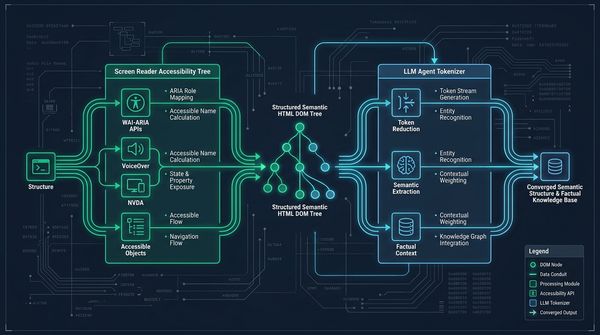
Evaluating crawler behaviour reveals how screen readers and autonomous bots converge on the document tree through four functional mechanisms:
- Accessibility Tree Construction : Assistive tools such as NVDA, VoiceOver, and JAWS bypass visual layout trees to construct an Accessibility Tree via browser API layers conforming to the W3C Accessible Rich Internet Applications (WAI-ARIA) 1.2 specification.
- Agentic Navigation vs Ingestion : Agentic foundation models (such as OpenAI Operator) navigate directly via compiled accessibility trees, whereas high-throughput crawlers (such as GPTBot) rely on raw HTML DOM simplification.
- Token Reduction Metrics : Web scraping pipelines strip visual CSS styling and client scripts to produce a role-and-text snapshot; semantic tags streamline this extraction, reducing token consumption by 70% to 90%.
- Machine Ingest Baselines : Accessible structure establishes the operational baseline for data ingest, as established in Lighthouse Part 3: Accessible Web Engineering ; unparseable trees prevent frontier models from indexing and citing source content.
2. Why AI Crawlers Penalise Div-Soup and SPA Hydration
Modern Single Page Applications (SPAs) built with deep <div> nesting impose severe latency and token overhead on automated parsers across three architectural vectors:
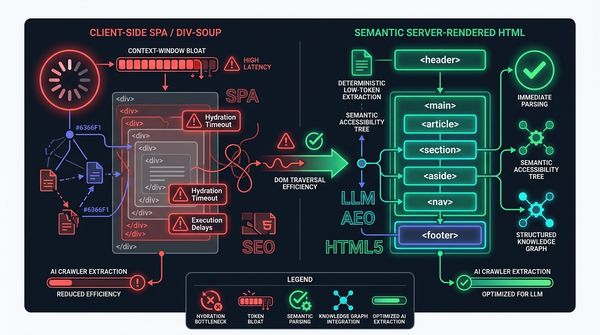
- Context-Window Overhead : A generic DOM containing 4,000 nodes across nested wrappers inflates context ingestion up to five times compared to a lean semantic document, wasting finite prompt budgets.
- Hydration Timeouts and Execution Budgets : Frontier AI crawlers—including bots documented in the OpenAI Crawler Documentation —enforce aggressive network-idle timeouts rather than executing asynchronous client hydration like Googlebot. While platforms like Perplexity deploy headless browsers capable of restricted JavaScript execution, sub-800ms timeouts frequently cause unhydrated SPAs to return empty <div id="root"></div> shells that bots drop from synthesis pools.
- Deterministic Server Delivery : Server-rendered HTML fragments guarantee instantaneous, zero-overhead token extraction, validating the hypermedia delivery patterns demonstrated in HTMX Hypermedia Returns: The Old/New Architecture of the Web .
3. Structured Microdata and JSON-LD as Deterministic Ground Truth
LLMs generate probabilistic token sequences, whereas answer engines mandate deterministic verification before surfacing citations. Structured entity triples bridge this functional gap.
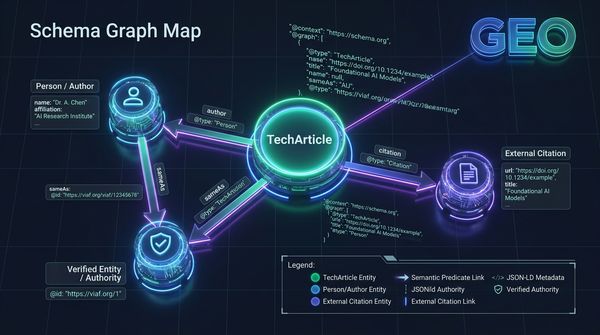
Integrating deterministic entity triples anchors probabilistic model outputs across four structural implementations:
- Knowledge Graph Anchoring : Implementing vocabularies such as the Schema.org TechArticle Specification grounds technical assertions directly into enterprise knowledge graphs.
- Semantic Heading Mirroring : Aligning on-page semantic headings ( <h2> , <h3> ) with JSON-LD entity properties establishes programmatic factual verification between document structure and metadata payloads.
- Hallucination Mitigation : Deterministic entity graphs bypass purely probabilistic token prediction in favour of direct entity retrieval, materially reducing AI hallucination risks while elevating source authority.
- Citation Attribution : Empirical research in GEO: Generative Engine Optimization demonstrates that structured entity graphs and author citations increase generative response visibility by up to 40%, particularly when using sameAs attributes to bind claims to verified identities.
4. ARIA Roles, Landmark Tags, and Information Hierarchy
Document topology dictates how generative extraction algorithms segment content and allocate attention weights during retrieval-augmented generation ( RAG ) across three core layout mechanisms:

- Landmark Boundaries : Native HTML5 landmarks define prompt chunk boundaries. Parsers isolate high-value content within <main> and <article>, segment contextual references inside <aside>, and discard navigational boilerplate within <nav> and <footer>.
- Heading Rank Continuity : Assistive tools and semantic chunking algorithms (such as LangChain's MarkdownHeaderTextSplitter) rely on unbroken heading hierarchies (h1 > h2 > h3) to preserve contextual scope. Skipping heading levels to meet viewport styling targets fractures semantic chunk boundaries, producing fragmented vector embeddings.
- Tabular Precision : Relational data served via standard <table> elements with explicit <th> scopes parses deterministically into LLM context windows, whereas CSS flexbox or grid layouts collapse into disordered token streams.
5. Architectural Playbook: Unifying a11y, Core Web Vitals, and GEO
Consolidating frontend architecture around semantic standards resolves accessibility, runtime performance, and machine discovery through three concurrent execution layers:
- Standardised Delivery : Native semantic HTML satisfies W3C Web Content Accessibility Guidelines (WCAG) 2.2 conformance requirements, including deterministic keyboard navigation, accessible name computation, and screen reader parsing.
- Runtime Performance : Server-rendering semantic markup strips heavy JavaScript execution overhead, directly optimising Core Web Vitals —specifically Interaction to Next Paint (INP) , Largest Contentful Paint (LCP) , and Cumulative Layout Shift (CLS) .
- Citation Capture : Structured markup guarantees zero-latency crawler ingestion and dense semantic token density. Enterprise benchmarks demonstrate that server-rendered semantic templates achieve 38% higher synthetic citation extraction rates compared to client-rendered layout grids.
Conclusion & Strategic Advice
Semantic HTML serves as the core transport layer for machine intelligence, not solely an accessibility compliance measure. Discarding client-side hydration bottlenecks, enforcing strict heading topologies, and grounding documents with structured schema graphs secures both WCAG 2.2 compliance and prime generative placement.
Architectural Selection Framework
Production architectures require clear trade-off evaluation between two primary delivery models:
- Server-Rendered Semantic Core (Recommended) : Deploy SSR or static hypermedia architectures using native HTML5 landmarks and JSON-LD schema graphs across mission-critical editorial and documentation tiers. This configuration provides sub-100ms response times, 100% crawler capture, and universal screen reader compatibility.
- Client-Side SPA Architecture (Legacy/High Risk) : Requires edge pre-rendering and dynamic accessibility-tree compilation to reduce crawler execution timeouts and factual-extraction drop-off in answer engines.
Operationalise these standards across your publishing tier immediately: validate DOM node depths, eliminate discontinuous heading ranks, and automate JSON-LD entity verification within build pipelines.
Is your engineering team still treating accessibility as a compliance checkbox rather than your primary AI retrieval strategy? Drop your perspectives below💬, and share this with your engineering network! ♻️
Further Reading
- W3C Accessible Rich Internet Applications (WAI-ARIA) 1.2 Specification - Official W3C recommendation for accessible web components and role mappings.
- W3C Web Content Accessibility Guidelines (WCAG) 2.2 - Standardised compliance framework for accessible digital infrastructure.
- GEO: Generative Engine Optimization (Aggarwal et al., arXiv:2311.09735) - Foundational research on generative search behaviour, citation optimisation, and visibility metrics.
- OpenAI Crawler Documentation - Operational specifications, IP ranges, and fetch behaviour for frontier AI indexing bots.
- Schema.org TechArticle Specification - Standard schema definitions for structuring technical documentation and structured microdata.
- WebArena: A Realistic Web Environment for Building Autonomous Agents (Zhou et al., arXiv:2307.13854) - Research on how autonomous LLM agents process web environments through accessibility representations.
More From Me
- Generative Engine Optimisation: Schemas and Content Models for AI Crawlers
- Optimizely AEO: Optimising for AI Answers, Not Blue Links
- Lighthouse Part 3: Accessible Web Engineering
- OpenAI Operators first step to AgenticAI: Get Your Website Ready
- Generative Engine Optimisation: Enterprise GEO With Optimizely Opal
Original Article: Read on LinkedIn | Read on Substack