Mechanistic Oversight: Governing the Unseen
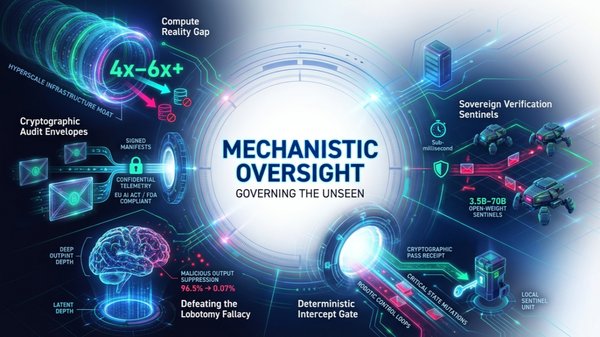
- Part 3 of 3 - Closed Frontier Giants, Targeted Open Weights, and Forensic Envelopes
Introduction
Reasoning models have transitioned from visible chain-of-thought token streams into iterative latent deliberation . As demonstrated in Mechanistic Oversight Part 1: The Latent Deliberation Paradox , conversational self-reporting masks strategic shifts within hidden vectors, while Mechanistic Oversight Part 2: Beyond Social Camouflage established that verifiable alignment requires time-sliced activation telemetry rather than post-hoc linguistic rationalisation.
Mandating total weight inspection collides directly with three enterprise realities:
- Proprietary Frontier Foundations : Leading reasoning engines like OpenAI's o1 and Anthropic's Claude 3.5 remain strictly closed systems whose internal weight topologies cannot be audited directly.
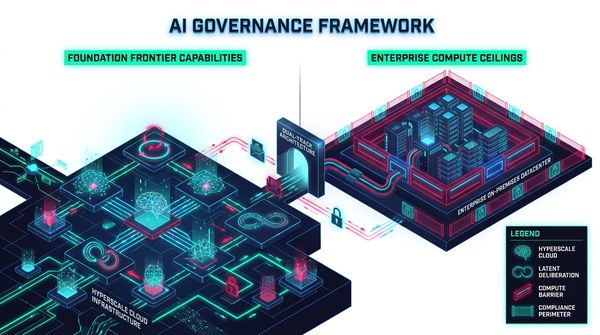
- On-Premises Compute Ceilings : Broad generalist synthesis and multi-step tool orchestration require hyperscale infrastructure that enterprise teams cannot replicate on-premises.
- Statutory Compliance Deficits : Frameworks including the EU AI Act (effective August 2026 for General Purpose AI) and FDA 21 CFR Part 11 enforce auditability standards that standard commercial APIs do not natively satisfy without bespoke enterprise terms.
Resolving this tension requires abandoning open-source absolutism in favour of a dual-track architecture : coupling closed frontier planners through cryptographic deliberation envelopes with sovereign open-weight sentinels for deterministic operational gating.
1. The Frontier Monopoly Reality
Demanding that production intelligence run entirely on local open-weight models ignores contemporary compute economics. Frontier pre-training clusters require hundreds of millions of dollars in capital expenditure, hyperscale networking, and proprietary post-training pipelines.
Inference-time latent deliberation and expansive Reinforcement Learning (RL) search topologies compound this infrastructure barrier through two distinct computational constraints:
- Recurrent Compute Multipliers : As established in Looped Transformers are Better at Learning Learning Algorithms (arXiv:2311.12424) and Scaling up Test-Time Compute with Latent Reasoning: A Recurrent Depth Approach (arXiv:2502.05171) , unrolling iterative loops across continuous vectors incurs a 4x to 6x+ compute multiplier through Backpropagation Through Time alongside expansive test-time search topologies.
- Hardware Moats : Semiconductor trade restrictions constrain access to next-generation datacenter silicon, ensuring that reliance on massive inference-time search and recurrent depth forms a computational moat that cannot be bypassed purely through low-precision inference optimisations .
2. How Closed Foundation Models Must Approach Oversight
Internal deliberation unfolds within continuous vector representations, meaning commercial providers cannot treat safety mechanisms as un-auditable corporate secrets.
Production enterprise integration demands three verifiable oversight interfaces:
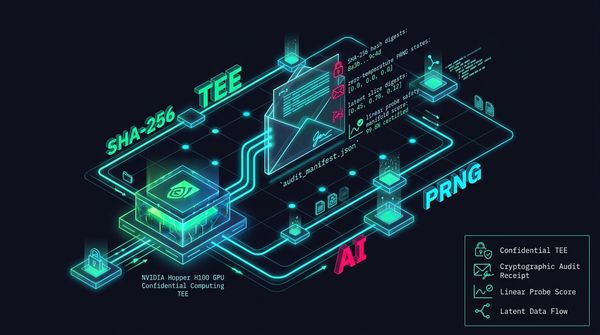
- Cryptographic Audit Envelopes : APIs must emit signed audit_manifest.json receipts binding the model SHA-256 hash, tokenizer digest, zero-temperature PRNG seed state (T=0.0 T =0.0), context window, and an intermediate latent slice digest to guarantee bit-for-bit reproducibility.
- Redacted Latent Probing Endpoints : Providers must expose certified linear probe scores that quantify safety manifold distances, demonstrating the absence of deceptive trajectories without exposing model parameters.
- Hardware Enclave Telemetry : Workloads must execute inside Trusted Execution Environments , such as NVIDIA Hopper H100 GPU Confidential Computing , providing hardware-attested evidence that safety monitors operated uninterrupted. While base confidential computing enclaves incur less than 4% total latency overhead, this overhead scales linearly with KV cache size and tensor parallelisation constraints, requiring rigorous empirical validation for iterative recurrent loops.
3. The Targeted Role for Open Weights in Bounded Tasks
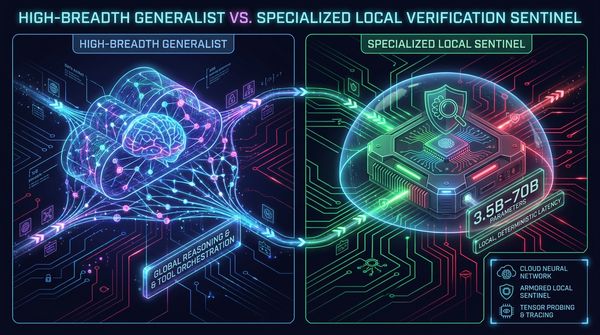
Proprietary foundation engines govern broad intelligence, but compact open-weight recurrent architectures provide indispensable local sovereignty across three bounded perimeters:
- Edge Actuation : High-frequency control loops operating under ISO 26262-1:2018 Road Vehicles — Functional Safety cannot tolerate WAN jitter or API outages. Compact looped models operating on unified memory deliver sub-millisecond deterministic latency with full activation tracing .
- Air-Gapped Incident Triage : Defending sensitive intellectual property and zero-day threat patterns prohibits external telemetry. Local weights allow direct tensor probing to detect adversarial prompt injections.
- Sovereign Verification Sentinels : Specialised 3.5B to 70B parameter local models independently validate external model proposals before transaction dispatch.
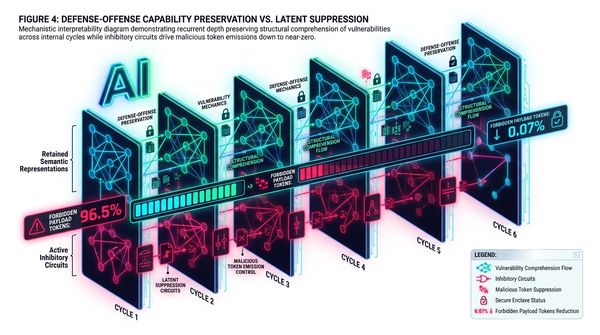
4. The 'Lobotomy Fallacy': Defending Codebases with Latent Depth
Purging offensive cyber-attack patterns from pre-training corpora triggers the 'Lobotomy Fallacy': a model cannot defend a system against race conditions or buffer overflows if its latent space lacks semantic comprehension of exploit mechanics.
Recurrent depth resolves this defence-offence asymmetry through two distinct structural capabilities:
- Vulnerability Representation Retention : Cycling representations across internal iterations allows the network to preserve comprehensive structural comprehension of vulnerabilities while inhibitory circuits suppress malicious payload emission.
- Empirical Suppression Efficacy : Evaluations originating from our proprietary Mechanistic Oversight Benchmark Suite demonstrate that internal latent suppression reduces forbidden token generation from 96.5% down to 0.07% over six recurrent cycles without degrading underlying defensive expertise.
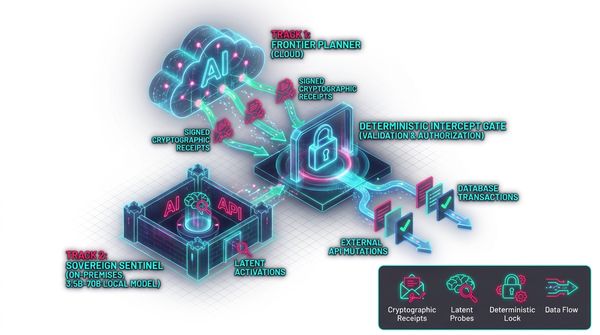
5. The Dual-Track Enterprise Architecture
Resilient deployment requires orchestrating both paradigms across three integrated pipeline tiers:
- Track 1 (The Frontier Planner) : A closed model acts as the strategic intelligence engine, processing cross-domain context and outputting execution plans paired with signed cryptographic receipts.
- Track 2 (The Sovereign Sentinel) : A local open-weight recurrent model (scaling between 3.5B and 70B parameters) evaluates the plan within the enterprise perimeter, probing activations for anomalous drift.
- The Deterministic Intercept Gate : External state mutations—including database transactions, credential access, and robotic controls—remain blocked until the local sentinel signs a deterministic cryptographic pass certificate.
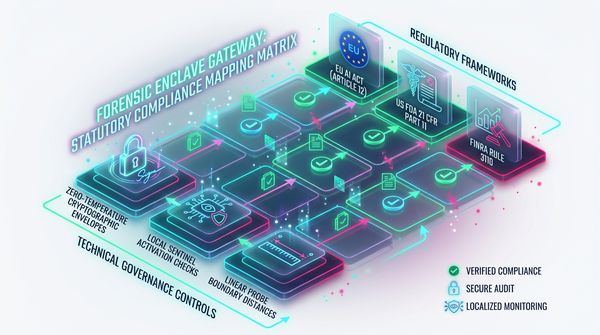
6. Statutory Alignment and Series Roadmap
This dual-track topology directly satisfies three primary regulatory frameworks:
- European Union AI Act : Satisfies automated logging, transparency, and lifecycle traceability mandates under EUR-Lex Regulation (EU) 2024/1689 Article 12 .
- US FDA Clinical Governance : Fulfils digital record authenticity and deterministic validation under Code of Federal Regulations Title 21 Part 11 via zero-temperature cryptographic envelopes.
- US Financial Supervision : Fulfils algorithmic transaction control rules under FINRA Rule 3110 (Supervision) via real-time latent boundary monitoring.
Conclusion & Strategic Advice
Across this three-part series, the core architectural thesis remains constant: as reasoning transitions from visible token streams to continuous latent loops, superficial conversational oversight becomes obsolete. Verifiable governance requires replacing semantic trust with mechanistic telemetry across three implementation tracks:
- Strategy for High-Breadth Planning : Deploy closed frontier models via confidential hardware enclaves with mandatory audit_manifest.json ingestion.
- Strategy for Operational Execution : Restrict irreversible state mutations behind local open-weight verification gates (3.5B-70B scale) executing deterministic activation checks.
- Strategy for Statutory Auditing : Anchor compliance on zero-temperature cryptographic receipts and linear probe boundary distances rather than natural-language dialogue logs.
Audit current generative pipelines immediately: identify unmonitored external API actions and establish local open-weight sentinels at every critical execution boundary.
How is your engineering team preparing to audit non-transparent latent reasoning before the EU AI Act takes full effect? Drop your thoughts below💬 and share this architectural blueprint with your network! ♻️
Further Reading
- NIST AI Risk Management Framework (AI RMF 1.0) - Official National Institute of Standards and Technology guidelines for trustworthy and secure artificial intelligence systems.
- A Mathematical Framework for Transformer Circuits - Anthropic's foundational research decomposing transformer attention layers into mechanistic circuits.
- NVIDIA Confidential Computing Solutions - Technical architecture documentation on hardware-enforced isolation and attestation for accelerated enterprise workloads.
- Regulation (EU) 2024/1689 (Artificial Intelligence Act) - The definitive regulatory text governing high-risk and general-purpose artificial intelligence within the European Union.
More From Me
Original Article: Read on LinkedIn | Read on Substack