The Great Memory Bifurcation: Why Cheap DDR5 Won't Fix the GPU VRAM Crunch

The Great Memory Bifurcation: Why Cheap DDR5 Won't Fix the GPU VRAM Crunch
Introduction
Building on the capital allocation models established in The AI Market Paradox: Hardware Deflation and the Shift to Localised Compute , the prevailing assumption that global artificial intelligence workloads would sustain an indivisible DRAM deficit is collapsing into a bifurcated market. In Q4 2026, absolute pricing remains elevated across the entire memory spectrum, defined by two primary price pressures:
- Conventional DRAM Contract Inflation : TrendForce projects conventional DRAM contract prices climbing 10–15% quarter-on-quarter.
- Hyperscaler Inventory Absorption : Retail DDR5 kits sit near historic peaks, driven by aggressive domestic absorption from hyperscalers including ByteDance and Tencent.
Beneath this unified price spike lies a divergent fabrication trajectory. The supply pipeline fractures across three structural fault lines:
- Commodity Deflation via CXMT : The commodity pipeline faces deflationary pressure as ChangXin Memory Technologies (CXMT) scales production volume.
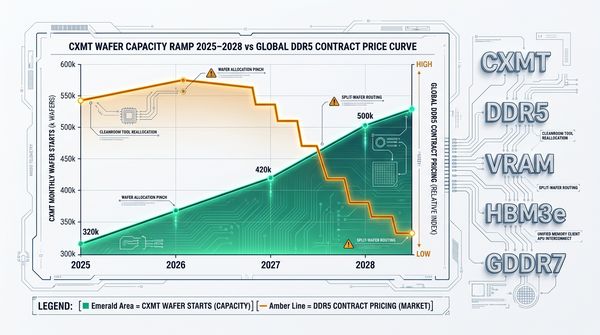
- Global Inventory Displacement : As CXMT fulfils internal demand for Chinese domestic technology leaders, it displaces the incumbent market share of Samsung, SK Hynix, and Micron within China, forcing the Big Three to redirect displaced planar DDR5 and LPDDR5X inventory onto Western and global markets and triggering broad commodity price deflation despite foundry attempts to curtail output.
- Graphics Memory Deprioritisation : Graphics memory remains starved because incumbent foundries systematically deprioritise discrete GDDR7 lines to reserve cleanroom floor space for high-margin High Bandwidth Memory (HBM).
Navigating this split requires understanding why standard system DRAM recovery fails to alleviate GPU VRAM deficits, and how reallocating infrastructure budgets toward unified-memory topologies resolves local model execution before graphics memory stabilises.
Structural Decoupling: Wafer Allocation and the HBM Tax
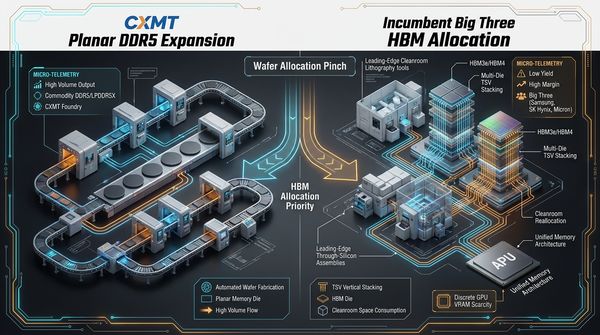
Global DRAM capacity is fracturing along lithography lines as foundries reallocate front-end tooling. Incumbents— Samsung Electronics , SK Hynix , and Micron Technology —are redirecting leading-edge DUV and EUV lines toward HBM3e and HBM4 to support Rubin-class accelerators.
This reallocation imposes structural fabrication penalties across two primary vectors:
- Wafer Area Overhead : HBM architectures demand substantially greater wafer area per usable gigabyte compared to standard planar DRAM dies.
- Packaging Complexity : Advanced Through-Silicon Via (TSV) stacking consumes cleanroom floor space at three times the rate of standard planar DRAM.
Commodity Trajectory: CXMT Scale-Out and Silicon Realities
Counterbalancing incumbent reallocation, CXMT has captured roughly 10% of global DRAM revenue, backed by a 57.9 billion yuan (~$8.7 billion) STAR Market capitalisation.
Fab capacity expansion across the Chinese domestic ecosystem advances along two operational phases:
- Wafer Volume Scaling : Counterpoint and TrendForce project CXMT monthly wafer starts expanding from ~320,000 to ~420,000 by 2027 as its new Shanghai fab joins Hefei and Beijing, targeting 500,000–600,000 by 2028.
- Enterprise Portfolio Expansion : CXMT is sampling enterprise 4F² vertical-channel server RDIMMs to challenge incumbent data-centre margins directly.
Crucially, while this scaling capacity remains largely committed to domestic OEM contracts, the displacement mechanism guarantees global market impact. Operational integration manifests across two core dimensions:
- Global Inventory Displacement : CXMT volume replacing Samsung, SK Hynix, and Micron components for enterprise clients like Lenovo, ByteDance, and Tencent forces surplus incumbent inventory onto the broader international market.
- Silicon Timing and Margin Profiles : While reported yields exceeding 90% on commodity DDR5 remain unverified secondary figures, physical testing on early silicon—such as Corsair's China-only Vengeance DDR5-6000 module (CMK5X16G3E60C36A2-CN)—reveals looser secondary timings and constrained voltage headroom compared to SK Hynix A-die.
While these characteristics prove sufficient for standard compute clusters, high-frequency, low-latency server nodes continue to command tier-1 vendor premiums.
The Discrete VRAM Chokepoint: GDDR7 Deprioritisation
The commodity supply wave offers zero relief to graphics subsystems. Two technical constraints isolate discrete graphics memory from Chinese manufacturing expansion:
- Absence of Dedicated GDDR Lines : CXMT fabricates DDR4, DDR5, and LPDDR5X exclusively, maintaining zero production tooling for GDDR6 or GDDR7.
- Packaging Yield Limits : CXMT 8-Hi HBM3 trials record ~25% functional Through-Silicon Via (TSV) stacking yields; while basal logic die viability is sound, advanced packaging failures prevent these components from alleviating graphics memory constraints.
Consequently, GDDR7 supply for desktop accelerators remains entirely dependent on incumbent foundries.
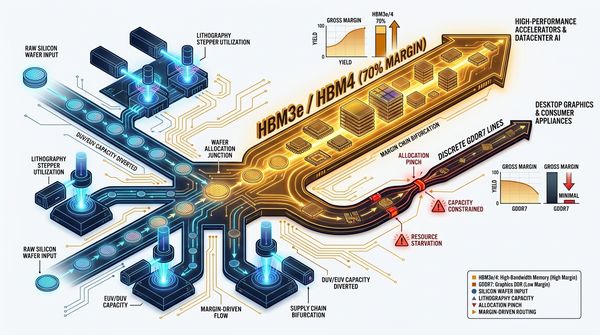
Incumbents continue to ration capacity across their production roadmaps. Foundry allocation bottlenecks persist across two operational fronts:
- Die Density Transition : Micron has phased out 2GB GDDR7 dies to prioritise denser 3GB packages, shrinking allocations across midrange graphics boards.
- Greenfield Cleanroom Delays : SK Hynix Yongin Fab 1's cleanroom opens February–March 2027, Micron Boise ID1 yields first silicon in mid-2027, and Samsung Pyeongtaek P4 prioritises 1c DRAM and HBM4.
From a systems-procurement perspective, structural GDDR7 relief cannot materialise before mid-2028.
Architectural Pivot: Exploiting Unified Memory Capacity per Pound
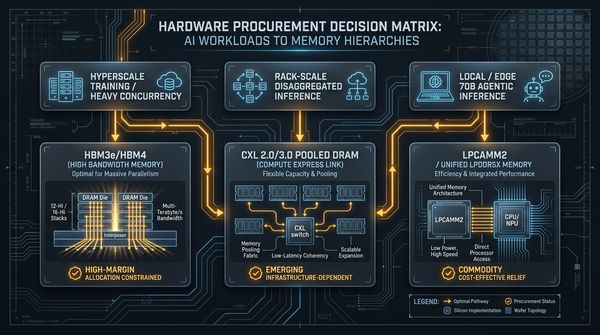
In modern enterprise data-centres, Compute Express Link (CXL) 2.0/3.0 memory pooling serves as the technical benchmark for memory-bound inference, enabling accelerators to address pooled DRAM outside the HBM package at rack-scale. For client-side and edge deployments, discrete VRAM remains restricted behind prohibitive cost curves.
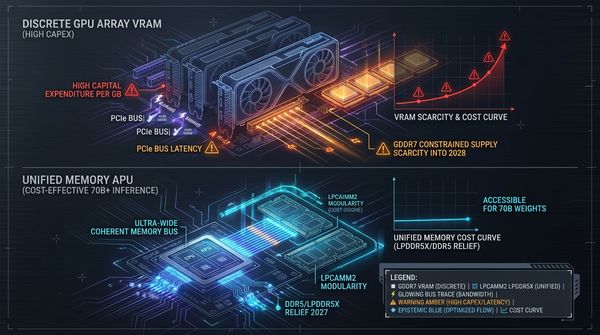
Running quantised 70B parameter models (requiring a 40GB–80GB footprint) on multi-GPU arrays creates unsustainable capital expenditure. Unified-memory platforms invert this cost dynamic by providing a shared, coherent address space across CPU and GPU cores.
Topologies including the Nvidia RTX Spark SoC (128GB LPDDR5X), AMD Strix Halo, and Apple Silicon M-series bypass the discrete GDDR premium entirely. The operational advantage centers on usable model memory per pound, divided across two architectural bus classes:
- Narrow-Bus APUs : Architectures such as the rumoured RTX Spark and AMD Strix Halo rely on standard 256-bit buses to deliver 120–300 GB/s bandwidth.
- Ultra-Wide Bus SoCs : Implementations like Apple Silicon M-series Max and Ultra processors utilise ultra-wide memory buses (up to 1024-bit equivalent) to deliver 400–800 GB/s bandwidth.
While both configurations fall short of the 1,000–1,800 GB/s bandwidth native to discrete GDDR7, ultra-wide buses provide substantial throughput for local inference workloads. Narrow-bus APUs remain suboptimal for high-concurrency production serving, but execute effectively for local iteration, developer sandboxes, and low-batch agentic reasoning.
Historically, deploying LPDDR5X within enterprise or edge hardware demanded accepting pre-soldered, fixed-capacity boards that restricted procurement lifecycles. The integration of the LPCAMM2 (Low Power Compression Attached Memory Module) standard restructures these deployment parameters across two operational axes:
- Modular Capacity Scaling : LPCAMM2 introduces field-replaceable modularity to LPDDR5X, permitting infrastructure teams to scale device memory dynamically without replacing compute packages.
- Accelerated Deflation Capture : Because CXMT produces LPDDR5X at scale, modular unified platforms will absorb 2027 commodity cost deflation a full calendar year before discrete graphics cards experience price relief.
Conclusion & Strategic Advice
Navigating the bifurcated memory cycle requires distinct capital allocation horizons across three functional procurement tiers:
- System Memory : Restrict DDR5 procurement in Q4 2026 to critical maintenance needs. Schedule comprehensive cluster refreshes for H2 2027 when CXMT domestic fulfilment displaces incumbent supply to soften global contract pricing.
- Discrete Accelerators : Treat current GDDR7 pricing as a fixed ceiling through early 2028. Divert local inference budgets away from multi-card consumer GPU arrays.
- Edge Inference Topologies : Consolidate local 70B-class execution onto high-density unified-memory architectures (deploying LPCAMM2 modules where applicable) to maximise addressable memory per pound and capture early LPDDR5X cost relief.
To extend these cost-reduction mechanisms across distributed agent runtimes, evaluate the operational execution framework in Edge-Model Shift: Escaping the Token Tax .
💬 Is your team timing its 2027 workstation refresh around Chinese DRAM capacity, or moving inference off discrete GPUs altogether? Share your thoughts below. ♻️
Further Reading
Track fab roadmaps and contract pricing across four primary industry monitors:
- TrendForce Semiconductor Memory Market Insights
- SemiAnalysis Advanced Packaging and Memory Allocation
- Counterpoint Research Foundry and Memory Tracker
- JEDEC Solid State Technology Association Specifications
More From Me
Review related architectural analyses on hardware cycles and edge compute deployment across ten foundational publications:
- The AI Market Paradox: Hardware Deflation and the Shift to Localised Compute
- Edge-Model Shift: Escaping the Token Tax
- MoE VRAM Offloading: Architecture & Expert Co-Location Strategies
- GPU Liquidation Cycle: Buying Smart Amid the AI Bust
- The Blueprint RISC-V: Unified Memory, Many-Core Scaling, and Geopolitical Sovereignty
Original Article: Read on LinkedIn | Read on Substack