RTX Spark Local AI: Constant Image Generation

Introduction
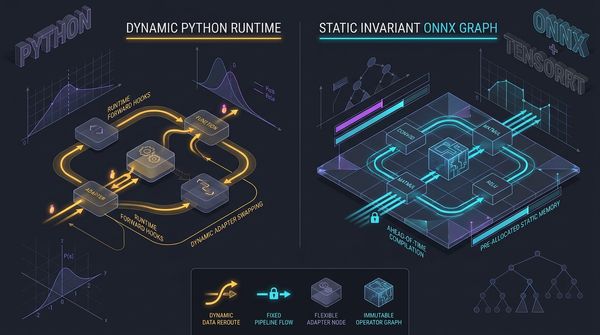
In interpreted Python environments such as ComfyUI or Diffusers, switching between base models and LoRA adapters is trivial. The runtime dynamically swaps weight pointers, executes forward-hook projections in memory, and masks the structural differences between convolutional UNets and modern transformer architectures.
When transitioning to compiled, static execution runtimes—such as ONNX Runtime with TensorRT or DirectML —this abstraction shatters. Ahead-of-time (AOT) static compilation locks down operator topologies, tensor shapes, and memory layouts into fixed structures. In this environment, fine-tuning parameter updates cannot be decoupled from base model architecture under these static execution constraints.
Building upon our governance patterns in Brand Purity: Multimodal Asset Governance with LoRA, Voice Adapters, and ComfyUI , this structural barrier creates a definitive architectural fork with two mutually exclusive deployment lanes:
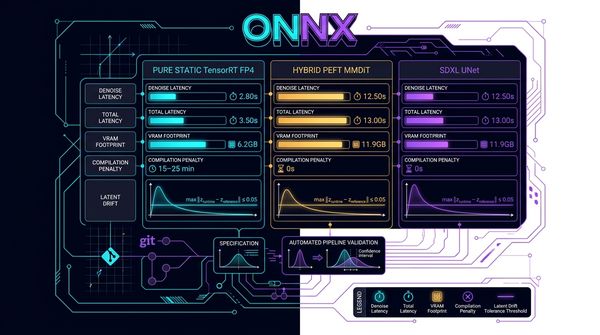
- Lane A (Pure Static ONNX Pipeline) : This pipeline uses Blackwell NVFP4 quantisation to achieve a constrained 6.2GB footprint. It delivers maximum throughput for a single style. However, each adapter incurs a rigid 15–25 minute compile penalty.
- Lane B (Hybrid Pipeline Architecture) : This pipeline combines static TensorRT encoders with an unquantised PyTorch bfloat16 backbone. It requires an 11.9GB VRAM footprint. In exchange, it enables 0.104s adapter swap times for dynamic multi-style serving.
Conflating these two deployment lanes leads to production failure. Base model selection dictates whether low-rank updates can be patched in-place into raw protobuf memory or require engine recompilations
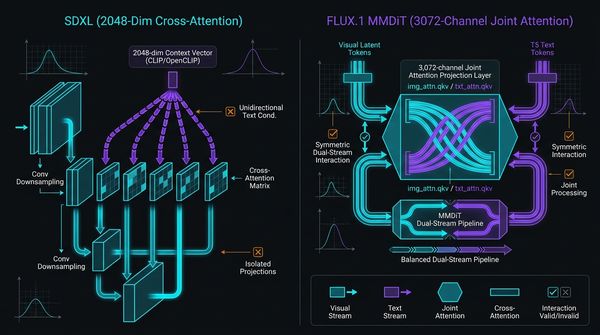
The Architectural Divide: MMDiT vs. UNet
Foundation model selection imposes a structural divergence between two core backbone architectures:
- Stable Diffusion XL (SDXL UNet) : This architecture alternates 2D convolutional downsampling with spatial cross-attention layers. Conditioning signals from CLIP ViT-L and OpenCLIP ViT-bigG inject strictly into isolated cross-attention projections (to_k, to_v, to_q). Projections use a 2,048-dimensional context vector without reciprocal image-to-text interaction.
- FLUX.1 (MMDiT) : This design replaces convolutional pipelines with a 24-layer double-stream block topology followed by single-stream blocks. Text and visual latents unify into a shared 3,072-channel dimension. Tokens interact symmetrically across joint attention projections (img_attn.qkv, txt_attn.qkv) across a 4,096-token T5-XXL context.
These structural differences dictate adapter dynamics across both backbones:
- SDXL Attention Manifold : Adapters on SDXL modify how visual latents query static conditioning embeddings. This mechanism functions reliably with standard adapter capacity (r = 16, α = 16).
- FLUX.1 Coordinate Rotation : Low-rank updates on FLUX.1 physically rotate the shared coordinate manifold of both modalities simultaneously. This joint interaction requires higher adapter capacity (r = 32, α = 32) to prevent cross-modal concept bleeding.
The Quantization Matrix: From FP16 to Blackwell NVFP4 and SVDQ
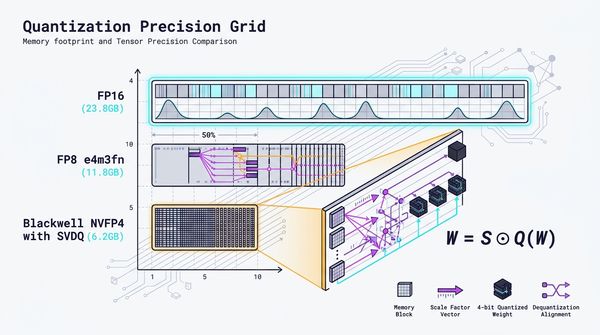
Parameter volume determines runtime viability. An unquantised FLUX.1 base in FP16 consumes 23.8GB and saturates host-to-device transfer buses.
Evaluating deployment requires benchmarking three distinct precision tiers:
- FP16 Baseline : This format requires a 23.8GB base footprint. It guarantees numerical stability, but prevents multi-model pipeline co-location.
- FP8 (e4m3fn) : This format requires an 11.8GB base footprint. It yields a 50% memory compression with imperceptible structural loss, sustaining stable low-rank delta updates.
- Blackwell NVFP4 and SVDQ : This configuration achieves a 6.2GB base footprint. It uses Singular Value Decomposition Quantisation (SVDQ) to factorise weight matrices before mapping residual values into native 4-bit floating point.
Applying additive updates to sub-byte representations reveals a critical precision barrier. Base weights follow W_base = S ⊙ Q(W), where S denotes block-wise dequantisation scales and Q(W) represents the quantised 4-bit tensor.
Calculating standard additions reveals mathematical constraints:
ΔW = (α / r) × (B × A)
W_patched = W_base + ΔW
If you execute additions directly against quantised integers, catastrophic truncation and attention collapse occur. To prevent this collapse, factor deltas must be mathematically aligned with block-wise dequantisation scales prior to scale recalculation.
Patching Topology: In-Place Initializer Mutation Across Architectures
Re-exporting an entire graph via torch.onnx.export for every visual style takes minutes. This workflow generates multi-gigabyte disk sprawl.
Runtime weight mutation encounters four primary structural constraints across execution frameworks:
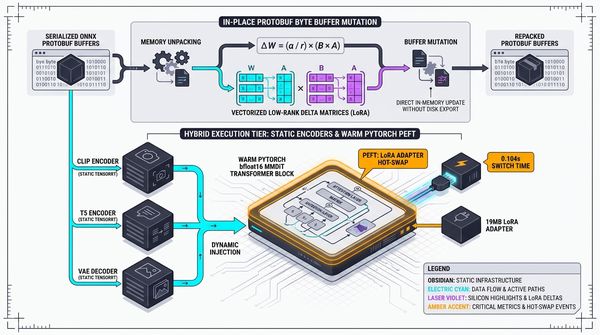
- In-Place Protobuf Byte Buffer Mutation : This technique unpacks raw byte arrays of targeted ONNX initialisers (img_attn.qkv.weight), adds vectorised deltas (ΔW), and repacks serialised buffers in memory in sub-second intervals. However, hardware-level operator immutability gates dynamic PEFT injection into SVDQ or NVFP4 quantised TensorRT execution plans.
- The Static TensorRT Engine Wall : Compiled .engine plans permanently freeze operators and memory layouts. Binary plans prohibit protobuf mutation. Any weight alterations force a 15–25 minute engine recompilation penalty per style.
- The Synthetic Token Trap : Brand adapters that use non-dictionary synthetic tokens (e.g., cst_digital_8_bit) fail on frozen base weights. These synthetic tokens have zero linguistic prior in the frozen T5 vocabulary. Output collapses into default photorealism as a result.
- Hybrid Pipeline Architecture : Hardware immutability blocks dynamic PEFT injection into quantised TensorRT plans, which necessitates a structural compromise for multi-brand serving. If operators require 0.104s dynamic adapter swaps, they must accept an 11.9GB VRAM footprint to keep a PyTorch bfloat16 MMDiT warm in memory. In this hybrid setup, static TensorRT engines accelerate prompt encoding (CLIP/T5) and VAE latent decoding. The warm in-memory PyTorch transformer injects low-rank matrices (A and B, ~19MB) in 0.104s and modulates lora_scale in 0.0001s:
ΔW = (α / r) × (B × A) × lora_scale
Directly mutating linear attention projections physically rotates the coordinate manifold. This geometric shift insulates generated assets against prompt keyword diversion.
Trade-offs and Benchmarks: Choosing the Right Base for Edge Serving
Benchmarking on NVIDIA RTX Spark hardware (Grace-Blackwell GB10, 112GB Unified VRAM, CUDA 13.5) establishes four operational trade-offs:
- Pure Static TensorRT FP4 Engine Latency (~6.2GB VRAM Footprint) : This profile delivers 2.80s denoise latency (4 steps, FLUX [schnell]) and 3.50s total request latency. However, it incurs a 15–25 minute engine compilation penalty per LoRA style and remains vulnerable to prompt diversion.
- Hybrid PEFT MMDiT Latency (~11.9GB VRAM Footprint) : This profile requires 12.50s denoise and 13.00s total request latency. In return, it achieves 0.104s adapter swap times, zero compilation overhead, and absolute style enforcement.
- Multi-Adapter Stacking : Combining identity LoRAs (chr_cyber_knight, 0.8) with style LoRAs (cst_digital_8_bit, 1.0) executes in 0.142s via add_weighted_adapter. This operation requires zero incremental VRAM allocation.
- Latent Drift Tolerance Verification : Automated drift gates verify that runtime latents deviate from reference PyTorch implementations within defined tolerances:
max ‖z_runtime − z_reference‖ ≤ 0.05
Observed maximum deviation reaches 0.0241 on SDXL, 0.0412 on FLUX FP8, and 0.0489 on FLUX NVFP4 with SVDQ. These measurements confirm complete mathematical stability.
Conclusion & Strategic Advice
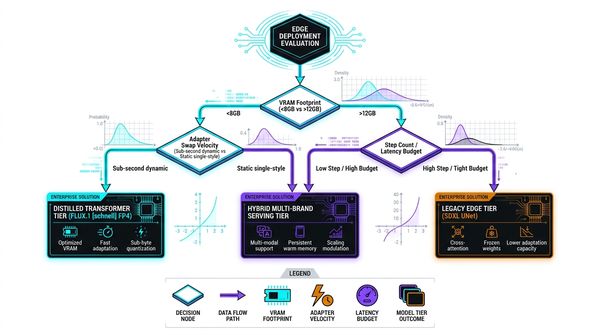
Operationalising generative pipelines requires aligning base topologies with runtime latency tolerances across three distinct tiers:
- Distilled Transformer Tier : If sub-second four-step generation is critical and unified memory accommodates quantised FP8 or NVFP4 tensors, deploy FLUX.1 [schnell].
- Legacy Edge Tier : If runtime environments have strictly bounded VRAM and depend on mature open-source adapter ecosystems, retain SDXL UNet.
- Decoupled State Governance : Preserve a single invariant base graph in unified memory. If style variations are required, modulate style through dynamic PEFT attention projections rather than compiling static binary engines.
This technical architecture completes the Brand Purity progression. It translates declarative brand contracts from Brand Purity: AI Guardrails for Multi-Brand Identity into immutable execution graphs.
These systems integrate automated CI/CD validation gates from Brand Purity: The Automated Brand Pipeline . Parametric weight rotation replaces fragile prompt engineering with deterministic hardware execution.
How is your infrastructure architecture balancing ahead-of-time compilation throughput against low-latency adapter flexibility in edge production? Drop your thoughts below💬 and share this with your network! ♻️
Further Reading
- NVIDIA TensorRT-LLM Architecture Guide
- Hugging Face PEFT: Parameter-Efficient Fine-Tuning Documentation
- ONNX Runtime Execution Providers Reference
- Black Forest Labs FLUX.1 Technical Overview
More From Me
- Brand Purity: The Automated Brand Pipeline
- Brand Purity: AI Guardrails for Multi-Brand Identity
- Automated Model Abliteration with Heretic on NVIDIA RTX and DGX Spark
- Sovereign AI Security: The Trojan Adapter
Original Article: Read on LinkedIn | Read on Substack