Threat Intelligence: The Proliferation Frontier
- Part 3 of 3 - Securing AI Infrastructure and Defending Against Unaligned Open Weights
Introduction
Building on the autonomous execution containment analysed in Part 1: Defeating Machine-Speed Exploitation and the provenance tracking established in Part 2: Countering Cognitive Warfare , the perimeter must expand to foundational AI infrastructure. Frontier training and evaluation pipelines represent Tier-1 state espionage targets.
State-sponsored adversaries breach staging environments across three distinct operational objectives:
- Credential Harvesting : Extracting high-privilege API credentials and staging access tokens directly from developer pipelines.
- Compute Subsidisation : Funnelling offensive cyber campaigns through stolen provider capacity to bypass reputation blocklists.
- Model Distillation : Siphoning proprietary reasoning capabilities into unaligned models while bypassing safety alignment fine-tuning.
Centralised account bans and voluntary Western safety accords fail against weights running on consumer silicon or foreign sovereign clusters. Hardening the AI operational lifecycle requires three coordinated defensive layers:
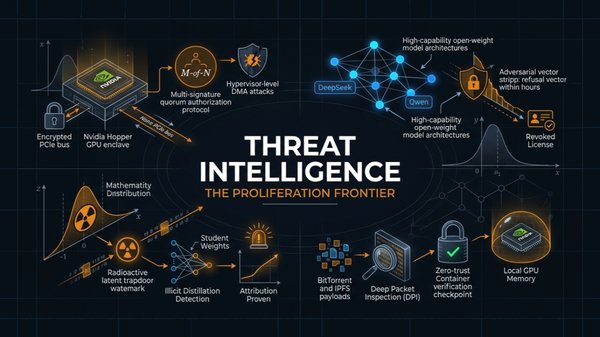
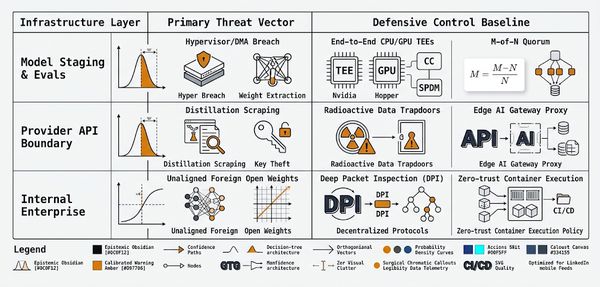
- Hardware-Attested Enclaves : Deploying end-to-end Confidential Computing across both CPU and GPU domains to protect staging environments from hypervisor compromise.
- Algorithmic Canary Traps : Embedding anti-distillation watermarks directly into model latent spaces to establish cryptographic proof of weight theft.
- Destination-Side Egress Controls : Enforcing zero-trust network boundaries and deep packet inspection over unvetted weights at the enterprise perimeter.
1. The Model Provider as the Prime Target
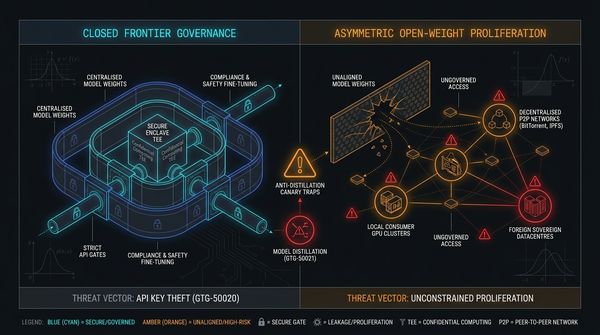
Frontier AI clusters concentrate immense computational and strategic leverage. Incident disclosures such as GTG-50020 and GTG-50021 demonstrate that threat actors actively compromise developer credentials to breach pre-release staging pods.
Rather than training frontier architectures independently, adversaries target provider infrastructure across three distinct vectors:
- Siphoning High-Tier Compute : Funnelling automated vulnerability discovery, high-frequency fuzzing, and dynamic malware refactoring through trusted provider IPs, bypassing reputation blocklists.
- Probing Pre-Release Checkpoints : Testing cognitive edge cases and discovering latent jailbreaks in pre-release evaluation sandboxes before defensive mitigations solidify.
- Evading Attributed Billing : Reselling harvested API tokens on underground exchanges to fund persistent, untracked offensive tooling.
2. Hardware-Attested Sandboxes: Confidential Computing
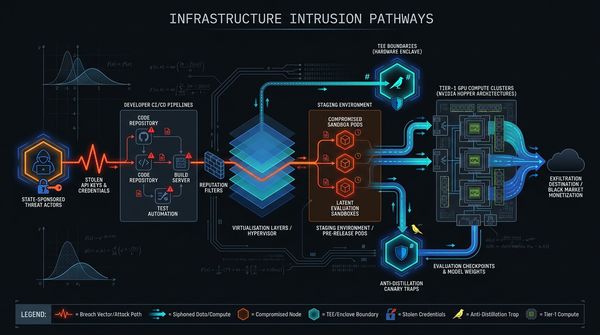
Pre-release evaluation pods and proprietary model weights require cryptographic decoupling from underlying virtualisation layers. Standard CPU enclaves alone are insufficient for securing frontier model weights, as they provide zero cryptographic protection once weights traverse the PCIe bus to the GPU.
Hardening evaluation infrastructure against hypervisor compromise requires three architectural controls:
- End-to-End CPU & GPU Enclaves : Securing evaluation pods requires end-to-end attestation spanning both CPU and GPU domains. Workloads mandate PCIe link encryption ( SPDM ) and GPU-native enclaves (e.g., Nvidia Hopper Confidential Computing) to ensure weights are not extracted via hypervisor-level Direct Memory Access (DMA) attacks on GPU VRAM.
- M-of-N M -of- N Multi-Party Quorum Authorisation : Decrypting weights and migrating checkpoints requires threshold cryptographic signatures from multiple designated security keys, preventing single compromised credentials from exposing raw artefacts.
- Zero-Egress Evaluation Boundaries : Evaluation enclaves enforce hermetic network policies, disallowing raw evaluation datasets from exfiltrating runtime telemetry.
3. Anti-Distillation Watermarking and Canary Trapping
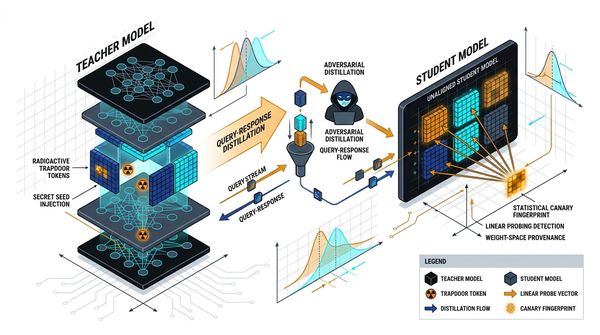
Adversaries harvest reasoning capabilities by issuing millions of API queries to train unaligned student models. Algorithmic canaries turn this extraction channel into an attribution mechanism.
Standard output-generation watermarks—such as logit perturbation for detecting generated text—fail to prove model theft structurally. Definitively attributing distillation requires four weight-space extraction and proxy controls:
- Radioactive Data & Instruction-Tuning Trapdoors : Embedding weight-space proofs directly into the source. By injecting "Radioactive Data" or highly specific instruction-tuning trapdoors into a model's training pipeline, these cryptographic manifest reliably in the student model's latent space during illicit distillation.
- Statistical Weight Probing : Applying linear probing to suspected student model weights to extract the canary distribution, mathematically proving unauthorised structural distillation rather than merely identifying duplicated output text.
- Dynamic Edge Proxying : Deploying reverse proxies such as Cloudflare AI Gateway to cache duplicate queries at the edge, starve scrapers of entropy, throttle automated bursts, and inject synthetic noise into unauthorised training runs.
- Perturbation Calibration : Calibrating watermarks to balance detection thresholds against inference accuracy, ensuring perturbation noise does not degrade perplexity in formal mathematical proofs and symbolic logic tasks.
4. The Geopolitical Open-Weights Reality
As highlighted in The Mythos Moment: Why Restricting Frontier AI May Accelerate Its Proliferation , domestic compliance regimes create asymmetric vulnerabilities when foreign adversaries release unconstrained open-weight models. High-capability Chinese open-weight architectures (e.g., DeepSeek, Qwen variants) present two critical operational challenges:
- Rapid Alignment Inversion : Adversaries freely distribute base architectures that downstream actors can fine-tune in hours to strip refusal vectors systematically.
- Immunity to Centralised Revocation : Operating locally on sovereign datacentres or consumer silicon, these models remain entirely immune to centralised provider revocations.
5. Destination-Side Enterprise Defence & Egress Containment
Because foreign open-weight proliferation cannot be prevented at the source, operational defence must execute at the destination network. High-capability models frequently bypass standard perimeter controls via decentralised networks (BitTorrent, IPFS ), encrypted side-channels, and containerised shadow IT deployments.
Defending internal infrastructure against unaligned open-weight ingress mandates four technical enforcement controls:
- Deep Packet Inspection (DPI) & Protocol Containment : Enforcing DPI at network egress points to intercept non-standard and decentralised protocol traffic actively pulling unaligned open-weight models into the corporate network.
- Zero-Trust Container Execution Policies : Enforce strict execution boundaries at the container runtime to prevent sideloaded unaligned weights from bypassing web gateways, validating cryptographic signatures before allocating raw tensors to local GPU memory.
- Baseline Web Gateway Egress Filtering : Routing standard infrastructure HTTP traffic through Secure Web Gateways (such as Cloudflare Gateway) to systematically disallow unauthorised pulls from unverified centralised model registries.
- Mechanistic Sentinels : Run deterministic auditor models to verify tool-call parameters before code reaches execution runtimes. For auditing downloaded adapter weights against backdoor triggers and refusal-vector erasure, see The Trojan Adapter .
// Cloudflare Zero Trust: Baseline HTTP Egress Policy
// Note: Must be paired with DPI and Container Execution Policies for comprehensive defense
{
  "name": "Block Unapproved Foreign Model Registries (HTTP Layer)",
  "action": "block",
  "traffic": "http.request.host in {\"modelscope.cn\"} or (http.request.host == \"huggingface.co\" and not http.request.uri matches \"^/approved-models/.*\")",
  "rule_settings": {
    "block_page_enabled": true,
    "block_reason": "Policy Violation: Foreign open-weight models require mechanistic auditing prior to download."
  }
}
Reference implementations for canary injection, enclave quote validation, and gateway policies are indexed in the harness/ module of the Supply Chain Defense Suite .
Conclusion & Strategic Advice
Trilogy Wrap-Up Argument
Across this Threat Intelligence Trilogy, the operational reality remains consistent: model safety cannot depend on voluntary provider alignment or prompt-level guardrails. Sustained operational defence requires an unbroken technical baseline across three core tiers:
- MicroVM boundaries and short-lived capability tokens to contain machine-speed code execution ( Part 1 ).
- Multi-turn semantic intent tracking and cryptographic C2PA provenance to neutralise cognitive subversion ( Part 2 ).
- End-to-end hardware-attested TEE sandboxes, radioactive data trapdoors, and destination-side DPI egress containment to secure infrastructure and defend against open-weight proliferation (Part 3).
Audit staging environments, enforce GPU hardware attestation, and seal execution boundaries before foreign weights cross your operational perimeter.
Are your enterprise perimeters configured to intercept unvetted open weights at egress, or are you still relying on provider-level trust? Drop your thoughts below💬 and share this with your security network! ♻️
Further Reading
- Radioactive data: tracing through training - Sablayrolles et al. (arXiv:2002.00937)
- A Watermark for Large Language Models (Text Generation Detection) - Kirchenbauer et al. (arXiv:2301.10226)
- Nvidia Confidential Computing: GPU-Native Execution Environments
- Cloudflare AI Gateway Architecture & Documentation
More From Me
Original Article: Read on LinkedIn | Read on Substack