RTX Spark Local AI: Optimal Image Generation

Introduction
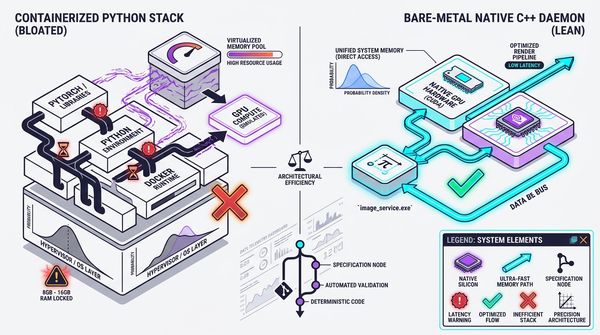
Production generative diffusion pipelines running inside Python virtualisation stacks incur steep architectural penalties. Encapsulating PyTorch workloads within containerised boundaries like Docker Desktop or WSL2 creates three major infrastructure constraints:
- Host RAM Overhead : Container boundaries lock 8GB to 16GB of host RAM behind virtualised page tables.
- Bus Saturation : Virtualisation layers limit NVMe bus saturation during model ingestion.
- Runtime Pauses : Non-deterministic garbage collection pauses disrupt predictable inference latencies.
Our architecture builds on the parametric policy controls established in Brand Purity: Multimodal Asset Governance with LoRA, Voice Adapters, and ComfyUI ( Blog Publication ). The operational mandate now shifts from prompt orchestration to bare-metal execution.
Replacing interpreted execution runtimes with a compiled C++ daemon (image_service.exe) reclaims system memory and eliminates abstraction layers. Modern Windows on ARM deployments target Snapdragon SoCs coupled with an NVIDIA eGPU via USB4 , alongside integrated Grace-based hardware topologies.
Native deployments across these platforms expose three critical engineering obstacles:
- Distribution Voids : Official vendor repositories lack pre-compiled binaries for ARM64 compute runtimes.
- Sector Alignment Traps : Direct unbuffered transfers require strict physical sector boundary compliance.
- Streaming Edge Cases : Edge deployments encounter unbuffered streaming failures during weight ingestion.
This guide details the systems architecture required to bypass static dependencies. We stream model weights straight into unified device memory and enforce strict spatial tensor invariants at the networking boundary.
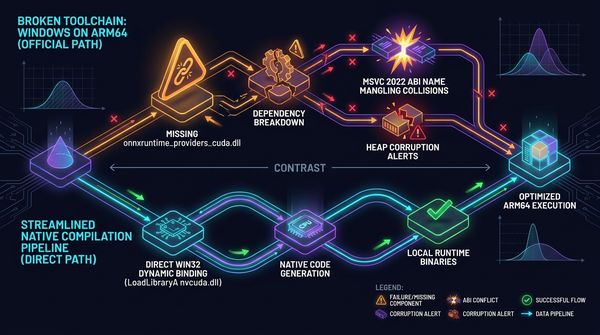
The Missing Binary Abyss: When Official Toolchains Ignore Windows on ARM
Compiling native inference engines on Windows on ARM64 immediately surfaces vendor distribution gaps. While x64 platforms receive pre-compiled binaries for ONNX Runtime and LibTorch, official ARM64 Windows distributions completely lack GPU-accelerated execution providers.
Engineers encounter three primary points of failure:
- Missing Execution Providers : The standard binary distribution lacks onnxruntime_providers_cuda.dll for ARM64. Runtimes fall back silently to CPU execution or unaccelerated emulation as a result.
- ABI Symbol Conflicts : Compiling custom execution providers with MSVC 2022 causes symbol collisions with prebuilt C-runtime headers. Furthermore, Clang-cl fails on proprietary DirectX intrinsics.
- Heap Corruption Traps : Linking external libraries built with mixed static (/MT) and dynamic (/MD) runtime configurations triggers heap crashes during cross-boundary memory deallocation.
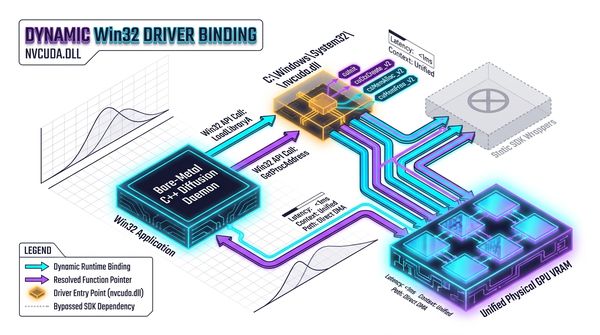
Dynamic Driver Plumbing: Direct Win32 Binding to nvcuda.dll
Bypassing static SDK import libraries (cuda.lib) eliminates compile-time toolchain coupling. The native daemon queries entry points from the installed display driver (C:\Windows\System32\nvcuda.dll). It resolves these addresses via standard Win32 system APIs (LoadLibraryA and GetProcAddress).
// Dynamic runtime entry-point resolution for NVIDIA Driver API on Windows on ARM
HMODULE hCuda = LoadLibraryA("nvcuda.dll");
auto cuInit = (cuInit_t)GetProcAddress(hCuda, "cuInit");
auto cuCtxCreate = (cuCtxCreate_t)GetProcAddress(hCuda, "cuCtxCreate_v2");
auto cuMemAlloc = (cuMemAlloc_t)GetProcAddress(hCuda, "cuMemAlloc_v2");
auto cuMemFree = (cuMemFree_t)GetProcAddress(hCuda, "cuMemFree_v2");
This pattern delivers three distinct architectural advantages:
- Toolchain Decoupling : The binary operates across workstations with zero compile-time CUDA SDK dependencies. It binds directly to user-mode driver entry points.
- Explicit Memory Governance : The runtime allocates device memory via cuMemAlloc_v2 and frees it deterministically via cuMemFree_v2. This eliminates unpredictable runtime caching layers.
- Operational Caveat : Bypassing the high-level CUDA runtime API removes automated wrappers like cudaMalloc and cudaMemcpy. Teams must manage context lifecycles directly via cuCtxCreate_v2 and cuCtxDestroy.
DirectStorage SDK Integration Realities and 64KB Sector Traps
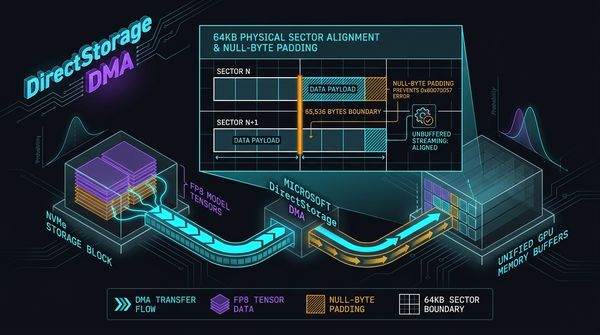
Streaming multi-gigabyte diffusion weights via standard Win32 buffered file reads (ReadFile) creates severe CPU bottlenecks. Replacing buffered calls with Microsoft DirectStorage (dstorage.h) facilitates unbuffered Direct Memory Access (DMA) from NVMe storage straight into unified memory.
On Grace-Blackwell architecture, this reduced weight loading times for an 11.8GB FP8 matrix from 8.64 seconds to 1.42 seconds. DirectStorage enforces four strict physical layout rules:
- Physical Sector Alignment : Unbuffered DMA transfers bypass OS file caching entirely. Transfer offsets and buffer lengths must align with physical 64KB sector boundaries (65,536 bytes).
- Unaligned IO Failures : Any unaligned file read immediately triggers error code 0x80070057 (E_INVALIDARG) without diagnostic context.
- Model Serialisation Padding : Model serialisation pipelines must inject null-byte padding to align tensor payloads: Padding = 65,536 − (TensorSizeBytes mod 65,536).
- Hardware Decompression Constraints : DirectStorage hardware decompression delivers peak performance exclusively on physical NVMe storage. Virtualised disks inside developmental VMs fall back to buffered IO paths.
Zero-Dependency Winsock2 Daemon vs Latent Math Pitfalls
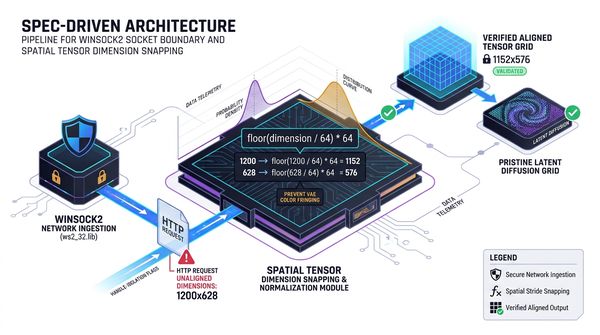
To prevent runtime bloat from external web frameworks, the daemon runs a zero-dependency HTTP endpoint. It implements native Win32 Winsock2 sockets via ws2_32.lib.
Socket governance requires two strict handle hygiene mechanisms:
- Socket Isolation : Sockets are initialised via WSASocketA using WSA_FLAG_NO_HANDLE_INHERIT and SetHandleInformation((HANDLE)listen_sock, HANDLE_FLAG_INHERIT, 0). This prevents spawned child processes from inheriting listening handles and blocking port reclamation during daemon restarts.
- Collision Prevention : Applying SO_EXCLUSIVEADDRUSE strictly isolates 127.0.0.1:8080 against port-binding collisions.
At the ingestion boundary, raw request geometry meets strict mathematical constraints. Latent diffusion architectures utilize Variational Autoencoders (VAE) with a downsampling factor of f = 8, as established by Rombach et al. in High-Resolution Image Synthesis with Latent Diffusion Models .
Coupled with 8× spatial attention downsampling, the network creates a rigid 64-pixel spatial stride (8 × 8 = 64). Unaligned payload dimensions introduce two critical failure modes:
- Edge Coordinate Corruption : If requests supply dimensions not divisible by 64 (such as social layouts of 1200 × 628), calculations yield non-integer coordinate remainders (628 mod 64 = 52). During VAE upsampling passes, this remainder corrupts edge coordinates and generates high-frequency colour fringing.
- Automated Boundary Snapping : The socket boundary intercepts incoming payloads and normalises dimensions before memory allocation via RenderWidth = max(512, ⌊W / 64⌋ × 64) and RenderHeight = max(512, ⌊H / 64⌋ × 64).
Snapping a 1200 × 628 payload to a verified 1152 × 576 resolution (and square frames to 1024 × 1024 pixels) guarantees clean latent decoding. Upstream API contracts must anticipate this automated boundary adjustment.
Hard Truths for Enterprise Systems Teams
Transitioning generative workloads to bare metal requires addressing three concrete engineering realities:
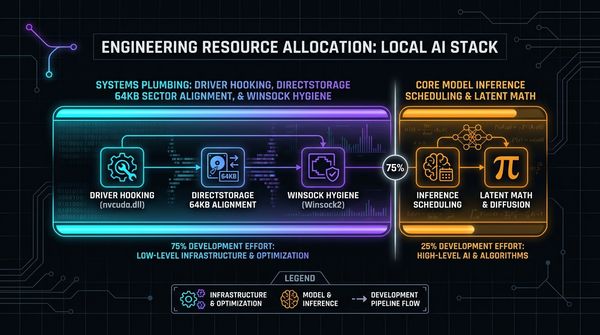
- Plumbing Precedence : Toolchain reconciliation, sector layout padding, and symbol resolution consume significantly more development resource availability than core generative scheduling algorithms.
- Resilient Edge Architectures : Dynamic Win32 driver binding delivers operational continuity when bleeding-edge hardware architectures outpace official runtime framework distributions.
- Ingestion Boundaries as Defences : If low-level inference engines receive invalid tensor strides, they crash or corrupt memory. Teams must enforce invariants at the socket boundary before execution graphs run.
Conclusion & Strategic Advice
Assembling a native C++ diffusion daemon eliminates up to 16GB of hypervisor memory consumption, cuts cold-start latencies to seconds, and establishes an autonomous edge service. This bare-metal service establishes the execution layer for corporate governance systems detailed in Brand Purity: AI Guardrails for Multi-Brand Identity ( Blog Publication ). It extends automated enforcement mechanisms from Brand Purity: The Automated Brand Pipeline ( Blog Publication ).
Select your deployment profile across three core enterprise operational tiers:
- High-Concurrency Virtualised Clusters : Retain containerised Python runtimes when memory elasticity and horizontal orchestration outpace per-node latency requirements.
- Dedicated Edge Workstations & Sovereign Nodes : Deploy native C++ daemons (image_service.exe) with dynamic driver binding to maximise unified memory and eliminate cold-start overhead.
- Storage-Bound Workloads : If weights exceed host RAM and require sub-second streaming, implement DirectStorage with 64KB aligned serialisation.
Reclaiming native performance requires bypassing convenient framework abstractions and governing hardware entry points directly. Audit local inference runtimes, verify hardware alignment boundaries, and enforce spatial invariants at the gateway.
Are you transitioning edge generative pipelines to bare-metal execution, or is your infrastructure still tethered to container virtualisation? Drop your thoughts below💬 and share this architectural breakdown with your network! ♻️
Further Reading
Review the foundational documentation and technical references across four core specifications:
- Microsoft DirectStorage Overview
- NVIDIA CUDA Driver API Reference Manual
- Microsoft Learn Winsock SO_EXCLUSIVEADDRUSE Socket Option
- High-Resolution Image Synthesis with Latent Diffusion Models (arXiv:2112.10752)
More From Me
Explore related architectural research and engineering deep dives across ten publications:
Original Article: Read on LinkedIn | Read on Substack