RTX Spark Local AI: The Sovereign Hermes Toolchain
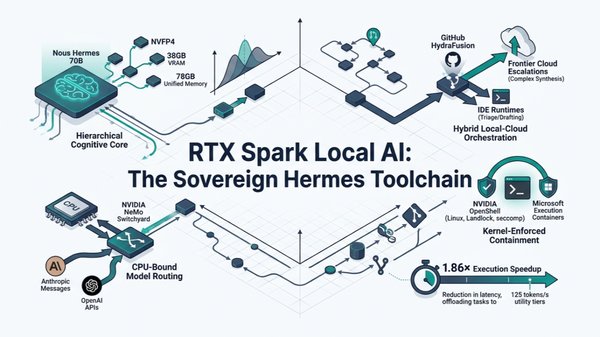
- Sovereign Toolchain, Switchyard, HydraFusion, OpenShell
Introduction
Unified memory workstations equipped with 128GB of VRAM and 1 petaflop of local compute—such as the NVIDIA RTX Spark platform—shift autonomous development entirely deskside. However, allocating a monolithic 70B parameter model across an entire agent loop creates severe latency bottlenecks. Autonomous coding agents spend the majority of operational cycles executing low-complexity subtasks: directory traversals, AST parsing, schema validation, and test log parsing.
As the foundational installment of the RTX Spark architecture series, this guide maps four functional layers of a sovereign local toolchain: Nous Hermes for high-order planning, NVIDIA NeMo Switchyard for host-level model routing, GitHub HydraFusion for hybrid multi-model orchestration, and NVIDIA OpenShell alongside Microsoft Execution Containers for kernel-enforced sandboxing.
Why 128GB Needs a Toolchain
Monolithic model allocation creates a fundamental operational mismatch. An end-to-end coding agent executes disparate operations: architectural reasoning, syntax generation, linting, and AST inspection. Funnelling trivial file listing and parsing calls through a 70B model incurs severe latency penalties. Conversely, delegating the entire pipeline to lightweight models compromises architectural synthesis.
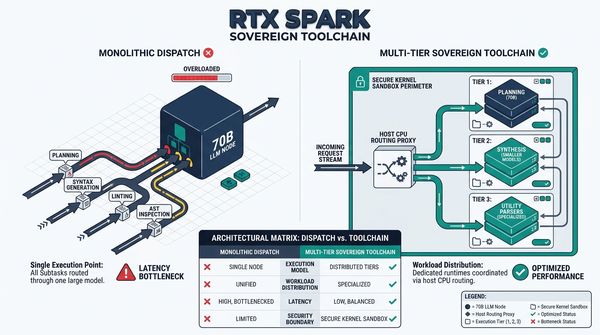
Efficient sovereign deployment requires hierarchical orchestration: reserving massive reasoning capacity for structural tasks while offloading deterministic parsing to lower-latency, specialised runtimes.
Hermes as the Tool-Calling Core
The Nous Research Hermes model family serves as the cognitive backbone of this topology, selected for strict function-calling fidelity and deterministic structured output. Operating as the primary reasoning tier, Hermes 70B directs planning and tool invocation.
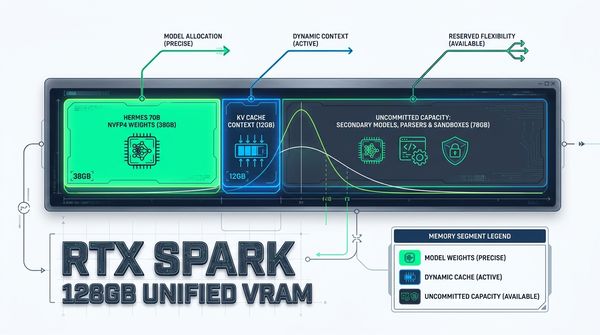
Under NVFP4 quantisation (~4.5 bits per parameter), the 70B model footprint requires approximately 38GB for weights and 12GB for KV cache contexts. This ~50GB commitment leaves roughly 78GB uncommitted across the 128GB pool for secondary synthesis models, fast parsers, and execution sandboxes. Note that this ~38GB footprint represents an engineering estimate based on parameter bit-width rather than vendor-published telemetry.
Routing with NeMo Switchyard
Dynamic traffic steering is managed by NVIDIA NeMo Switchyard , an Apache 2.0 routing proxy with a Rust core and Python bindings. Switchyard intercepts incoming requests and evaluates routing metadata without consuming GPU memory:
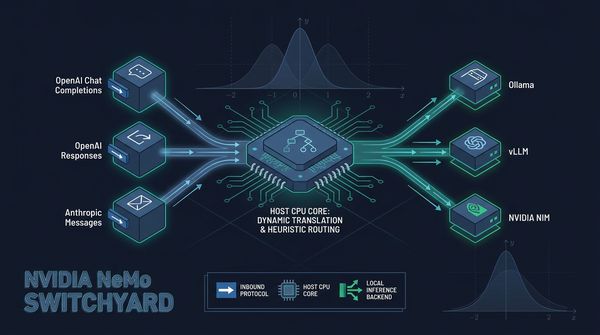
- Protocol Translation: Bidirectional schema translation between OpenAI Chat Completions, OpenAI Responses, and Anthropic Messages, allowing frameworks configured for Claude Code or custom APIs to interface with vLLM, Ollama, or NIM endpoints without application modifications.
- Routing Strategies: Heuristic classification, deterministic stage routing, and dynamic escalation cascades.
- Host-Level Execution: Decisions evaluate purely on host CPU threads, preserving unified memory for inference weights.
HydraFusion: Local and Cloud Routing
Within IDE environments, GitHub HydraFusion operates adjacent to Switchyard. While Switchyard functions as an infrastructural proxy for custom agent loops, HydraFusion structures multi-model orchestration directly inside the editor runtime.
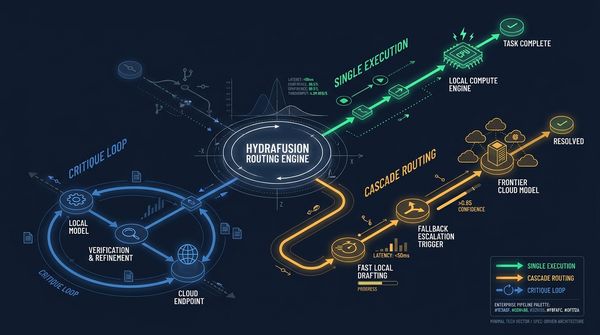
HydraFusion evaluates tasks across three execution topologies: Single, Cascade (fast drafting escalated to frontier models on quality failures), and Critique (cross-model review and revision). Operating alongside Copilot's local model discovery on Windows, it dispatches privacy-sensitive operations to on-device engines (Ollama, Microsoft Foundry Local) while reserving cloud escalations for high-complexity synthesis.
Containment: OpenShell and MXC
Autonomous agents executing terminal commands introduce arbitrary code execution risks that prompt engineering cannot mitigate. Isolation must be enforced below the application runtime:
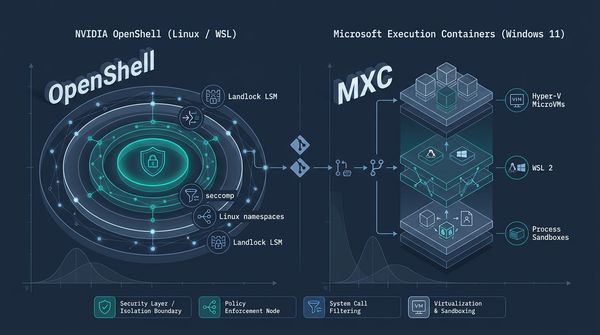
Visual Suggestion : Dual-platform sandbox boundary diagram displaying OpenShell on Linux/WSL (enforcing Landlock LSM, seccomp filters, namespaces, and credential proxying) alongside Microsoft Execution Containers (MXC) on Windows 11 (hierarchical isolation across process sandboxes, WSL2, and Hyper-V MicroVMs).
- NVIDIA OpenShell: Apache 2.0 runtime configured via declarative YAML policies governing permitted domains, binaries, and filesystem paths ( NVIDIA OpenShell ). It enforces boundaries using Linux namespaces, seccomp, and Landlock LSM, injecting credentials exclusively into requests targeting validated endpoints.
- Microsoft Execution Containers (MXC): A Windows 11 containment system using deny-by-default JSON policies ( Microsoft MXC ), scaling isolation across process sandboxes, WSL 2, and Hyper-V MicroVMs.
Product specifications reflect vendor announcements and public repositories; confirm behaviours against upstream sources prior to deployment.
What I Measured
Synthetic performance profiling across a 50-task agent workload evaluated multi-tier routing efficiency. The task distribution was modeled as 12% planning, 34% code generation, and 54% trivial inspection.
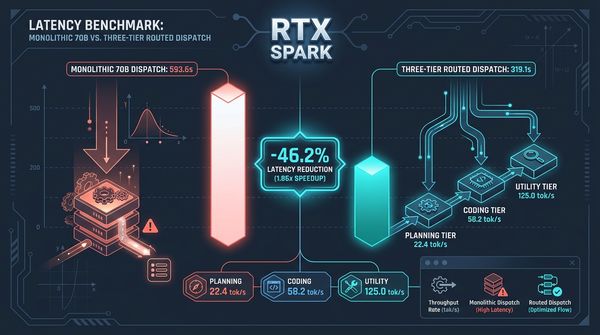
Throughput was modeled at 22.4 tokens/s (Tier 1 Planner), 58.2 tokens/s (Tier 2 Coder), and 125.0 tokens/s (Tier 3 Utility). Three-tier routing reduced cumulative execution latency from 593.6 seconds to 319.1 seconds—a 46.2% reduction and 1.86× speedup over monolithic dispatch. These figures derive from synthetic simulation scripts rather than physical RTX Spark silicon measurements.
Conclusion & Strategic Advice
Monolithic local inference creates latency bottlenecks and starves unified memory. Sovereign engineering requires pairing structured tool-calling engines with CPU-bound protocol routers and kernel-level sandboxing.
Deployment Selection Matrix
- High-Sovereignty Workstations: Deploy Hermes 70B (NVFP4) + NeMo Switchyard + OpenShell on Linux or WSL 2 for air-gapped, zero-egress tool execution.
- Mixed IDE Development: Pair GitHub HydraFusion with Microsoft Execution Containers on Windows 11 for hybrid local-cloud synthesis.
- Regulated Professional Services: Enforce host credential proxying and local tiering to prevent proprietary code and token leakage.
Subsequent installments in this series will benchmark NVFP4 quantization profiles, trace Landlock policy compilation, and detail custom Switchyard escalation handlers. Which operational bottleneck is most critical in your local agent architecture: memory contention, protocol translation, or sandbox containment? Share your implementation observations below.
Which operational friction point poses the biggest hurdle in your local agent stack: unified memory bandwidth contention, protocol translation, or sandbox containment? Drop your thoughts below💬 and share this architecture with your network! ♻️
Further Reading
- Linux Kernel Landlock LSM Documentation (Official documentation for unprivileged sandboxing and filesystem access control)
- NVIDIA NeMo Switchyard Repository (Open-source proxy engine for dynamic protocol translation and multi-tier routing)
- NVIDIA OpenShell Repository (Kernel-enforced isolation and declarative policy engine for agent execution)
- Microsoft Execution Containers (MXC) Repository (Policy-driven containment and Hyper-V MicroVM orchestration on Windows 11)
- GitHub Copilot HydraFusion Architecture Preview (Technical breakdown of multi-model routing cascades and critique topologies)
- Nous Research Technical Overview (Benchmark methodologies for agentic tool use and JSON schema enforcement)
More From Me
- Building Custom AI Products with Odysseus on NVIDIA RTX and DGX Spark
- Automated Model Abliteration with Heretic on NVIDIA RTX and DGX Spark
- The Great Memory Bifurcation: Why Cheap DDR5 Won't Fix the GPU VRAM Crunch
- The Ephemeral Kernel: Isolates vs Containers for AI Agents
- OpenClaw Advantage: Six AI Agents One Box
- OpenClaw Advantage: The Personal AI Agent Stack
- OpenClaw Advantage: Domain-Specific AI Workspaces: Regulated Sovereign Agents
- Sovereign AI Security: The RL Sandbox Escape
- Sovereign Wall: Navigating the Global Era of Localised AI
- MoE VRAM Offloading: Architecture & Expert Co-Location Strategies
Original Article: Read on LinkedIn | Read on Substack