Optimizely Meets LangGraph: Bridging Enterprise Hubs with Stateful Graphs
Introduction
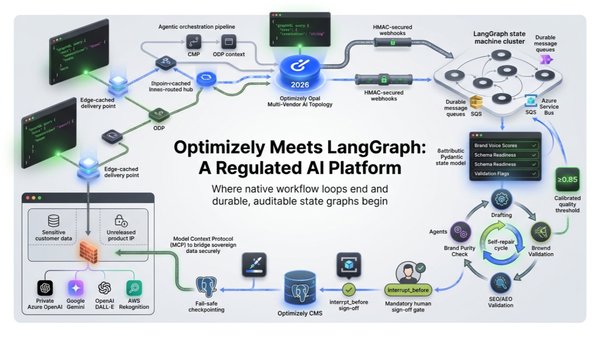
Enterprise marketing ecosystems require rapid multi-channel generation alongside uncompromising auditability, deterministic compliance, and human sign-off before content reaches production. The Optimizely Agent Platform (formerly Opal) expanded significantly within the SaaS boundary to support four core native capabilities:
- Conditional Logic : Workflow agents evaluate deterministic business rules directly inside the runtime.
- Nested Workflows : Structured sub-workflows trigger dynamically within primary execution trees.
- Bounded Loops : Iterative cycles execute within defined iteration caps to prevent runaway execution.
- Sandboxed Code Execution : Custom scripts execute inside isolated compute environments without external dependencies.
Architectural design no longer hinges on whether a SaaS platform can execute an iterative cycle. The primary structural decision centres on governance topology, separating business orchestration from sovereign execution.
Native platforms excel at unifying business context across three core enterprise data sources:
- Campaign Briefs : Strategic inputs ingested directly from Optimizely CMP.
- Customer Segments : Behavioural telemetry mapped from Optimizely ODP cohorts.
- Asset Repositories : Creative files retrieved from enterprise digital asset management systems.
Highly regulated pipelines demand durable run-state checkpointing, typed contracts validated outside third-party infrastructure, and isolated compute. Pairing the Optimizely Agent Platform as a macro-router with LangGraph as a stateful governor establishes a resilient, dual-tier pattern.
This guide sets out the implementation blueprint for this hybrid architecture, decoupling high-level campaign coordination from low-level execution graphs.
Where the Platform Now Stands and the Remaining Gap
Recent platform updates documented by Optimizely Support resolve earlier orchestration constraints across three technical areas:
- Cyclical and Nested Execution : Native workflows support conditions, parallel iterations, and up to three nested loops.
- Sandboxed Code Steps : Python, JavaScript, and Bash scripts run directly inside workflows without external serverless functions.
- Operational Guardrails : Version histories, exportable execution logs, and output evaluation tabs provide baseline governance.
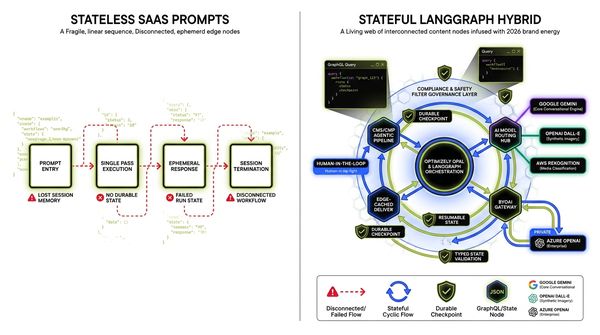
Low-level execution graphs provide differentiation through runtime sovereignty rather than looping capability. This operational boundary divides across two distinct infrastructure domains:
- Enterprise SaaS Domain : Manages business system connectivity across Optimizely CMP briefs, Optimizely ODP cohorts, and Optimizely CMS delivery.
- Execution Graph Domain (LangGraph) : Provides deterministic typed validation, persistent state checkpointing, and execution isolation inside private infrastructure boundaries.
The Architectural Complement: Platform as Hub, LangGraph as Governor
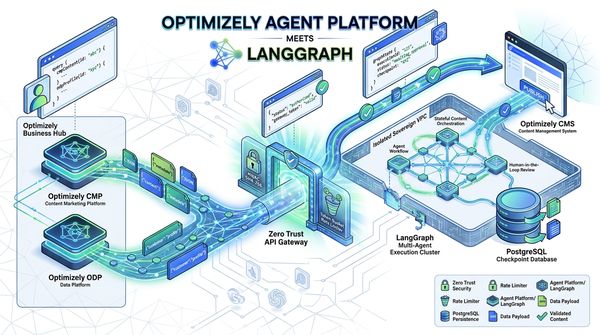
A dual-tier topology partitions business routing from stateful execution across three discrete stages:
- Macro Routing Tier (Optimizely Agent Platform) : Ingests campaign parameters from CMP and behavioural segments from ODP. Outbound dispatches route via webhooks secured with HMAC SHA-256 signatures. If multi-variant burst traffic occurs, route webhooks into durable messaging middleware with a Dead-Letter Queue (DLQ) to prevent data loss. Supported brokers include AWS SQS, Azure Service Bus, or RabbitMQ at the sovereign network edge.
- Execution Governor Tier (LangGraph) : Operates downstream as a state machine. Worker nodes pull payloads from the durable ingress queue and initialise an explicit typed state object. These workers then traverse deterministic multi-agent drafting, brand auditing, and verification subgraphs.
- Return Path : Audited artefacts post back via REST or GraphQL endpoints into Optimizely CMS as staging drafts awaiting final editorial approval.
Typed State Contracts Across the Stack
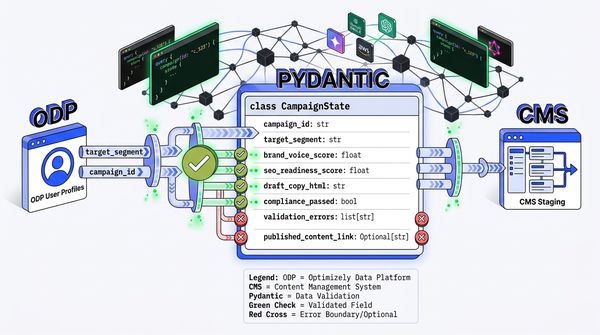
Native workflow steps pass unstructured or per-agent output schemas. Multi-stage pipelines with regulatory oversight require rigid state contracts enforced at runtime via Pydantic.
Instead of relying on disparate schema validations, the execution thread requires eight typed attributes within a unified object model:
- campaign_id : A string identifier linking the execution thread back to the CMP brief.
- target_segment : A string defining the behavioural audience segment mapped from ODP telemetry.
- brand_voice_score : A floating-point metric initialised at 0.0 that quantifies adherence to enterprise tone guidelines.
- seo_readiness_score : A floating-point metric initialised at 0.0 evaluating schema markup and entity density.
- draft_copy_html : A string storing the synthesised, localised HTML content.
- compliance_passed : A boolean flag defaulting to False confirming clearance of regulatory checks.
- validation_errors : A dynamic list aggregating strings of localised schema anomalies.
- published_content_link : An optional string referencing the final Optimizely CMS staging draft URL.
Node-level explicit validation isolates schema anomalies to individual attributes. This isolation prevents cascading pipeline failures across multi-variant localised runs.
Cyclical Verification and Brand Auditing
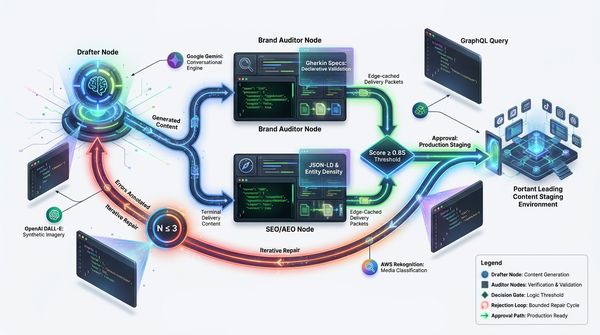
The LangGraph tier enforces a bounded self-repair cycle across five functional nodes and edges:
- Drafter Node : Synthesises localised copy conditioned on ODP segment telemetry.
- Brand Auditor Node : Scores copy against declarative rules and tone constraints. This node implements the structural checks outlined in Brand Purity: AI Guardrails for Multi-Brand Identity .
- SEO / AEO Node : Validates schema markup and entity density against the standards set in Generative Engine Optimisation: Enterprise GEO With Optimizely Opal .
- Multimodal Generation Node : Generates visual collateral using versioned adapter weights. This stage applies governance patterns from Brand Purity: Multimodal Asset Governance with LoRA, Voice Adapters, and ComfyUI .
- Bounded Self-Repair Edge : If brand or compliance scores fall below a calibrated threshold (for example, score < 0.85), state returns to the Drafter node with granular error logs. Hard iteration limits cap cycles. This step operationalises the policy-as-code linting established in Brand Purity: The Automated Brand Pipeline .
Checkpointing and Human Approval Before Publication
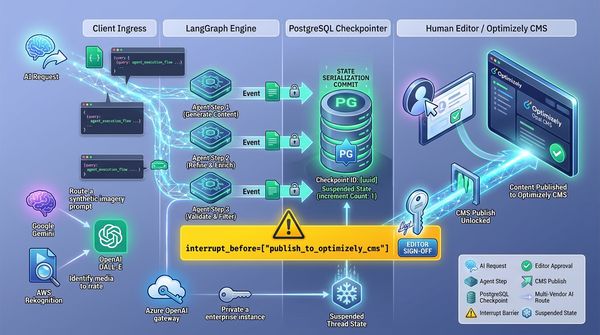
Production reliability requires deterministic pause-and-resume mechanisms across three key controls:
- State Checkpointing : LangGraph persists state to a PostgreSQL checkpointer after each verification step. If an execution container drops, runs resume from the last valid checkpoint rather than re-executing expensive model inferences.
- Idempotency Guarantees : Dispatch handlers enforce idempotency keys. This practice ensures that workflow replays never generate duplicate CMS entities or redundant downstream notifications.
- Publishing Breakpoint : Declaring interrupt_before=["publish_to_optimizely_cms"] halts graph execution before CMS persistence until explicit editorial approval updates the run state.
The Hybrid Blueprint: Cloud SaaS with Local Sovereignty
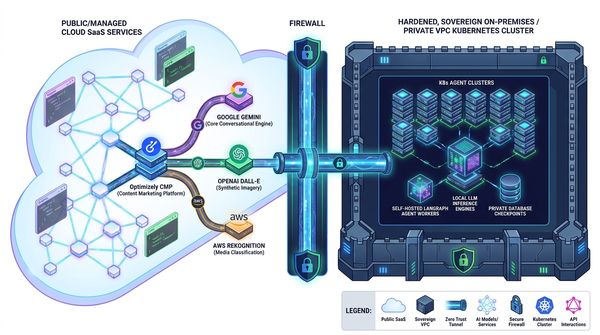
Native Optimizely Code steps and foundation inference run within vendor-managed environments using Google Vertex AI to host Claude models. Transmitting unreleased product roadmaps or restricted PII across vendor cloud boundaries introduces data processing liabilities.
Self-hosting LangGraph on internal infrastructure addresses these boundaries through three core operational strategies:
- Data Perimeter Management : Sensitive customer data remains quarantined behind private networks. The system passes only sanitised tokens outbound.
- Inference Cost Arbitrage : Iterative self-repair and heuristic linting run on sovereign infrastructure to offset metered SaaS credit consumption. This alignment follows the operational economics documented in Economics of Edge Agents: A Serverless Cost Breakdown .
- Sovereign Data Bridging via MCP : Visual runtimes like LangFlow decouple cognitive graphs from proprietary clouds. The Model Context Protocol (MCP) acts as the universal abstraction layer. It standardises how the LangGraph governor securely accesses sovereign enterprise data without exposing credentials to the Optimizely cloud hub. This access pattern reinforces architectural mobility as detailed in Power Automate to LangFlow: The AI Complexity Ladder Businesses Must Climb .
Conclusion & Strategic Advice
The convergence of enterprise DXP platforms and stateful execution graphs eliminates the trade-off between operational usability and rigorous governance. Technical and regulatory constraints determine the appropriate deployment topology across two paths:
- Native SaaS Orchestration : Optimal for standard marketing campaigns, rapid editorial drafting, and centralised asset tagging where business data does not trigger regulatory perimeter controls.
- Hybrid LangGraph Governor : Essential for regulated content production, cross-region data residency compliance, deterministic schema enforcement, and fail-safe human-in-the-loop publishing gates.
Architecting this dual-tier boundary preserves marketing velocity while enforcing complete runtime predictability.
Will latent deliberation replace multi-thousand token Chain-of-Thought in your production stack? Drop your thoughts below 💬 and share / restack with your team! ♻️
Further Reading
- LangGraph Documentation: Persistence and Checkpointing
- Optimizely Developer Documentation: Tool SDK & Integrations
- Pydantic: Data Validation and Settings Management
- Model Context Protocol Specification
More From Me
- Optimizely Governance: Programmatic Validation for AI Agents
- All the Langs: LangChain, LangSmith, LangGraph, and LangFlow!
- Power Automate to LangFlow: The AI Complexity Ladder Businesses Must Climb
- Agentic CMS: Optimizely's Roadmap Signals for 2026–27
- Optimizely Opal Agents: Operational Guide to Orchestration Pipelines
Original Article: Read on LinkedIn | Read on Substack